

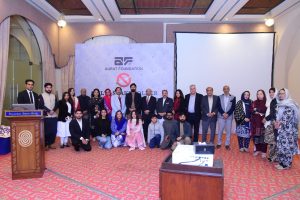
 Islamabad: Rising tobacco and nicotine use among Pakistan’s youth, especially around educational institutions, emerged as the central concern at a national review session on tobacco control held by the Aurat Foundation in Islamabad.
Participants from Parliament, government departments, health organizations, and civil society warned that easy availability of cigarettes, vapes, nicotine pouches, and flavored tobacco near schools is creating a growing public health threat. The discussion also pointed to a noticeable increase in tobacco use among women, indicating a shifting trend.
The session called for stronger legislation, faster policy action, and strict enforcement to counter the rapid spread of emerging nicotine products. Speakers emphasized that existing laws remain poorly implemented due to procedural delays, weak monitoring, and limited coordination between federal and provincial bodies.
The need for clear parental awareness, community engagement, and better recognition of new nicotine products was highlighted as an essential part of early prevention. Officials noted that families and schools often remain unaware of modern products marketed to young people.
Technical briefings identified major enforcement gaps and policy loopholes that allow the tobacco industry to expand its reach. Participants noted that companies are increasingly using social media trends, entertainment content, and youth-focused marketing to promote vaping in urban areas.
Government representatives reaffirmed ongoing federal efforts to implement the Prohibition of Smoking and Protection of Non-Smokers Health Ordinance 2002 and to tighten regulations where required. Provincial representatives also announced plans to introduce new resolutions to strengthen tobacco control.
Education sector officials raised alarms over the rise of nicotine products around private institutions and called for tougher regulatory checks. Regulatory authorities stressed the need for a broader social movement to counter tobacco use nationwide.
Closing the event, the Aurat Foundation reiterated its commitment to evidence-based advocacy, cross-sector collaboration, and long-term public awareness initiatives aimed at building a healthier, tobacco-free society.
Islamabad: Rising tobacco and nicotine use among Pakistan’s youth, especially around educational institutions, emerged as the central concern at a national review session on tobacco control held by the Aurat Foundation in Islamabad.
Participants from Parliament, government departments, health organizations, and civil society warned that easy availability of cigarettes, vapes, nicotine pouches, and flavored tobacco near schools is creating a growing public health threat. The discussion also pointed to a noticeable increase in tobacco use among women, indicating a shifting trend.
The session called for stronger legislation, faster policy action, and strict enforcement to counter the rapid spread of emerging nicotine products. Speakers emphasized that existing laws remain poorly implemented due to procedural delays, weak monitoring, and limited coordination between federal and provincial bodies.
The need for clear parental awareness, community engagement, and better recognition of new nicotine products was highlighted as an essential part of early prevention. Officials noted that families and schools often remain unaware of modern products marketed to young people.
Technical briefings identified major enforcement gaps and policy loopholes that allow the tobacco industry to expand its reach. Participants noted that companies are increasingly using social media trends, entertainment content, and youth-focused marketing to promote vaping in urban areas.
Government representatives reaffirmed ongoing federal efforts to implement the Prohibition of Smoking and Protection of Non-Smokers Health Ordinance 2002 and to tighten regulations where required. Provincial representatives also announced plans to introduce new resolutions to strengthen tobacco control.
Education sector officials raised alarms over the rise of nicotine products around private institutions and called for tougher regulatory checks. Regulatory authorities stressed the need for a broader social movement to counter tobacco use nationwide.
Closing the event, the Aurat Foundation reiterated its commitment to evidence-based advocacy, cross-sector collaboration, and long-term public awareness initiatives aimed at building a healthier, tobacco-free society.NEW DELHI: Indian External Affairs Minister S. Jaishankar has made a startling revelation, admitting that India agreed to a ceasefire in May due to the imminent threat of a major Pakistani military response and direct intervention from the United States.
While talking to media Jaishankar disclosed that on the night of May 9, US Vice President JD Vance personally intervened and called Indian Prime Minister Narendra Modi, urging India to accept the ceasefire to prevent full-scale retaliation from Pakistan.
“On the night of May 9, when US Vice President JD Vance called Prime Minister Narendra Modi, I was in the room. He told us that if we did not agree to certain terms, Pakistan would launch a major assault on India,” Jaishankar stated, acknowledging for the first time that the decision to halt Indian military operations was influenced by US diplomatic pressure.
According to the Indian foreign minister, Prime Minister Modi signaled India was ready to respond. “That night, Pakistan launched a large-scale attack. We retaliated immediately.”
He added that the following morning, US Secretary of State Marco Rubio contacted him and conveyed that Pakistan was ready for dialogue.
Moreover, Jaishankar has once again accused Pakistan of involvement in terrorist activities, including the deadly Pahalgam attack in April this year.
Jaishankar described the April 22 attack in Indian-administered Kashmir as a critical moment for India. “The Pahalgam attack was a turning point, and there is a growing sentiment in India that enough is enough,” he stated.
He added, “We decided we cannot allow terrorists to operate freely. The idea that terrorists can exist across the border and act with impunity had to be challenged — and that is exactly what we did.”
Pakistan has categorically denied any involvement in the Pahalgam attack, in which 26 people were killed by unidentified gunmen. However, tensions escalated rapidly in the aftermath.
On May 7, India launched strikes inside Pakistan in response to the Pahalgam incident. This triggered a series of missile and drone attacks between the two nuclear-armed neighbours. The hostilities came to a halt three days later, on May 10, after successful mediation by the United States.
US President Donald Trump has since taken credit for brokering the ceasefire, a claim indirectly acknowledged by several Pakistani officials, including Prime Minister Shehbaz Sharif.
Reaffirming India’s stance, Jaishankar told Newsweek: “We want to make it absolutely clear — there will be no freedom for terrorists to operate. We will not tolerate proxy warfare any longer.”
He added, “We will not allow nuclear blackmail to prevent us from defending ourselves. We’ve heard for years that because both sides are nuclear-armed, India must act with restraint — that narrative ends now.”
“If something bad happens to us, we will cross the border and target those who harm us,” the Indian minister warned.
Read more: PSX Touchs New Record-breaking High On Beginning Of New Fiscal Year
