

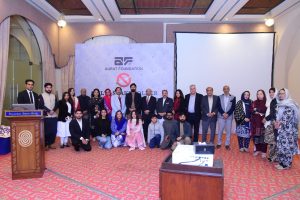
 Islamabad: Rising tobacco and nicotine use among Pakistan’s youth, especially around educational institutions, emerged as the central concern at a national review session on tobacco control held by the Aurat Foundation in Islamabad.
Participants from Parliament, government departments, health organizations, and civil society warned that easy availability of cigarettes, vapes, nicotine pouches, and flavored tobacco near schools is creating a growing public health threat. The discussion also pointed to a noticeable increase in tobacco use among women, indicating a shifting trend.
The session called for stronger legislation, faster policy action, and strict enforcement to counter the rapid spread of emerging nicotine products. Speakers emphasized that existing laws remain poorly implemented due to procedural delays, weak monitoring, and limited coordination between federal and provincial bodies.
The need for clear parental awareness, community engagement, and better recognition of new nicotine products was highlighted as an essential part of early prevention. Officials noted that families and schools often remain unaware of modern products marketed to young people.
Technical briefings identified major enforcement gaps and policy loopholes that allow the tobacco industry to expand its reach. Participants noted that companies are increasingly using social media trends, entertainment content, and youth-focused marketing to promote vaping in urban areas.
Government representatives reaffirmed ongoing federal efforts to implement the Prohibition of Smoking and Protection of Non-Smokers Health Ordinance 2002 and to tighten regulations where required. Provincial representatives also announced plans to introduce new resolutions to strengthen tobacco control.
Education sector officials raised alarms over the rise of nicotine products around private institutions and called for tougher regulatory checks. Regulatory authorities stressed the need for a broader social movement to counter tobacco use nationwide.
Closing the event, the Aurat Foundation reiterated its commitment to evidence-based advocacy, cross-sector collaboration, and long-term public awareness initiatives aimed at building a healthier, tobacco-free society.
Islamabad: Rising tobacco and nicotine use among Pakistan’s youth, especially around educational institutions, emerged as the central concern at a national review session on tobacco control held by the Aurat Foundation in Islamabad.
Participants from Parliament, government departments, health organizations, and civil society warned that easy availability of cigarettes, vapes, nicotine pouches, and flavored tobacco near schools is creating a growing public health threat. The discussion also pointed to a noticeable increase in tobacco use among women, indicating a shifting trend.
The session called for stronger legislation, faster policy action, and strict enforcement to counter the rapid spread of emerging nicotine products. Speakers emphasized that existing laws remain poorly implemented due to procedural delays, weak monitoring, and limited coordination between federal and provincial bodies.
The need for clear parental awareness, community engagement, and better recognition of new nicotine products was highlighted as an essential part of early prevention. Officials noted that families and schools often remain unaware of modern products marketed to young people.
Technical briefings identified major enforcement gaps and policy loopholes that allow the tobacco industry to expand its reach. Participants noted that companies are increasingly using social media trends, entertainment content, and youth-focused marketing to promote vaping in urban areas.
Government representatives reaffirmed ongoing federal efforts to implement the Prohibition of Smoking and Protection of Non-Smokers Health Ordinance 2002 and to tighten regulations where required. Provincial representatives also announced plans to introduce new resolutions to strengthen tobacco control.
Education sector officials raised alarms over the rise of nicotine products around private institutions and called for tougher regulatory checks. Regulatory authorities stressed the need for a broader social movement to counter tobacco use nationwide.
Closing the event, the Aurat Foundation reiterated its commitment to evidence-based advocacy, cross-sector collaboration, and long-term public awareness initiatives aimed at building a healthier, tobacco-free society.WASHINGTON: Prime Minister Imran Khan on Saturday arrived in Washington for his 3-day ‘official working visit’ to the United States on a commercial Qatar Airways flight.
Imran Khan reached the Pakistan House where members of the Pakistani community welcomed him. He will stay at the Pakistan House all three days.
This would be the first summit-level engagement between Pakistan and the United States since both leaders assumed their respective offices, according to a statement issued by Foreign Office.
Pakistani-Americans braved out sweltering heat to welcome Prime Minister Imran Khan as he arrived in Washington D.C.
Hundreds of members of the community belonging to Washington metro area and other states came to the U.S. capital and lined up along Massachusetts Avenue near Pakistan House, where the prime minister is staying during the visit.
“We are so excited that our leader is here. Pakistani-Americans are here to show their love for him,” Johny Bashir, a Virginia-based PTI enthusiast said, as people waved Pakistani and American flags to express their support for the visit.
“I am so happy as a Pakistani-American that PM Khan is here.

Prime Minister Khan and President Trump would have wide-ranging interaction at the White House on July 22, covering bilateral and regional matters. The PM will also be meeting prominent members of the US Congress, corporate leaders and opinion makers as well as members of the Pakistani diaspora.
The premier will highlight Pakistan’s policy of “peaceful neighborhood” aimed at resolving disputes through dialogue and promoting the vision of peace, progress and prosperity in South Asia and beyond.
The visit will focus on strengthening cooperation between Pakistan and the United States and to bring peace, stability, and economic prosperity to the region.
Trump and Khan will discuss a range of issues, including counterterrorism, defense, energy, and trade, with the goal of creating the conditions for a peaceful South Asia and an enduring partnership between the two countries.

Chief of the Army Staff Gen Qamar Javed Bajwa and the director general of Inter-Services Intelligence (ISI) are accompanying the prime minister.
Apparently, this is the first time that the country’s top generals are accompanying a prime minister to a White House meeting with the US president.
Diplomatic sources told Dawn that Gen Bajwa would meet Defence Secretary Patrick M. Shanahan, the new chairman of Joint Chiefs of Staff Gen Mark Milley and other senior officials during his visit to Pentagon.
This will be Gen Milley’s first meeting with a foreign military leader since his confirmation on Thursday by the US Senate’s Armed Services Committee.
Commenting on the PM’s decision to bring top military officials to Washington, Marvin Weinbaum, a US scholar of South Asian affairs, said: “Policymakers in Washington have noticed that after a long time, Pakistan’s civil and military leaders are on the same page on key issues.”
Weinbaum said Afghanistan and terrorism were two primary concerns of the Trump administration in South Asia, and they knew on such issues “no major decision can be implemented in Pakistan without the army’s support.”
