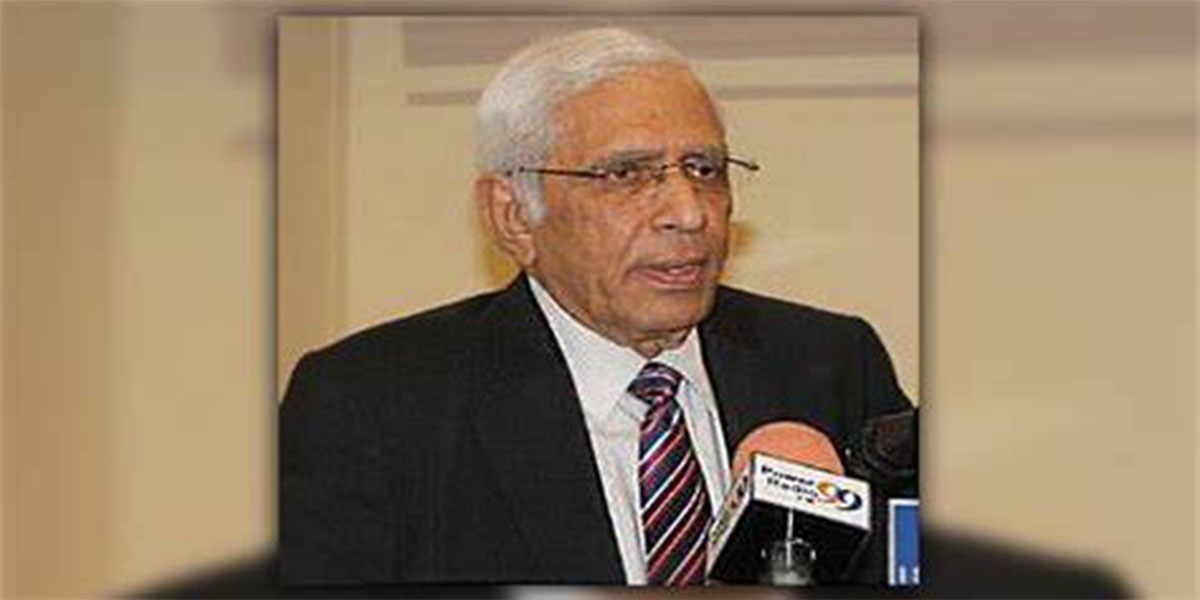
Muhammad Ziauddin, a veteran journalist and the last editor of a class of editors in Pakistan’s media industry was laid to rest on Monday amid the grief and sorrow of the journalist community.
In his splendid career spanning around six decades, he worked with almost all the leading newspapers of the country, including The Muslim, Dawn, The News, and The Express Tribune.
Executive Editor of The Express Tribune was his last regular job; after which had been writing columns for different newspapers as a freelance journalist.
Those who worked with him in different capacities remember him as an institution in his own and a towering personality in journalism who never compromised on principles.
A thorough professional and a rare class of journalists who disdained personal publicity and never hesitated in raising questions against rulers including dictators.
Senior Journalist Hamid Mir sharing one of his memories with a web channel- MJ TV, narrated an event back in early 1999 when then army chief General Pervez Musharraf invited a select group of journalists for a briefing at General Headquarters and shared his ambitious idea of crossing Line of Control (LoC) if Prime Minister gives a go-ahead.
“Using maps, Musharraf along with General Aziz and some other Generals said if Prime Minister gives us permission, we will cut off such and such roads and can conquer Kashmir in three days. I was very excited to hear this. Zia Sahib intervened and said ‘General’ you can only conquer the Pakistani nation, you can not conquer Kashmir. Later events proved that Zia Sahib was right”, Mir said.
There are so many examples most of us who knew him can quote. Former Senator Farhatullah Babar who served as Press Secretary to Prime Minister Benazir Bhutto recalls his call to Ziauddin telling him that: “Prime Minister desires if he can accompany her on a foreign tour”.
The reply from Ziauddin is worth remembering for media professionals; “I cannot go merely on the desire of Prime Minister. These instructions should come from my Editor”, a reply worth quoting for journalists when they have to give examples of professional integrity.
On another occasion, when he was asked to become part of a delegation of journalists going for state-sponsored Umrah, he declined by telling the office of then Prime Minister that they may take some deserving journalist.
Staffers at The Express Tribune (ET) have so many examples of his professionalism. Working under him at ET was an honor in my professional career. I have so many fine memories. I was the chief correspondent at the Islamabad bureau and he was Executive Editor, he would pass on event invitations with the sentence “you may look into this”. This would mean, it is your discretion if you find the event worth reporting.
Javaid Siddique, former Editor Nawa e Waqat said during his professional life, Ziauddin had seen very tough times of military dictatorships but never refrained to say and write what he considered truth.
Many believe that he was probably the last Editor, and after him, the office of an Editor in Pakistan is left as cosmetic.
Ziauddin was born in 1938, moved to Pakistan in 1960. After completing his degree in journalism from the University of Karachi in 1964, he started his career as a reporter at Pakistan Press Agency, which was later renamed Pakistan Press International (PPI).
His longest association remained with Dawn. He served as a resident editor for Islamabad and Lahore and paper’s correspondent in London from 2006 to 2009, before joining The Express Tribune.
It was during his stint as London correspondent of Dawn where he confronted then military dictator General Pervez Musharraf with tough questions in a press conference in Pakistan High Commission.
He was among the pioneers of economic journalism in Pakistan. Among his other experience in the field, he served as the assistant secretary-general for the Pakistan Federal Union of Journalists and as the president of the South Asia Free Media Association from 2002 to 2006.
After his retirement from active journalism, he started “senior journalists’ forum” at the National Press Club where they invited people of different shades including those whom conventional media could not give coverage due to restrictions on media houses.
Journalists, politicians, and activists expressed their condolences, many paying rich tributes to the iconic journalist of this era