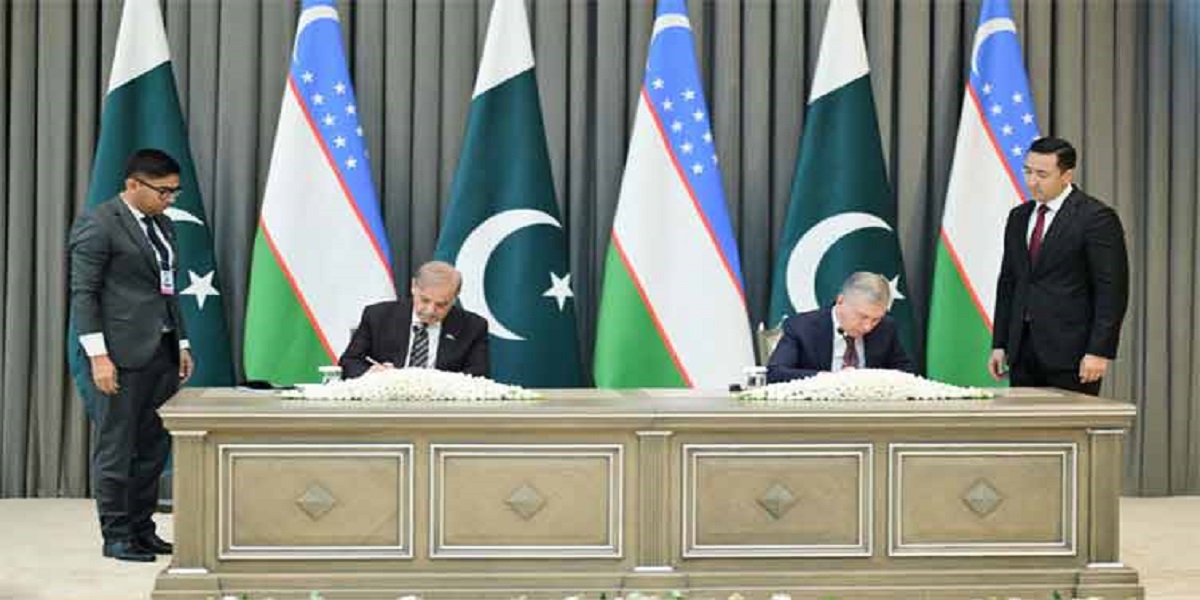
TASHKENT: Pakistan and Uzbekistan on Wednesday signed multiple memorandums of understanding (MoUs) and agreements aimed at strengthening cooperation in various sectors, including trade, science and technology, and youth affairs.
Prime Minister Shehbaz Sharif and Uzbek President Shavkat Mirziyoyev attended the signing ceremony, which took place at the Congress Center in Tashkent.
The agreements – which include facilitation of diplomatic passports and initiatives to promote scientific collaboration – mark a significant step in deepening relations between the two nations.
Upon his arrival at the venue, Prime Minister Shehbaz Sharif was received by President Mirziyoyev with full state protocol.
A guard of honor was presented to the Pakistani premier, and the national anthems of both countries were played. The two leaders engaged in a cordial discussion before formally proceeding with the event.
During the ceremony, members of both countries’ delegations were introduced, with President Mirziyoyev presenting his cabinet members to Prime Minister Shehbaz Sharif, who in turn introduced his delegation.
Following the signing of the MoUs, the two leaders addressed a joint press conference, reaffirming their commitment to enhancing bilateral trade and investment.
Prime Minister Shehbaz Sharif lauded Uzbekistan’s rapid economic progress and expressed Pakistan’s intent to benefit from its development model. “Uzbekistan is a reliable partner of Pakistan, and increasing trade and investment is in the interest of both nations. We have a shared commitment to prosperity and growth,” he stated.
The premier further highlighted Pakistan’s economic progress, noting a sharp decline in inflation from 38% to 2.4% and an increase in investor confidence due to a reduction in the policy rate. He credited the economic revival to the vision set forth by former Prime Minister Nawaz Sharif, adding that Pakistan was on the path to regaining its lost economic strength through sustained efforts.
He also emphasized the importance of regional connectivity, particularly in trade via railways, calling it a vital step toward strengthening economic ties.
President Mirziyoyev, while addressing the press, described the agreements as “crucial for a bright future” and underscored the deepening strategic relations between Tashkent and Islamabad. He announced plans to increase the trade volume between the two countries to $2 billion, citing ongoing discussions on investment and commercial opportunities.
“The flights between Lahore and Tashkent are beneficial for both countries. We are engaging in fruitful talks regarding trade and investment, and a new era of cooperation is beginning,” he said. The Uzbek leader also reiterated his country’s commitment to working closely with Pakistan at regional and international forums.
The signing of agreements marks another milestone in Pakistan-Uzbekistan relations, with MoUs exchanged in key areas, including information exchange, sports, science and technology, and youth affairs.
One of the key agreements was a direct cooperation pact between Lahore and Tashkent, aimed at fostering business and cultural exchanges. Officials from both sides noted that the agreement would pave the way for deeper economic engagement.
The prime minister and the Uzbek president later attended the Pakistan-Uzbekistan Joint Business Forum, where prominent business leaders from both countries held discussions on investment opportunities. The event underscored the growing interest of Pakistani enterprises in expanding trade with Uzbekistan, particularly in textiles, pharmaceuticals, and technology.
As part of his official visit, Prime Minister Shehbaz Sharif also toured Tashkent’s Techno Park, where he was briefed on Uzbekistan’s advancements in industrial manufacturing. The premier took a keen interest in the country’s locally produced industrial products and expressed Pakistan’s willingness to explore technological collaboration.
The visit comes at a time when Pakistan is actively seeking to diversify its trade partnerships and improve economic ties with Central Asian nations. The agreements signed between Islamabad and Tashkent are expected to lay the foundation for greater cooperation in trade, technology, and investment.
Read more: Finance Minister Underlines Significance Of Well-regulated Digital Asset Framework