In the early hours of Friday, Israeli F-35I “Adir” stealth jets thundered across Iranian airspace under the cover of darkness. What followed was one of the most aggressive military strikes in Middle Eastern history—targeting over a hundred strategic sites, including nuclear enrichment facilities at Natanz and Esfahan, as well as high-level command posts and the residences of Iran’s top military leaders. The offensive, reportedly backed by U.S. intelligence and long in planning through joint CIA-Mossad coordination, resulted in scores of Iranian casualties, including prominent IRGC commanders and nuclear scientists.
Israel had anticipated this strike to be the final word—a show of dominance, an assertion of impunity. Publicly, President Donald Trump attempted to distance the United States from the operation, insisting that Israel had acted independently. However, credible leaks from within the White House painted a different picture. This was no rogue mission; it was a meticulously orchestrated assault, sanctioned at the highest levels of Washington. American satellites, logistical support, and defense planners had all contributed to what was, by all accounts, a premeditated act of war—cloaked in plausible deniability.
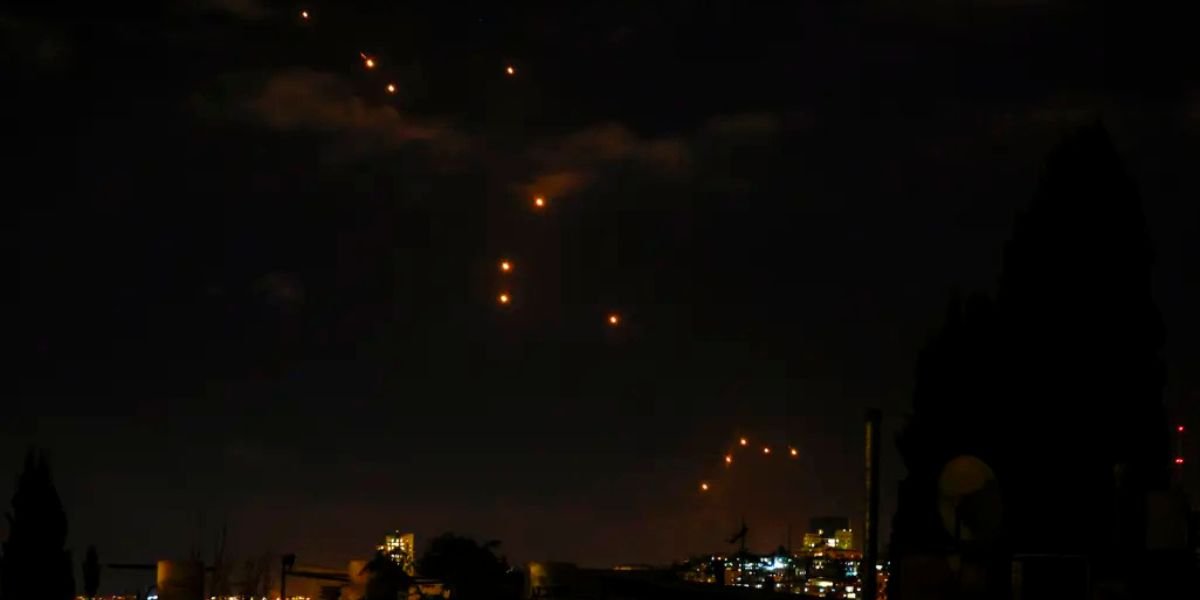
Caught off guard by what it saw as a betrayal disguised as diplomacy, Iran was shaken—but not silenced. Within hours, Tehran launched a blistering counterattack that would redefine the military calculus of the region. Operation True Promise III was not simply retaliation—it was a declaration. Over 150 ballistic missiles and more than 100 armed drones rained down on Israeli territory, piercing through what was once believed to be an impenetrable multilayered defense system.
For the first time in its modern history, Israel experienced vulnerability on its own soil. Its famed Iron Dome, David’s Sling, Arrow-3, and Patriot batteries were overwhelmed. Iranian missiles—including the newly unveiled Fattah-2 and Qassem Bassir hypersonic variants—reached speeds of Mach 15, evaded radar detection, and maneuvered mid-flight with deadly precision. These systems, equipped with electro-optical guidance, penetrated the heart of Israel’s defense grid. The technological superiority Israel once boasted was no longer a guarantee of security.
Open-source estimates suggest Iran’s Fattah-2 has an interception probability of only 5–10 percent—well below the capabilities of current global defense shields. In contrast, Israel’s Iron Dome interceptors, each costing over $40,000, were ill-equipped to handle the sheer speed and volume of incoming projectiles. The skies above Tel Aviv and Haifa—once fortified by billions of dollars in U.S.-backed infrastructure—were suddenly porous, unpredictable, and terrifying.
Importantly, Iran’s response was not random. It focused on military installations, intelligence hubs, and symbolic targets like the Mossad headquarters and air defense command centers. While civilian casualties were inevitable, they were not the objective. Iranian officials stressed the operation’s proportionality—a counter to Israel’s bombing of Tehran that had killed civilians, including women and children. As one Iranian academic noted, the aim was to force Israel to feel the fear and insecurity long endured by Palestinians in Gaza.
The conflict has laid bare not just vulnerabilities in Israel’s military doctrine, but also the glaring hypocrisy in Western political narratives. Israel’s initial strike was praised in Western capitals as a legitimate act of self-defense. Yet, Iran’s response was swiftly condemned as disproportionate and provocative. The same lawmakers in Washington who can’t reach consensus on domestic issues like healthcare or gun control were united in defense of Tel Aviv—an alignment fueled by powerful lobbying, political donations, and ideological entrenchment.
But the tide is shifting. Global public opinion—across Europe, Latin America, Asia, and even within the United States—is no longer monolithic. The relentless footage of Gaza’s ruins, the cries of orphaned Palestinian children, and now the images of Israeli civilians under fire have started to humanize both sides of the conflict. War is no longer a one-sided story. Civilians—whether in Tehran or Tel Aviv—suffer the same agony, the same irreparable loss. It is this human cost that is beginning to challenge long-held geopolitical postures.
Beyond Israel and Iran, the consequences of this conflict ripple across the region. Iran wields influence through a vast network of allies and militias in Iraq, Syria, Lebanon, and Yemen—each capable of escalating the conflict. Meanwhile, Sunni-majority nations such as Saudi Arabia, the UAE, and Egypt—ideologically opposed to Iran—have so far remained silent. They neither align with Tehran nor openly support Israel. They watch, cautious and conflicted.
Persistent but unconfirmed reports suggest that Iranian systems may have downed at least two Israeli F-35 jets—each worth over $100 million. If validated, this would be a severe blow to Israel’s air dominance and to the perceived invincibility of U.S. military exports.
Yet, the most profound lesson of this confrontation is neither technological nor military—it is moral. Iran, a nation sanctioned, vilified, and isolated, stood alone. And yet, it responded not with chaos, but with precision and discipline. Israel, with all its alliances and unmatched resources, underestimated its adversary. In doing so, it may have permanently shifted the strategic balance in the Middle East.
The path forward is precarious. Both nations now teeter on the edge of a broader war. Escalation could engulf the entire region. The United Nations must act swiftly, and global powers—whether it is the U.S. with Israel, or Russia and China with Iran—must rein in their allies. Drones and missiles must give way to dialogue and diplomacy.
Iran has made its point. Israel must now recognize its limits. The world, witnessing yet another region on the brink, must choose peace over vengeance.
In a world already scarred by war, climate collapse, and economic uncertainty, the Middle East cannot afford another inferno.
The time for pride is over. The time for peace is now.