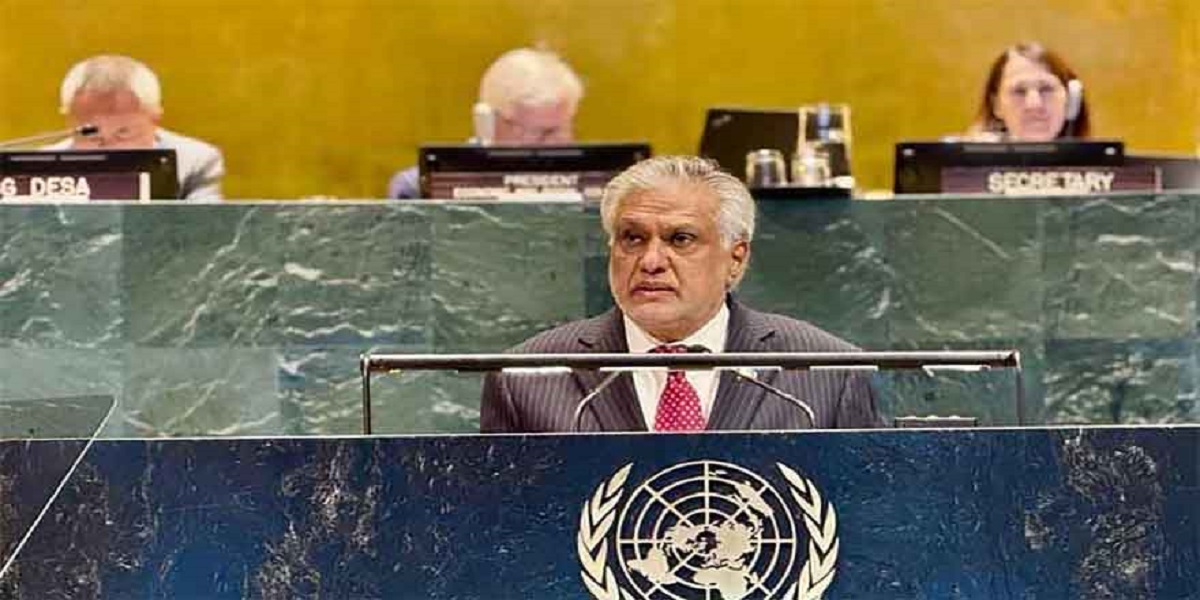
UNITED NATIONS: The Deputy Prime Minister and Foreign Minister Senator Ishaq Dar highlighted food insecurity and climate change as two of the gravest global challenges while addressing the UN High-Level Political Forum on Sustainable Development in New York on Monday.
Speaking during the General Debate of the Ministerial Segment, Dar reaffirmed Pakistan’s commitment to the 2030 Agenda for Sustainable Development and said the country is striving to ensure inclusive progress while protecting its most vulnerable segments.
Dar was of the view that despite the compounded impacts of the pandemic, economic disruptions, and worsening climate threats, Pakistan remained focused on long-term development goals.
He introduced Pakistan’s flagship “Uraan Pakistan” initiative as a cornerstone of the national development agenda. He highlighted efforts such as the expansion of Danish Schools across the country, aimed at providing free and quality education to deserving children.
The Benazir Income Support Programme (BISP), he noted, continues to be a lifeline for millions of families facing economic hardship. He also discussed environment-focused projects like the ‘Living Indus’ and ‘Recharge Pakistan’ programmes, designed to build climate resilience and improve water conservation.
In a major policy commitment, Dar announced Pakistan’s target to derive 60 percent of its energy from renewable sources by 2030. He also underlined the importance of the Special Investment Facilitation Council (SIFC) in channelling foreign investment into sectors that align with sustainable growth goals.
Calling for urgent reforms, Dar stressed the need to revamp the global financial architecture, urging greater access to concessional funding, climate finance, and debt relief for developing nations. “National efforts cannot succeed in isolation,” he remarked.
Meanwhile, on the sidelines of the forum, Dar held a meeting with UN Secretary-General Antonio Guterres. According to the Foreign Office, he reiterated Pakistan’s steadfast support for multilateralism and the UN Charter.
The Secretary-General praised Pakistan’s initiatives under its current Presidency of the UN Security Council (UNSC), which Islamabad assumed for July 2025. This marks Pakistan’s eighth term as a non-permanent member, continuing through 2026.
During its presidency, Pakistan is advancing discussions on multilateralism, peaceful dispute resolution, and cooperation between the UN and the Organisation of Islamic Cooperation (OIC).
Read more: Tribal Clashes Claim 6 Lives In Qila Abdullah