
By Reuters
“For those who believe that Brian walks on water, I will always be the Antichrist.”
In his memoir, “Good Vibrations: My Life as a Beach Boy,” Mike Love distilled decades of controversy into a single sentence, reflecting both his long-running feud with the rock band’s mastermind, Brian Wilson, and the distrust with which many fans and critics viewed him.
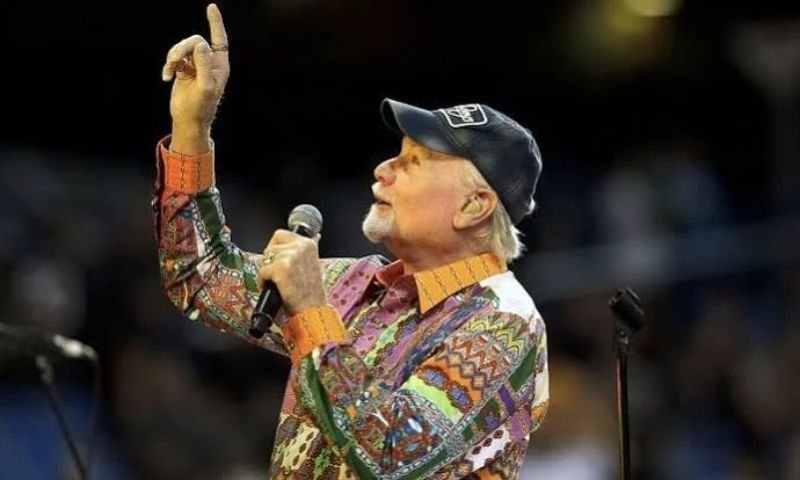
Love may have been the lead singer on some of the Beach Boys’ biggest hits including “California Girls,” the group’s frontman in live performances, and the only constant member since its formation in 1961, but many admirers of the sun-soaked California band also viewed him as abrasive, greedy and harmful to the creativity and mental health of Wilson, his cousin, who died at age 82 in June 2025.
Love, who in the 1990s successfully sued Wilson to receive songwriting credits on dozens of old tunes, disputed the accusations.
His legacy was a complicated one. “Love has been perceived as a calculating opportunist involved in some nasty lawsuits over the past decade with former band members, as well as, allegedly, at times bullying his fragile cousin, without whom many Beach Boys fans believe the singer would never (have) had a proper career in music,” Elliot Stephen Cohen wrote in the magazine Record Collector in 2007.
Yet Love also made many contributions that helped give the band its distinctive sound.
He co-wrote the lyrics for “Fun, Fun, Fun,” “I Get Around,” “Good Vibrations” and many other classic songs that remain embedded in American popular culture more than 60 years after their release. His vocals, meanwhile, helped define the 1960s dream of fun and endless summer.
Love died on Saturday at the age of 85, his publicist Katie Altman said. No cause of death was given.
His frail appearance at Beach Boys concerts in Cincinnati and Nashville in October had sparked widespread speculation about his health.
The oldest of six children, Michael Edward Love was born in Los Angeles on March 15, 1941. His mother, Emily Wilson, was the sister of Brian Wilson’s father, Murry.
Emily, who sang and played the piano, encouraged her children to appreciate music. His father, Milt Love, worked in the sheet-metal industry. “I admired my father’s work ethic and my mom’s love of music and culture,” Love wrote in his autobiography.
The core lineup of the Beach Boys consisted of brothers Brian, Dennis and Carl Wilson, along with Love and high school friend Al Jardine. Several other members joined at different times.
As a teenager, Love shared a mischievous sense of humor with the band’s leader, who was one year his junior. He fondly recalled evenings when Brian would sleep over and they would listen to music on Love’s transistor radio in the wee hours. Brian admired 1950s harmony vocal groups like the Four Freshmen while Mike liked Little Richard, the Coasters and Chuck Berry.
“We both had other friends and we both had girlfriends, but I don’t know that either of us had a better friend,” Love wrote in his memoir.
The Beach Boys scored their first, regional hit with “Surfin'” in 1961, which led to their signing the following year as Capitol Records’ first rock act. Wilson’s talents as a composer and arranger fully blossomed with the landmark album “Pet Sounds” and the single “Good Vibrations,” both released in 1966.
Love was a key part of the early success.
“Looking less like a Beach Boy than a beach bachelor — lanky and bantering in demeanor, but balding and carefully poised in carriage — Love’s sportive attitude and knowing nasal vocals lent roguish adult accreditation to his group’s most sentimental visions,” Timothy White wrote in his 1994 Beach Boys biography, “The Nearest Faraway Place.”
“And of all Brian’s collaborators, he was already the most important and least appreciated — or credited. A good ad-libber in the studio, Love had the glib tendency to offer memorable tag lines like ‘she’s real fine, my 409′ (about a Chevrolet car) to fill out the spaces behind each scripted chorus.”
By 1968, changing tastes in rock music made the barbershop quartet-inspired Beach Boys seem a bit quaint. Wilson struggled with mental health issues and withdrew from the spotlight.
The group released a string of albums including “Sunflower” in 1970 and “Holland” three years later, which became cult favorites but were ignored by mainstream listeners.
The oldies compilation “Endless Summer” revived the Beach Boys’ career in 1974. In 1988, the song “Kokomo” — co-written by Love — hit No. 1 on the charts, some 22 years after “Good Vibrations” rose to the top.
Dennis Wilson drowned at age 39 in 1983. Carl Wilson, the youngest Wilson brother, died of cancer in 1998 at age 51.
Shortly after that, Love leased exclusive rights to tour under the Beach Boys name. Brian Wilson and the estate of Carl Wilson approved the deal. Heirs of the late Dennis Wilson were no longer involved in the band’s corporate entity, Brother Records Inc. Founding member Jardine disagreed with the deal, leading to a lengthy legal battle with Love.
For decades thereafter, Love kept up an energetic touring schedule with his own edition of the group, attracting aging baby boomers and some younger fans.
At live shows, Love regaled fans with the band’s old hits. His mantra, according to some accounts, was “Don’t mess with the formula.” He denied ever saying that, however. Similarly, he rejected narratives in which he had supposedly resisted Brian Wilson’s creative explorations on “Pet Sounds” or on the legendary, abandoned “Smile” album.
“The people around Brian who do his PR have always (perpetuated) these myths about what I liked and didn’t like,” Love told Record Collector in 2007. “It’s a bunch of crap to say that I didn’t like the ‘Pet Sounds’ album. It’s fantastically crafted.”
Wilson acknowledged tensions with Love, even saying in a 2005 British television documentary: “I don’t like Mike Love at all … He’s too egotistical.” But he struck a more diplomatic note in his 2016 autobiography: “I’ve always admired Mike’s dedication to the music and to the group. We did some great work together.”
A vegetarian and an environmentalist, Love was also an early advocate of Maharishi Mahesh Yogi’s Transcendental Meditation technique. He accompanied the Beatles on their famous 1968 trip to the maharishi’s ashram in India.
But 20 years later, Love gave a puzzling, notorious speech at a Rock and Roll Hall of Fame induction ceremony, in which he attacked the Beatles’ Paul McCartney, as well as the Rolling Stones’ Mick Jagger. It prompted Bob Dylan to quip: “I want to thank Mike Love for not mentioning me.”
Love was married five times and had eight children.
The surviving Beach Boys reunited in 2012 for the album “That’s Why God Made the Radio.” The ensuing reunion tour, however, ended in disharmony when Love opted to resume performing with his own edition of the Beach Boys. He disputed perceptions that he had fired Brian Wilson and Jardine from the band.
Shortly after Wilson’s death, Love posted a tribute on social media: “Today, the world lost a genius, and I lost a cousin by blood and my partner in music.” For more obituaries, click here.
Also read:Hackers breach US Air Force’s flagship cloud computing platform