
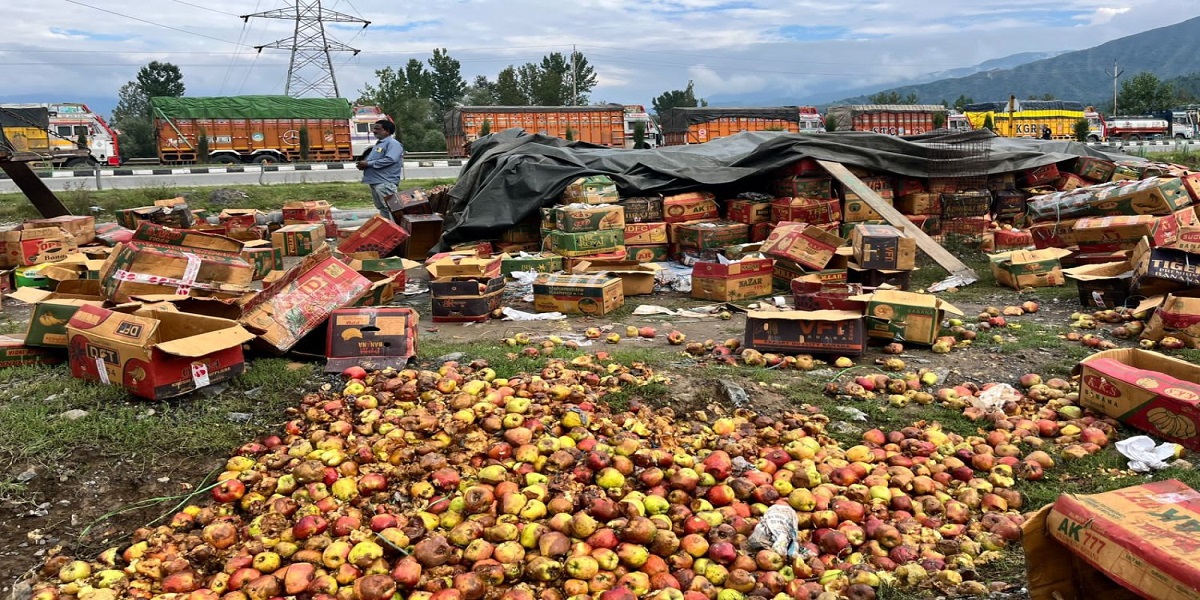
SRINAGAR: Kashmiri apple being a backbone of Kashmiri economy is facing worst type of Indian conspiracy as closure of Srinagar Jammu Highway, forced over 4000 apple loaded trucks stranded on Highway for over two weeks.
The fruit has started to get rotten and growers are forced to dislodge the fruit from the boxes supposed to unload in Azadpur Fruit Market.
The Kashmir contributes almost 80 per cent of India’s apples. But 4,000 trucks carrying them stand stranded while Indian claim of running train direct to Delhi also prove a hollow rhetoric.
An Apple grower Mir Javid fears that he may lose the entire year’s earnings from the apples he grows.
Trucks bearing his apples worth more than $10,000 are among rows of stranded carriers that stretch for miles along a key highway connecting his city, Shopian to India.
Their tarpaulin covers bulge with crates of fruits that have begun to blacken and collapse under the weight of rot.
All our hard work for the entire year has gone to waste. What we painstakingly nurtured since the spring is lost, Mir said and added, no one will buy these rotten apples, and they will never reach New Delhi.
“We are left with no choice but to throw away both truckloads along the highway”, Mir said with tears in his eyes over this huge loss.
The Jammu–Srinagar national highway – the only road connection in the Jammu Kashmir with India, has been repeatedly blocked since August 24 after rain-triggered landslides damaged a section of it.
For more than a month, the region has been battered by a severe monsoon fury, killing at least 170 people and causing extensive damage to properties, roads, and other infrastructure.
Highway blockade during peak harvest season, the horticulture forms the backbone of Kashmir’s economy, with the valley producing about 20–25 million metric tonnes of apples every year, that is almost 78 per cent of India’s total apple output.
The highway blockade coincides with the peak harvest season in Kashmir, the autumn during which apples, walnuts and rice are gathered from thousands of orchards and fields across the valley.
This is not just me or my village – this crisis is hitting all of Kashmir’s apple growers, said a apple growers Ahmed Bhat fro Shopian, known as Fruit Basket of Kashmir, adding that it is a conspiracy to destroy Kashmir and Kashmiris.
“Our entire livelihood depends on apple harvest,” Bhat said, adding that it was second blow to the region’s economy this year after the Pahalgam attack in April, when suspected rebels killed 28 people, severely disrupting tourism – another key sector in the valley.
One is being forced to think the mischievous mind as earlier huge number of apple orchards were forcibly snatched on the name of layin railway line and now at the time of peak season highway blockade is getting unnoticed.
A government official on the condition of anonymity told media person that about 4,000 trucks have been stranded on the highway at Qazigund area in Anantnag district for two over weeks, and the fruit loaded on them has begun to rot, resulting in estimated losses of nearly $146m.
Growers and fruit seller shut down fruit markets across Kashmir on Monday, Tuesday and Wednesday as they condemned the government’s inability to clear the key road.
“If the highway stays blocked for even a few more days, our losses will skyrocket beyond imagination,” Ishfaq Ahmad, a fruit grower in Sopore town, said while talking to media person.
Read more: