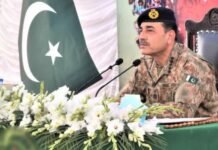
RAWALPINDI: Director General Inter-Services Public Relations (ISPR) Maj Gen Asif Ghafoor has told the people of Indian occupied Kashmir (IoK) that the Pakistani armed forces were standing by them and will go to any length to protect their land.
Addressing a press conference at the General Headquarters on Wednesday on the situation in occupied Kashmir since the Indian government revoked its special autonomy, the military’s spokesperson also said a “befitting response” will be given to any false-flag operation staged by India.
“I want to give this message to Kashmiris that we stand by you and will continue to do so. It is sad that your independence struggle was presented as terrorism,” he said.
“Kashmir is our jugular vein and we will go to any lengths to protect it.”
Maj Gen Asif Ghafoor began his presser by saying that he would talk about the situation in Indian-occupied Kashmir and its effect on national security.
He said Pakistan’s geographical situation cannot be ignored by regional countries or world powers.

“India is a country with a huge population, a follower of Hitler is in power [there]. The world community has interests in India.
“Then there is China, an emerging world power. China has issues with India as well but their economic relations with India are stable. Afghanistan has seen nothing but war, martyrdom and loss of lives,” he added.
Maj Gen Asif Ghafoor said Pakistan has good relations with Iran but due to the situation in the Middle East, Iran is facing some problems. “But Iran has a huge role in regional peace,” he added.
“In India, the Rashtriya Swayamsevak Sangh (RSS) and Nazi ideology are in power. They endanger minorities including Muslims and Dalits,” he said, adding that the situation is such in India that there is no religious or social freedom there.
In occupied Kashmir, he said, the “fascist” government of Indian Prime Minister Narendra Modi has “uprooted Nehru’s step for the region”.
In contrast, the armed forces have established peace in Pakistan and the country is also playing its role for regional peace.
“We have avoided escalation,” he said of recent tensions with India over occupied Kashmir.
He said Prime Minister Imran Khan in his first speech after taking office had extended an offer of dialogue to India “in response to which they sent in two warplanes and received a fitting reply”.
“Nuclear countries have no room for war,” the military’s spokesperson said.
He said India has “indirectly continued to attack Pakistan”, an example of which he said was Indian spy Kulbhushan Jadhav.
“We are playing a role in the Afghan reconciliation process. If peace is established in Afghanistan, our troops deployed at the western border will probably be removed.
“Maybe India thinks that it should take action against us that would weaken us. We want to tell India that wars are not only fought with weapons and economy but with patriotism.
“The Quaid-i-Azam’s vision and our belief is that Kashmir is our jugular vein.”
He recalled that there are United Nations resolutions on the conflict in Kashmir.
“Recently Modi took an immoral step and repealed Article 370 of the Indian constitution. This is no longer a conflict of ideologies.”
He said Pakistan has been fighting a hybrid war for the past 20 years and considering the conflict spectrum, Pakistan’s options of response revolved around economy, diplomacy, finance, intelligence, etc.
“For the first time in 50 years, the UN Security Council held a session on Kashmir. PM and the foreign minister have talked to several nations’ heads and foreign ministers.
“Modi says he doesn’t want mediation. If you don’t want mediation, then what did you talk to [US President Donald] Trump about?” he said.
Thanking international and local media for effectively covering the oppression in Kashmir, he said the issue of Kashmir which was previously ignored by the world has now gained international attention.
“No step by Indian authorities that does not lead to the self-determination of Kashmiris is acceptable to us,” Maj Gen Ghafoor said.
At the same time, he added, “Any isolated step by us that might take the attention away from Kashmir issue will be cruelty to them.
“Armies protect a nation’s sovereignty. When that is threatened, war fighting becomes a compulsion instead of a choice. It is up to India and the rest of the world.
“How can you think that we can do a deal over Kashmir? we have not agreed to do that in 72 years, why would we do that now?” the ISPR chief said.
Maj Gen Ghafoor’s Asif press conference comes amidst heightened tensions between India and Pakistan following the Indian government’s decision to unilaterally revoke Article 370 of its constitution, which granted special autonomy to occupied Kashmir. A communications blackout and heavy restrictions on movement imposed by the Indian authorities from the eve of this development entered their 31st day today.
Following India’s decision to repeal Article 370, Pakistan downgraded diplomatic relations with New Delhi and suspended all bilateral trade. The Indian ambassador was asked to leave and train and bus services with India were also suspended.
In response to a question, Maj Gen Asif Ghafoor said the decision to grant an extension to Army Chief Gen Qamar Javed Bajwa was a prerogative of the prime minister, which he had exercised.
“Army chief did not want [an extension]. After over 40 years of service, every person wants to return to normal life and rest, but he has personal rapport with many nations’ heads. It was the prime minister’s prerogative and he exercised it and let’s hope it pays off,” he added.
INP