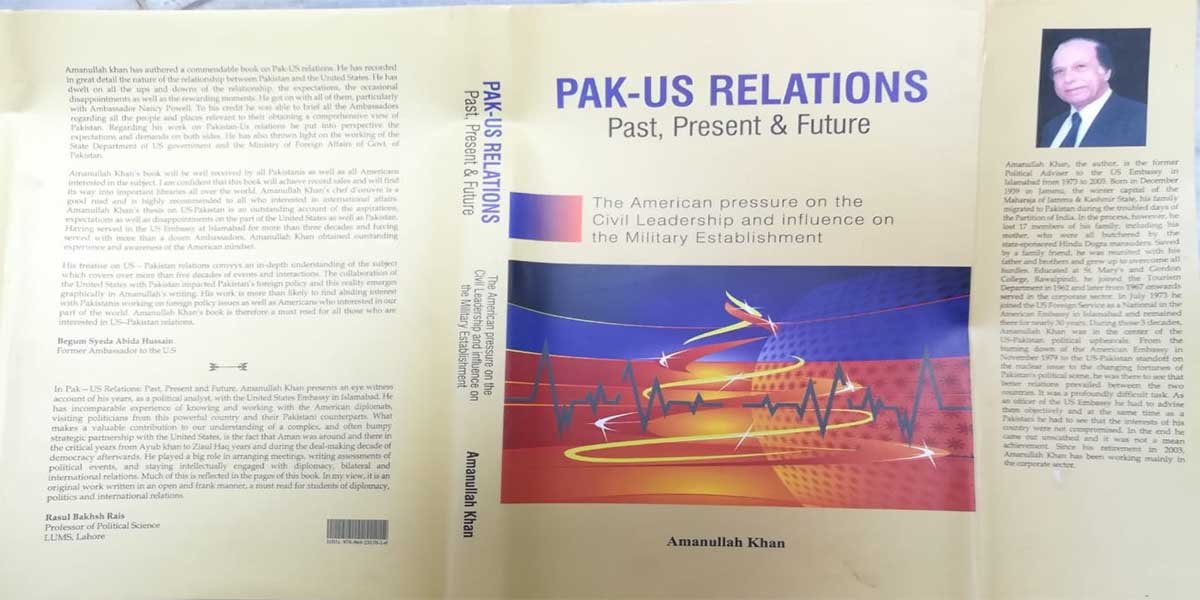
I read Mr. Aman Ullah Khan’s second book on Pak-US Relation: Past, Present and Future with enhanced interest after reading his first book entitled Tightrope Walk.
In both the books he successfully maintained an objective, impartial, honest and skillful balance between his patriotism as Pakistani national and his professional loyalty and duty as advisor to the American Ambassadors for three decades.
Certainly, it was not an easy task because of the complexity of the issues involved and intricacies of Pak-US ties which experienced numerous ups and downs as he himself very rightly termed it as a “mystery of the US frequent U-terns to the Pakistan’s chagrin at the most inappropriate times”.
It could have been beyond the patience of a lesser mettle person the pains he felt but never shown any sign of intolerance or unpleasantness on his face when American policy-makers let Pakistan down many times especially in critical situations.
At the same time he was very successful in tolerating but politely highlighting the tragedy to his surprise that Pakistani ruling elites were always ready to oblige every US administration for all their policies and military aggression but it was beyond his limits of tolerance when military regime in Pakistan itself took a U-turn especially after 9/11 and facilitated US aggression in its neighbouring and brotherly Muslim Afghanistan for which Pakistan is still paying heavy price.
Mr. Khan’s book is a narration as well as critical analysis of his first-hand information, participant observations and experiences of dealing with Pak-US relations highlighting the intricacies in the process of decision-making in Pakistan with respect to some selected but major issues including Kashmir dispute, Afghanistan crisis, Pak-India tensions, Pakistan’s nuclear programme and domestic politics with an objective to measure the American influence on Pakistan’s military establishments and civil administrations and expose the character of the faces behind the scenes.
Mr. Khan begins by disclosing the personal tragedy he faced as a seven-year old Kashmiri boy when his mother and number of his close relatives were brutally butchered by Hindu mobs in Jammu and Kashmir during migration at the time of partition of the Subcontinent into Pakistan and India.
The remarkable aspect of his human attributes was that he not only overcome the trauma shedding away all preconceptions which might have embedded in his mind but also rose to a prominent position of an advisor to many US Ambassadors and diplomats. Certainly, this position has provided him deep insights enabling him to be a skillful writer.
Mr. Khan’s book provides a blunt, straightforward, frank and interesting narrative clean from entangling the reader into complex theoretical framework, though it cannot be termed as research work as no evidence/citation has been provided to support the observation as well as argumentation but his life-long personal engagement in the process of diplomatic negotiation and close association with American ambassadors in Pakistan, his objective and honest understanding and observations make it more authentic.
Mr. Khan has narrated the conduct of some of the American ambassadors which are not only interesting by at time revealing too. Similarly, he is critical of successive governments in Pakistan conceding much than gains rather most of the time acting contrary to the national interests.
But at the same time some of his arguments that Kashmir dispute could have been resolved bilaterally but was kept dormant “whenever certain elements feel the need for it” may seem oversimplified. But I also believe that Nehru’s cunningness worked in separating Kashmir from Indus waters dispute as a pre-condition in accepting World Bank’s mediation otherwise water and Kashmir are intertwined in nature.
Chennab Formula has its roots in the signing of IWT but Gen. Ayub Khan cold not sell this idea in Pakistan owing to risk of his popularity. Nevertheless, his proposal that Pakistan would have been better without adopting the nuclear path is a simple and reductionist approach without realizing Pakistan’s perception of existential threat from India, though he has full right to hold such view.
Anyhow, I fully endorse his views that there is zero pressure on Modi government either from the US, EU and Muslim world rather Muslim Ummah especially KSA and ME are criminally silent on both the issues of Kashmir and Palestine.
Mr. Khan’s concerns about American role in Afghan crisis is well founded, military regimes of Gen. Zia-ul-Haq “chose to play a virtual stooge” and Gen. Musharraf conceded too much without a little appreciation or recognition from America rather faced “do more” mantra at the cost of national priorities.
American role and influence on our national politics is really ironical, barring words from the author “Pakistani officials had no guts to sustain that pressure because of their personal reasons and selfish interests.” Many Pakistanis do agree that “our ruling elite has been bowing before American bosses who at times were assertive and at times more than impolite in the diplomatic norms.”
CPEC will really a test case for the new administration in Pakistan, the US is openly opposing the project supporting India to be a real counter-weight against China. India is trying to sabotage it through acts of terrorism and cyber warfare against Pakistan. Recent joint press conference of Pakistan’s Foreign Minister and DG ISPR is sufficient to believe the unfolding scenarios.
I congratulate the author for providing us very insightful personal experiences and life-long observations as participant observant to the process of diplomatic pressures and arm-twisting of a client state by a super power and subservient role of Pakistani ruling elite for their own personal and myopic gains sometimes compromising national interests. Unmasking of the elements behind such conspiracies is a very courageous and bold disclosure many Pakistani writers prefer to avoid.
The book contains factual analysis and objective narrative of US influence and Pakistani ruling elite’s character in decision-making from a person best qualified to describe. The book abundantly contains a must read material for policy-makers, diplomats, academics and students of International Relations and politics.
Also Read:Saudi Rushes To Improve Its Image In Advance Of G20 And Biden