
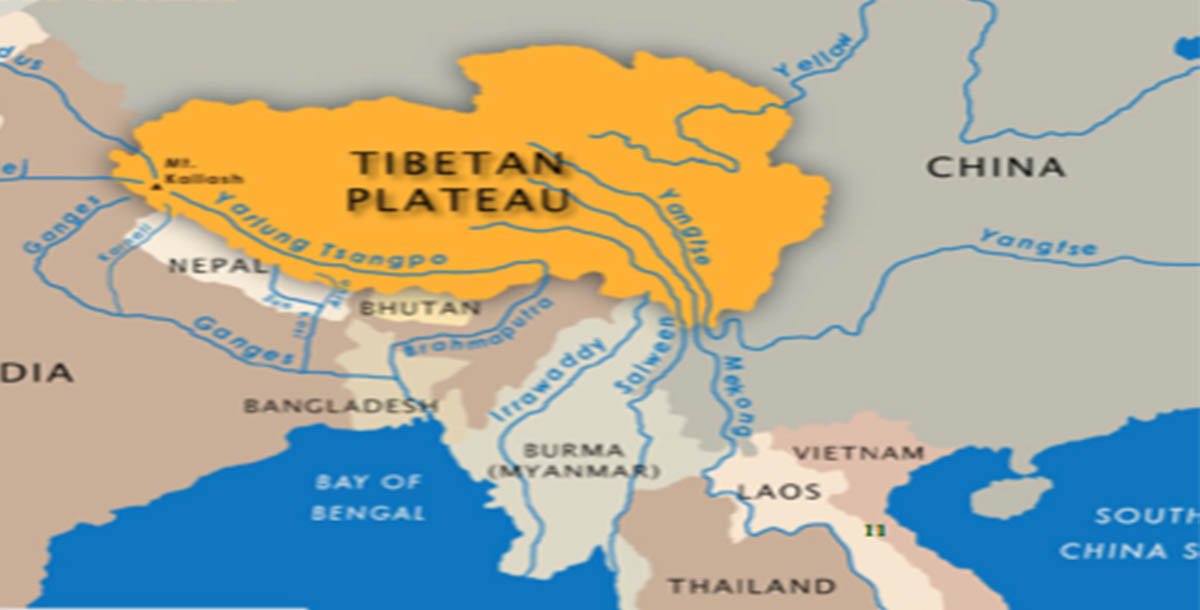
As a famous saying goes, ” He who controls water, he controls all.”
Widely known as the ” Water Tower” of Asia, the Tibetan Plateau is a rich repository of freshwater to most of southern and south-eastern Asia. It is the source of various trans-border rivers, including the Yangtze, Yellow River, Indus, Ganges, Brahmaputra, Irrawaddy, Salween, and Makan rivers.
Collectively an astonishing three billion people either directly, or indirectly are dependent on these rivers. This gives China an unquestionable geopolitical advantage. The slightest of alterations could trigger an environmental and geopolitical cascade in some of the most densely populated nations on Earth.
In its pursuit of renewable hydropower, China has constructed more than 8,700 dams over seven decades at a rate unmatched in human history. Collectively by the sources of the Chinese government, these dams produce 352 gigawatts of power, which is more than the combined output of Brazil, Canada, and The United States of America.
However, after damming up its internal rivers, now China looks toward damming its international rivers. As China increasingly dams up the rivers which originate in Tibet, this gives the lawmakers in Beijing more political power and leverage over the downriver states.
The countries of Pakistan, India, Bangladesh, Nepal, Bhutan, Myanmar, Thailand, Laos, Cambodia, and Vietnam are reliant on rivers originating in Tibet. Thus, as China is an upper riparian state, if it wishes, it could exercise significant control over all these downstream nations. China has shown that it will not shy away from the exploitation of hydropower on these rivers.
For instance, the Brahmaputra is a major international river shared by China, India and Bangladesh. It stretches over a length of 2,900 kilometers and originates in the Chang Jung Dongha glacier in Tibet. Starting from the Zheng mu hydro-electric facility, there has been a cascade in construction along the Brahmaputra.
When China approved the construction of three new projects on the Brahmaputra river, downstream India raised a voice of concern over the implication this would have on the flow of water. The concerns are valid as the damming of the river could indirectly affect 1.3 billion people in India and Bangladesh.
Policymakers in Delhi have brought up the “Memorandum Of Understanding” regarding the water resource distribution between China and India. However, the issue is that the bilateral understanding is non-binding, and it is without any international body that ensures its application.
Rather there are no legal mechanisms in place over the sharing of water between China and the down-river nations. The construction of these three dams is only the opening salvo of China’s geopolitical ambitions.
The closest Beijing ever came to a transboundary water agreement was in 1995. The nations adjacent to the Makkan river of Thailand, Laos, Cambodia and Vietnam proclaimed that the river belonged to no single state. But China refused to join the agreement at the last moment.
In 1997, there was another attempt to lay down a mechanism of legal rules on the sharing of transboundary rivers in the United Nations, but the Chinese voted not in favor. These diplomatic incidents occurred when Beijing was still relatively poor. For reference, at the time, the economy of Hong Kong was more than 18% of the economy of mainland China.
The Beijing of then was much less financially and politically confident as compared to the Beijing of now. Therefore, a bill for the governance of transboundary water sharing has little to no chance of success.
This situation explains the predicament India finds itself. When even India is incapable of stopping the engineering ambitions of China, one can imagine the political tantrum in the other downstream nations. Rapid population growth, urbanization, industrialization and climate change threaten water security across South and South East Asia. As China rolls out its new hydropower policy, water scarcity will become an authentic policy issue for the downstream nations.
However, among all the downstream nations, Bangladesh will be worst affected. The Ganges and Brahmaputra merge in Bangladesh and then flow out into the Bay of Bengal. India who is by no means an innocent bystander is pursuing its very own hydropower ambitions along the Ganges. Restricted water flow is already causing an increase in soil salinity in downstream Bangladesh. In turn, this is destroying its farmlands.
This is forcing thousands of Bangladeshi’s to relocate to the south west, India, which is adding fuel to the ethnic conflict. The policymakers in Dhaka have little to no leverage over their larger upstream neighbors, nor do they have the capacity to look elsewhere for options. Other than dealing with its upstream water issues, Bangladesh has to deal with the rising sea levels as well as the influx of refugees from neighboring Myanmar, consequently due to the ongoing ethnic cleansing. If ever there was a lose-lose situation, one may find it in the current predicament that Bangladesh finds itself in.
As the number of dams is on the rise in Tibet, water scarcity will become a policy nightmare for the downstream nations. The fear is that China may use the flow of water as a political weapon.
One would imagine that the opposition of Chinese hydropower ambitions would be deafening, if not universal. However, that could not be further from the truth. Thailand has a deal with China for the purchase of thousands of megawatts of power. Cambodia and Laos retain a very passive attitude as they do not wish to disrupt their business relationship with China, for which they have become heavily reliant on. Meanwhile, Pakistan enjoys a very special relationship with its neighbor China. Thus far Beijing has not announced any plans or policies which would disrupt and harm the flow of water to their ally.
Unless the narrative changes, China will slowly secure and subdue her periphery, and Tibet the Water Tower of Asia is at the epicenter of Beijing’s quest for hegemony.
Also Read: I Can’t Breathe – George Floyd