Islamabad: When floods submerged a third of Pakistan in 2022, they left more than broken infrastructure in their wake — they left questions. Questions about preparedness, justice, accountability, and most of all, education. What did the children who survived those floods learn from them? And what tools do they have now to face the next climate catastrophe?
For Cambridge University Press & Assessment, part of the University of Cambridge, climate education is the answer. And they’ve now brought that answer to Pakistan in the form of Cambridge Climate Quest: Pakistan Edition — an ambitious, free, self-paced online learning program tailored to the country’s unique environmental and educational challenges.
A Quest to Learn, A Mission to Act
Launched in September 2025, Cambridge Climate Quest Pakistan is more than a course — it’s a carefully designed journey. Developed in collaboration with Cambridge Zero and Lahore University of Management Sciences (LUMS), the program targets learners in Years 8 to 12 across all education boards, including government schools.
Structured into three interactive eLearning modules hosted on Cambridge GO, the course blends videos, quizzes, case studies, and local insights to deliver a dynamic and engaging experience. The modules include:
- Understanding Climate Change – covering key scientific concepts
- Climate Change on the Ground – exploring Pakistan-specific challenges
- Addressing the Crisis – offering solutions and global perspectives
With 2.5 hours of core content and a project-based component, it fits within tight school schedules and self-paced learning. Students receive certificates of completion, and teachers gain access to professional development resources.
Why Pakistan?
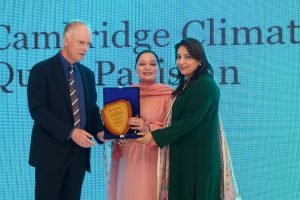
“Pakistan is on the frontline of the climate crisis,” said Peter Phillips, Chief Executive of Cambridge University Press & Assessment, at the program’s launch event in Islamabad. “But it is also home to one of the world’s largest youth populations, full of resilience, innovation, and talent. Through Climate Quest, we want to support learners in Pakistan not only to understand the science of climate change but to design and lead solutions that make a real difference in their communities.”
His message was echoed by Uzma Yousuf, Country Director for Cambridge in Pakistan:
“Climate Quest Pakistan is more than a program — it is a call to action. Our effort is for our children, to ensure they are equipped with the climate adaptability and resilience needed to navigate the challenges of today and tomorrow.”
Backed by data showing that over 53% of Pakistani students are aware of climate change, but lack deep understanding, the course connects global science with local challenges such as:
- The 2010 and 2022 floods
- The 2017 heatwave
- Air pollution in Lahore
- National flood protection and sustainability policies
Regional language translations, such as Sindhi, also improve accessibility.
A Powerful Launch: Voices from the Ground
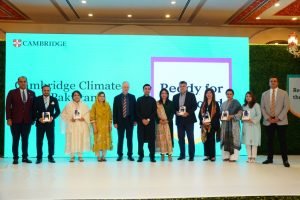
The launch event was more than ceremonial — it was a national conversation. Held in Islamabad, it brought together school leaders, climate experts, policymakers, and members of the Ministry of Climate Change and the Ministry of Federal Education and Professional Training (MoFEPT).
Notable attendees included:
- Ms. Romina Khurshid Alam, Coordinator to the Prime Minister on Climate Change
- Mr. Faisal Khan Tarakai, Minister for Elementary and Secondary Education, KPK
- Ms. Farah Naz Akbar, Parliamentary Secretary, MoFEPT
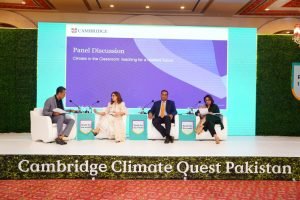
A key highlight was the panel discussion titled “Climate in the Classroom: Teaching for a Resilient Future”, moderated by journalist Syed Talat Hussain. Panelists included:
- Dr. Mehreen Mujtaba, Director, Climate Change, Nutrition and Health, MoNHSR&C
- Mr. Malik Amin Aslam, former Advisor to the Prime Minister on Climate Change
The panel explored the urgent role of climate literacy in public health, resilience, and media awareness.
Digital Equity and Emotional Resilience
In Q&A, special correspondent Dr. Aatif Iftikhar raised concerns around the digital divide, misinformation, and eco-anxiety.
The response emphasized media literacy and fact-based learning as central pillars of the program. “We can enlighten the public through supportive education — including religious framing — and turn myths into science-backed facts,” noted the panel.
To improve accessibility, Cambridge has introduced a mobile app so students can learn on-the-go, especially in regions with limited internet access. The course also includes support for mental health and eco-anxiety, featuring:
- Storytelling and reflection activities
- Community-based learning
- Practical, small-step action plans
Building a Climate-Conscious Generation
While Climate Quest is educational at its core, its ultimate ambition is societal. By integrating:
- Community projects
- Localized storytelling
- Critical thinking
The program aims to build resilience, foster collaboration, and empower students to influence their surroundings.
Cambridge’s commitment is long-term. As a signatory to the UN Global Compact, the institution plans to continue expanding Climate Quest to more countries and age groups, with regular content updates reflecting the latest in science and pedagogy.
The Road Ahead
As Pakistan faces another season of climatic uncertainty, its classrooms are becoming engines of adaptation. Cambridge Climate Quest Pakistan doesn’t just teach facts — it empowers a generation with the tools, confidence, and courage to understand, adapt, and lead.
In a world often defined by climate despair, that might just be the most powerful form of action we have.
To access the program:
???? https://climate.cambridgeconnect.org
???? https://www.cambridgeinternational.org/climatechangeeducation