
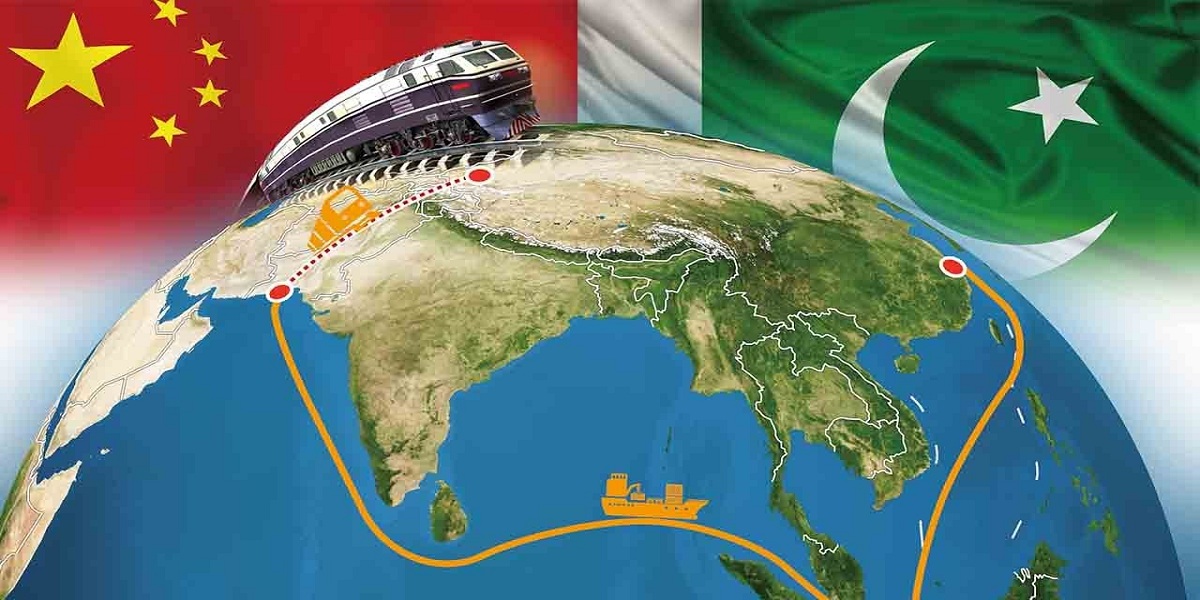
The China-Pakistan Economic Corridor, better known as CPEC, has become a symbol of both hope and contention in Pakistan’s development narrative. On paper, it is a monumental $62 billion undertaking aimed at connecting Gwadar Port in Balochistan with Kashgar in China’s Xinjiang province. But beyond the maps and budgets, CPEC carries deep economic, political, and strategic implications for Pakistan, China, and the wider region.
Why China Took an Interest in CPEC
China’s motivations for backing CPEC go far beyond goodwill or friendship. For Beijing, the corridor offers a shorter and safer route to the Arabian Sea, drastically reducing trade transit times compared to reliance on the longer and vulnerable Strait of Malacca route. By accessing Gwadar, China reduces its maritime dependency and strengthens its energy security.
Additionally, China aims to develop its underdeveloped western regions, especially Xinjiang, which has experienced social unrest and economic disparities. CPEC provides an opportunity to generate economic activity and foster stability. Strategically, it also strengthens China’s reach into the Indian Ocean, an area historically dominated by U.S. naval power.
Who Pushed the Idea Forward
The corridor did not emerge overnight. In 2013, under Prime Minister Nawaz Sharif’s government, foundational agreements for CPEC were signed. On China’s side, the vision was led by President Xi Jinping under the broader Belt and Road Initiative (BRI), aiming to revive Silk Road-style global trade routes. Other key figures included Chinese Premier Li Keqiang, who laid diplomatic groundwork during his visit to Pakistan, and Ahsan Iqbal, Pakistan’s Minister for Planning at the time, who played a critical role in shaping the plans. General Raheel Sharif, then Chief of Army Staff, ensured the Pakistani military provided protection for Chinese workers and installations amid security concerns.
The Agreement and What It Entailed
The official Memorandum of Understanding (MoU) for CPEC was signed in July 2013, but the real breakthrough came with President Xi Jinping’s visit to Pakistan in April 2015, when agreements worth $46 billion were formally announced, later expanding to $62 billion. The deal included energy projects, industrial zones, highways, railways, fiber optic cables, and the transformation of Gwadar into a world-class port. China financed and constructed most major infrastructure and energy projects, while Pakistan provided land, legal frameworks, and security.
Who Benefits and Who’s Been Left Waiting
CPEC was designed to benefit the entire country, running through Balochistan, Sindh, Punjab, Khyber Pakhtunkhwa, and Gilgit-Baltistan, aiming to uplift regions long excluded from mainstream development.
-
Balochistan: The largest share through Gwadar Port and coastal infrastructure.
-
Punjab and Sindh: Energy plants and major highway routes.
-
KP and GB: Inclusion in the Western Route, promising roads, jobs, and connectivity to peripheral regions.
External Pressures and Regional Opposition
A project of this scale inevitably attracts regional scrutiny. India has repeatedly opposed CPEC, especially as it passes through Gilgit-Baltistan, a region India claims as part of Jammu and Kashmir. For New Delhi, CPEC challenges its sovereignty and signifies China’s deepening presence in its neighborhood.
The United States has also expressed concerns, viewing CPEC and the broader BRI as strategies for China to extend its influence across Asia, Africa, and Europe, challenging existing global trade norms. Discussions around “debt trap diplomacy” have emerged, though the narrative remains contested. Meanwhile, Iran has been cautiously observing while developing its Chabahar Port with Indian support, just 170 km from Gwadar.
Where Pakistan Dropped the Ball
Despite a grand vision, Pakistan’s execution has faltered:
-
Delays in land acquisition and regulatory frameworks stalled many projects.
-
Political changes, including Nawaz Sharif’s disqualification in 2017, disrupted policy continuity.
-
Coordination issues between provinces and the federal government caused hurdles.
-
SEZs, envisioned as job-creating engines, have progressed slowly.
-
The lack of a skilled local workforce led to heavy reliance on Chinese labor.
The Delays: Who’s to Blame?
By mid-2025, several flagship components are either stalled or progressing slowly. The Main Line-1 (ML-1) railway upgrade from Karachi to Peshawar remains on hold due to financing issues and IMF concerns over Pakistan’s debt sustainability. SEZs like Rashakai in KP and Dhabeji in Sindh lag behind schedule.
Delays have been caused by slow fund disbursement, policy confusion, and at times, Chinese reluctance to proceed without sovereign guarantees. Both countries share responsibility, but Pakistan’s domestic governance challenges have played a larger role.
The Numbers Behind CPEC
-
Total value: $62 billion (estimated)
-
Energy sector: $33 billion
-
Infrastructure (roads, railways): $11 billion
-
Gwadar Port development: $1.6 billion
-
ML-1 railway upgrade: $6.8 billion
Funding primarily comes from Chinese investments and concessional loans, with Pakistan repaying over an extended timeline, raising concerns over debt servicing and fiscal space.
Where Things Stand Now (July 2025)
Completed: Energy plants in Sahiwal, Port Qasim, and Hub; sections of the M-5 Motorway and Gwadar Expressway.
Partially functional: Gwadar Port is operational but underutilized.
Stalled: ML-1 railway, several SEZs, and the Karachi Circular Railway upgrade.
CPEC’s early momentum has undeniably slowed.
What Can Be Done to Move Things Forward
CPEC is not dead but requires urgent revitalization:
-
Strengthen institutional capacity: Revamp the CPEC Authority and improve inter-ministerial coordination.
-
Negotiate IMF flexibility: Secure exemptions for strategic infrastructure spending.
-
Expand the investment base: Encourage participation from countries beyond China, especially in SEZs.
-
Transparent communication: Share project timelines and costs to build public trust.
-
Enhance security: Ensure the safety of Chinese nationals and local workers.
Recommendations for Both Sides
For Pakistan:
-
Simplify procedures for investors.
-
Align CPEC with broader national development goals.
-
Improve project oversight to reduce dependence on Chinese firms.
For China:
-
Encourage joint ventures and technology transfer.
-
Integrate Pakistani SMEs into the CPEC value chain.
-
Engage local communities to reduce resistance and suspicion.
A Corridor at the Crossroads
CPEC was envisioned as more than just roads and railways; it was meant to be a lifeline for Pakistan’s economic revival. A decade in, that promise remains partially fulfilled. With the right leadership, transparency, and cooperation, CPEC can still deliver transformative results. If left to drift, it risks becoming yet another tale of missed opportunities in a country that can ill afford many more.