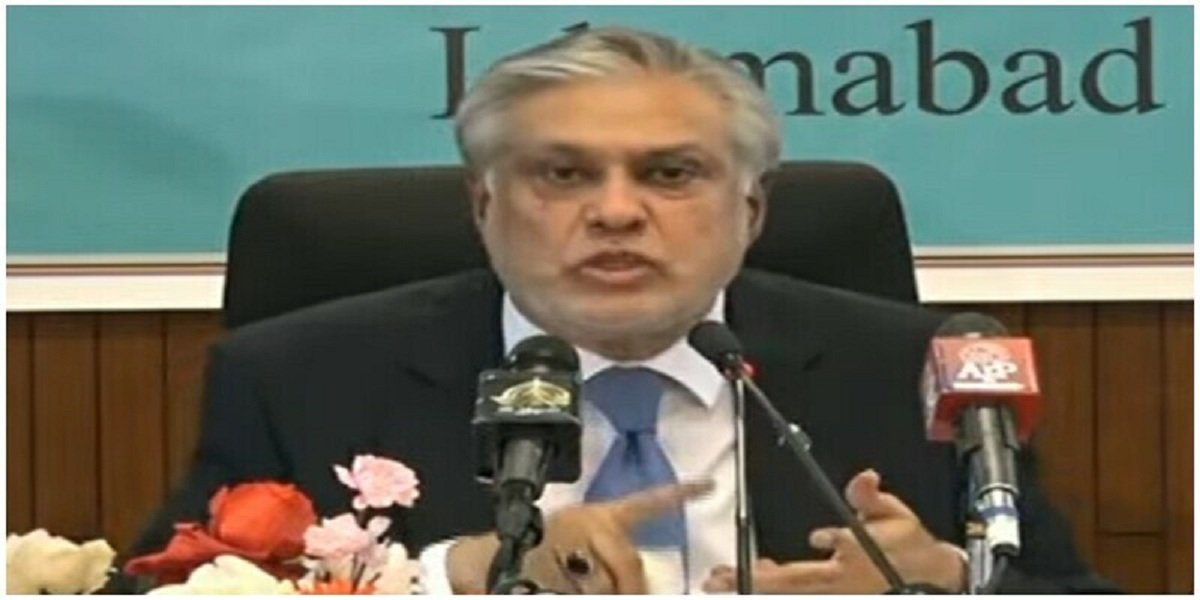
ISLAMABAD: Finance Minister Ishaq Dar unveiled the Pakistan Economic Survey for the fiscal year 2022-23, revealing disappointing figures that fell short of targets by a significant margin.
During a press conference here on Thursday, the Finance Minister presented the pre-budget document, disclosing that the country’s GDP growth rate had plummeted to 0.3%. This decline was attributed to a combination of natural disasters and political challenges.
Analysts closely scrutinized the finance minister’s presentation, seeking indications of potential populist measures in the upcoming budget, as well as assessing the government’s commitment to the economic discipline necessary for another IMF program.
He highlighted the challenges faced at the time, including a struggling economy, severe electricity shortages, and a rising threat of terrorism. Dar credited the government’s implementation of the “3 Es” concept, which led to macroeconomic growth.
The finance minister outlined the government’s focus on five key areas, referred to as the “5 Es”: exports, equity, empowerment, environment, and energy.
These areas would form the roadmap for the upcoming year. Despite acknowledging the challenging economic conditions of the current year, Dar stated that the government had made its best efforts to address the situation.
“Major part of the revenue collection is being spent on interest payments, during the Pakistan Tehreek-e-Insaf period, the debts and liabilities were increased by 100%, and the debt and interest payments have reached Rs7,000 billion rupees, these cases caused great damage to the country.”
The GDP growth rate target for the next fiscal year has been set at 3.5%. According to the ministry’s report, the economy faced significant challenges in the outgoing fiscal year, including macroeconomic imbalances, supply shocks, and a slowdown in the international economy. As a result, the real GDP only grew by 0.29%.
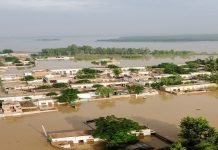
During the first quarter of FY23, a large portion of agricultural land was submerged due to floods, causing disruption in domestic supply chains.
The damages caused by the floods amounted to Rs3.2 trillion ($14.9 billion), resulting in a GDP loss of Rs3.3 trillion ($15.2 billion). Additionally, the rehabilitation expenditures reached Rs3.5 trillion ($16.3 billion).
The document highlighted that the increase in international prices and currency depreciation led to higher domestic commodity prices, which in turn reduced aggregate demand in FY23.
At current market prices, the GDP for FY23 reached Rs84,657.9 billion, representing a growth of 27.1% compared to the previous year’s Rs66,623.6 billion.
The report also noted a decline in the investment-to-GDP ratio, which stood at 13.6% in FY23, down from 15.6% in FY22. This was primarily due to the global and domestic economic slowdown, as well as contractionary macroeconomic policies.
Furthermore, the per capita income decreased to $1,568 from $1,765 last year. The decline can be attributed to currency depreciation, lower GDP growth, and a rise in the population.
Agriculture
The document revealed that the agriculture sector faced severe setbacks during the fiscal year 2022-23, primarily due to the flash floods in 2022. As a result, the sector’s growth rate was only 1.55%, compared to 4.27% in the previous year.
When examining specific crops, cotton production experienced a significant decline of 41%, with output falling to 4.91 million bales from 8.33 million bales the previous year.
Rice production also witnessed a decline of 21.5%, reaching 7.32 million tonnes compared to 9.32 million tonnes last year. On the other hand, sugarcane production increased by 2.8%, reaching 91.11 million tonnes compared to 88.65 million tonnes in the previous year.
Maize production showed a positive growth of 6.9%, reaching 10.18 million tonnes compared to 9.52 million tonnes last year. Similarly, wheat production increased by 5.4%, with a recorded output of 27.63 million tonnes compared to 26.21 million tonnes in the previous year.
During the first quarter of the fiscal year 2022-23, the monsoon season witnessed unusually high rainfall, with a recorded amount of 387.8mm, marking a significant increase of 175.3% compared to the average rainfall of 140.9mm.
However, in the post-monsoon season (October-December) of 2022, the rainfall decreased to 21.5mm, reflecting an 18.6% decrease from the average rainfall of 26.4mm.
Furthermore, during the winter season (January-March) of 2023, the rainfall remained below average at 63.8mm, showing a decrease of 13.9% from the normal average rainfall of 74.1mm.
Fiscal deficit
According to the pre-budget document, the fiscal deficit as a percentage of GDP decreased to 4.6% (amounting to Rs3,929.3 billion) during the period of July-April FY23. In comparison, it was 4.9% of GDP (equivalent to Rs3,275.2 billion) during the same period last year.
Additionally, the primary balance showed a surplus of Rs99.1 billion during the review period, in contrast to a deficit of Rs890.2 billion in the previous year. This positive change can be attributed to a slowdown in the growth of non-markup expenditures.
Furthermore, the current account deficit experienced a significant reduction of 76.1%. During the period of July-April FY23, it recorded a deficit of $3.3 billion, whereas it stood at $13.7 billion in the corresponding period last year. This improvement in the current account deficit was primarily due to a decline in the merchandise trade deficit.
As per the survey document, Rs6,210 billion was collected in taxes in the 11 months of the ongoing fiscal year. During the same period last year, Rs5,348 billion were collected.
The finance minister said Rs700 million is yet to be received from the IMF and other institutions. During the previous government, the circular debt ballooned by Rs330 billion annually.
The current account deficit decreased from $13.7 billion last year to $3.3 billion this financial year.
The average inflation from July-May was recorded at 29.2%.
The finance minister said barter trade is being initiated with Russia, Iran and Afghanistan, while it will be expanded to similar such countries.
The BISP budget was increased from Rs360 billion to Rs400 billion, and the stipend for the beneficiaries increased by 25%. Moreover, Rs75 billion were spent on the provinces as Ramazan Package.
He further said Rs1,750 billion worth of agricultural loans were handed out. The foreign loans dropped by $4 billion.
Dar claimed that the dollar rate will improve and those attempting to obtain undue benefits will suffer. “Our currency is under-valued,” he remarked.
Even today, he claimed, the actual exchange rate is 244, adding a spectacle of the IMF has been created. There is a gap of Rs40-50 in the exchange rate, he claimed.
Planning Minister Ahsan Iqbal said this year, three major accidents occurred: the trade deficit was recorded at $50 billion, due to the irresponsibility of the previous government imports increased to $84 billion, and the previous rulers did not release 240 billion in the last quarter.
Due to last year’s floods, losses worth $31 billion were faced and the GDP suffered a loss of $15.2 billion. Other losses of $14.9 billion were also recorded.
Pakistan needs $16.3 billion in four years to recover from the damages caused by the floods.
Under the prime minister’s program, Rs80 billion will be spent.
The HEC budget saw an increase of 131% in two years. The HEC budget reached Rs60 billion after an increase of Rs26 billion.
PM meets economic team
Earlier, the government’s economic team led by Finance Minister Dar called on Prime Minister Shehbaz Sharif in Islamabad and presented the Economic Survey for the year 2022-23.
The PM commended the economic team’s one-year performance for economic stability and development.
He said regardless of the economic challenges left behind by the previous government and unprecedented floods, the services of the economic team for the country’s economy are appreciable.
The PM said the government will invest a substantial amount in the next budget for the uplift of agriculture and IT sectors.
He said the small farmers will be provided with high quality seeds and equipped with state-of-the-art agriculture equipment. He said that interest free loan program for the small farmers will also be expanded in the next budget.
He announced that the government will award prizes to the farmers achieving higher per acre yield.
Read more: Turkmenistan, Pakistan sign JIP to gear up work on TAPI Gas Pipeline