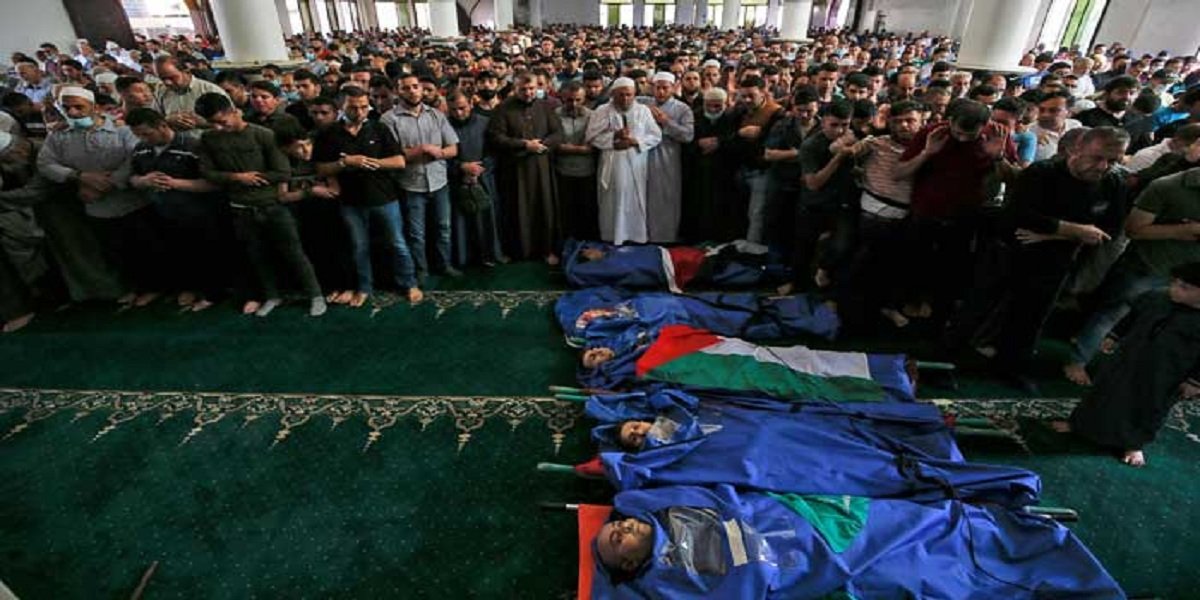
GAZA: Israeli airstrikes on civilian population in Gaza have took the death toll to 35 and tension and hostilities between Israel and Hamas heightened overnight.
Israel carried out hundreds of air strikes in Gaza on early Wednesday as militant fired multiple rocket barrages at Tel Aviv and Beersheba.
One multi-story residential building in Gaza collapsed and another was heavily damaged after they were repeatedly hit by Israeli air strikes.
Israel said its jets had targeted and killed several Hamas intelligence leaders early on Wednesday. Other strikes targeted what the military said were rocket launch sites and Hamas offices.
Read more: At least 28 Palestinians killed, scores injured in Israeli strikes: health ministry
It was the heaviest offensive between Israel and Hamas since a 2014 war in Gaza, and prompted international concern that the situation could spiral out of control.
UN Middle East peace envoy Tor Wennesland tweeted: “Stop the fire immediately. We’re escalating towards a full scale war. Leaders on all sides have to take the responsibility of de-escalation.
“The cost of war in Gaza is devastating & is being paid by ordinary people. UN is working w/ all sides to restore calm. Stop the violence now,” he wrote.
Into the early hours of Wednesday morning, Gazans reported their homes shaking and the sky lighting up with Israeli attacks, outgoing rockets and Israeli air defence missiles intercepting them.
Israelis ran for shelters or flattened themselves on pavements in communities more than 70 km (45 miles) up the coast and into southern Israel amid sounds of explosions as interceptor missiles streaked into the sky.
In the mixed Arab-Jewish town of Lod, near Tel Aviv, two people were killed after a rocket hit a vehicle in the area. Israeli media reported one was a 7-year-old girl.
Hamas’s armed wing said it fired 210 rockets towards Beersheba and Tel Aviv in response to the bombing of the tower buildings in Gaza City.
For Israel, the militants’ targeting of Tel Aviv, its commercial capital, posed a new challenge in the confrontation with the militant Hamas group, regarded as a terrorist organisation by Israel and the United States.
The violence followed weeks of tension in Jerusalem during the Muslim fasting month of Ramadan, with an attack by Israeli police on Palestinian worshippers in and around Al-Aqsa Mosque, on the compound revered by Jews as Temple Mount and by Muslims as the Noble Sanctuary.
These escalated in recent days ahead of a – now postponed – court hearing in a case that could end with Palestinian families evicted from East Jerusalem homes claimed by Jewish settlers.
Violence has also flared in the occupied West Bank, where a 26-year-old Palestinian was killed by Israeli gunfire during stone-throwing clashes in a refugee camp near the city of Hebron.
There appeared no imminent end to the violence. Israeli Prime Minister Benjamin Netanyahu warned that militants would pay a “very heavy” price for the rockets, which reached the outskirts of Jerusalem on Monday during a holiday in Israel commemorating its capture of East Jerusalem in a 1967 war.
The outbreak of hostilities led Netanyahu’s political opponents to suspend negotiations on forming a coalition of right-wing, leftist and centre-left parties to unseat him after an inconclusive March 23 election.
Opposition leader Yair Lapid has three weeks left to establish a government, with a new election – and another chance for Netanyahu to retain power – likely if he fails.
The Arab League, some of whose members have warmed ties with Israel over the last year, accused it of “indiscriminate and irresponsible” attacks in Gaza and said it was responsible for “dangerous escalation” in Jerusalem.
Hamas named its rocket assault “Sword of Jerusalem”, seeking to marginalise Palestinian President Mahmoud Abbas and to present itself as the guardians of Palestinians in Jerusalem.
The militant group’s leader, Ismail Haniyeh, said Israel had “ignited fire in Jerusalem and Al-Aqsa and the flames extended to Gaza, therefore, it is responsible for the consequences.”
Haniyeh said that Qatar, Egypt and the United Nations had been in contact urging calm but that Hamas’s message to Israel was: “If they want to escalate, the resistance is ready, if they want to stop, the resistance is ready.”
Read more: 22 Palestinians, including 9 children, killed in Israeli air strikes