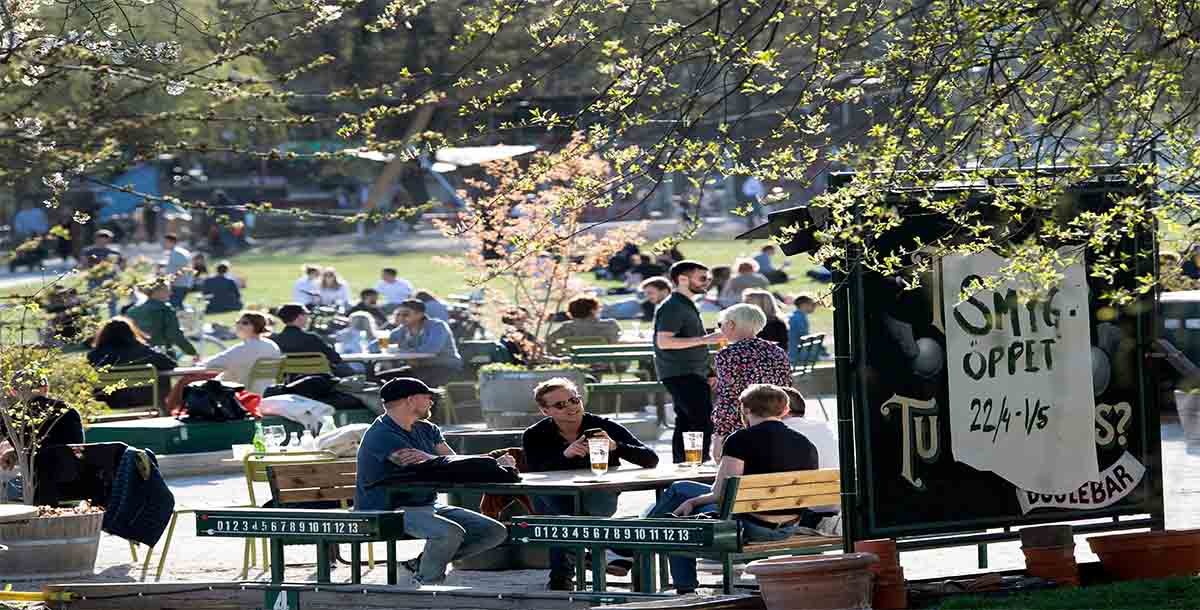
During this current pandemic, not all countries have decided to go for a lockdown policy. The prime example would be the Scandinavian nation of Sweden. Despite no serious lockdown, it would be folly to assume that the policymakers in Stockholm are taking this pandemic lightly.
On the 1st, of February, the Swedish government declared that the pandemic poses a grave risk to the well-being and health of the public. It then further set out six aims and objectives, them being:
- Limit the spread of infection in the country.
- Ensuring that the health and medical resources are available in the country.
- The limitation of the impact on critical key services.
- The alleviation of impact on people and businesses.
- The easing of concern.
- Finally, the implementation of the right thought-out measures.
Despite these early concerns, Sweden has gone for very light restrictions. Most countries have gone one of two ways, either suppression or complete lockdown. Sweden has gone for a third radical way of no lockdowns.
This is not to say that no action was taken, on the contrary, secondary schools were closed and all public gatherings of more than fifty individuals were also banned. The government also urged its citizens to avoid travel, work from home, and encourage social distancing. Defending the actions of the Swedish government, Johan Carlson, the head of the Swedish Public Health Agency issued a statement saying, ” Sweden cannot take draconian measures that have a limited impact on the epidemic, but knock out the functions of society.”
The Swedish approach was predominantly based on public trust in the government as well as the trust of the government in its people. The Chief Executive Director of the World Health Organization’s Emergency Program, Michael Ryan, stated in regards to Sweden,
“What it has done differently is, it is very much relying on its relationship with its citizenry. It has trusted in its communities to implement that physical distance.”
The question then arises, is the Swedish policy working?
Provisional figures for the first half of 2020 show that the Swedish economy has only had a contraction of -0.3%, far better than its neighbors. The Eurozone average has been -3.8%. For Italy, it has been -4.7%. -5.7% for Spain and -5.8% for France. That said, it is unlikely that Sweden will be able to avoid damage to its economy. The European Commission predicts a fall in GDP of -6.1% by the years’ end. Still far better than some of its neighbors.
That said, what do the figures tell about the health of the Swedish people in this pandemic? According to the figures provided by the John Hopkins Resource Center for Coronavirus, as of 18th. May 2020, Sweden has 30,377 confirmed cases and 3,698 deaths. Its neighbors paint a different picture, Norway and Finland have 8,257 and 6,380 confirmed cases respectively. Regardless of the immediate situation, Sweden is playing the long game.
It seems the policymakers in Stockholm have unofficially pursued a strategy of herd immunity, as they are well aware that globally, a second wave is inevitable. And hopes are that by then the Swedish population will have some level of immunity to the virus. But only time will tell.