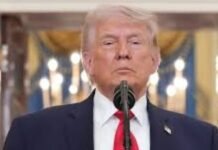

WASHINGTON: US President Donald Trump on Sunday announced a naval blockade of the Strait of Hormuz after the end of ‘Islamabad talks’, a move that immediately triggered a sharp warning from Iran’s Islamic Revolutionary Guard (IRGC), which vowed a “forceful response” to any hostile action.
As per the US Central Command (CENTCOM), the blockade will formally come into effect on Monday evening regional time, extending to Iranian ports and applying to vessels of all nationalities. However, ships travelling between non-Iranian ports will still be permitted to transit the waterway.
In a lengthy declaration on his social media platform, Trump stated his eventual goal was to clear the strait of mines and reopen it to all shipping, but that in the meantime Tehran must not be allowed to profit from its control of the waterway.
“Effective immediately, the United States Navy, the Finest in the World, will begin the process of BLOCKADING any and all Ships trying to enter, or leave, the Strait of Hormuz,” Trump said, threatening that any Iranian who fires at us, or at peaceful vessels, will be BLOWN TO HELL!
Following the Trump’s announcement, in response the Iran’s Revolutionary Guards warned they had traffic in the strategic waterway under their full control and would trap any enemy who tried to challenge it “in a deadly vortex”. The force’s naval command insisted that “contrary to the false claims of some enemy officials”, the Strait of Hormuz is “open to the harmless passage of civilian vessels in compliance with specific relevant regulations”.
The announcement came shortly after US Vice President JD Vance concluded talks in Islamabad with a senior Iranian delegation led by Parliamentary Speaker Mohammad Bagher Ghalibaf. The negotiations – the highest-level direct engagement between the two sides since the 1979 revolution – ended without a breakthrough, though Washington described its proposal as a “final and best offer”.
Also read:Most issues settled in ‘Islamabad Talks’, nuclear question still unresolved: Trump