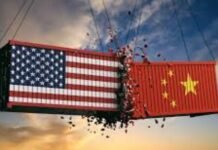

BEIJING: Economic experts hinted at emerging trade and business opportunities for Pakistan, following US-China trade war.
According to Nomura Securities strategists, Pakistan could potentially be the third most fortunate beneficiary in this feud, says a report published in China Economic Net.
Abdul Razzak Dawood, adviser to the prime minister, has also reported to have given a similar statement, “The trade war between China and the United States is getting bigger and bigger by the day… and the demand for goods is not declining (in the US market).
Pakistan needs to explore ways so that it can benefit from this war.” These controversial claims; however, have certain assumptions attached to them.
There are three possible ways that Pakistan can turn one of the greatest economic feuds into its favor and establish itself in the international market as a key player in world economics.
First of all, the high tariffs on the Chinese products in the US makes Pakistani exports more competitive in the US market.
It had always been very difficult to compete with Chinese products in any international market because of their low production costs due to cheap labor and economies of scale of Chinese firms.
However, the high tariffs have made these “cheap” Chinese product more expensive for the US buyers. Higher prices have led to a decrease in their demand. This has left a gap that can be potentially filled by alternative sellers in the US market such as Pakistan.
Ehsan Malik, Pakistan Business Council’s CEO, has also brought this to our attention by saying, “The US-China trade war has put Pakistan in an advantageous position and we have become more competitive than China in some areas like textiles.
It offers an opportunity for Pakistan to boost its exports to the United States as well as revive the closed manufacturing capacity (mostly in Punjab).” Engineering, textile, surgical tools, sportswear, plastics, footwear, fishery, packaging, pharma, kitchenware, furniture and jewelry are some of the types of Chinese products that have been subjected to the high US tariffs.
Out of these many Chinese products, Pakistan has the capacity to produce a substantial amount of these products as exports for the US market. Of course, the production of items from each of these categories will depend on the availability of resources to Pakistani industries. For example, Pakistan has a flourishing industry for sportswear products.
The tariff war between China and the US could lead to potential industrial growth and inflow of foreign investment into Pakistan. The Pakistan Business Council’s CEO, Ehsan Malik, is reported to have said that the Chinese manufacturers can ward off punitive tariffs on their exports to the United States by relocating their labor-intensive industries to Pakistan.
The US has put tariffs on Chinese products, I.e. products produced in China. Moving industries to Pakistan will be a trend in this case because of the recent economic goodwill established by CPEC. Such inflow of foreign investment would boost the economic growth of Pakistan as the national income of the country will increase.
These huge sums of foreign investment could lead to the establishment of Special Economic Zones in Pakistan. Establishment of these new industries will be closely linked to foreign investments in improving the infrastructure of the country to make long term production cost less.
Related: China wishes to expand scope of CPEC: Cheng Xizhong
The inflow of Chinese investment will only be the start of a very fruitful ripple effect, as more foreign investors will be attracted to set up industries in Pakistan. With Pakistan’s geographical location, it could become a hot spot for future investments from all over the globe.
The US-China trade war has given Pakistan a golden opportunity that if used wisely could be an economic leap in Pakistan’s history.
Pakistan could potentially end up with an increased amount of exports to the US, become a hot spot for international investments (especially from Chinese investors). However, certain economic and political limitations might put a dent in how well this opportunity can be explored.
Thus, what the Pakistani government should do is closely analyze all developments in the US-China trade war and make numerous alternative plans of action, keeping in mind the geographic, political and economic feasibility in mind. Then the best course of action can be taken.
What Pakistan should not do is make rash decisions by overestimating their own potential and underestimating their limitations. Similarly,
Pakistan should also not underestimate its potential and overestimate its limitations. It should tread carefully over one of the biggest economic feuds in history and try to benefit from it in the best possible way. (With additional input from INP)