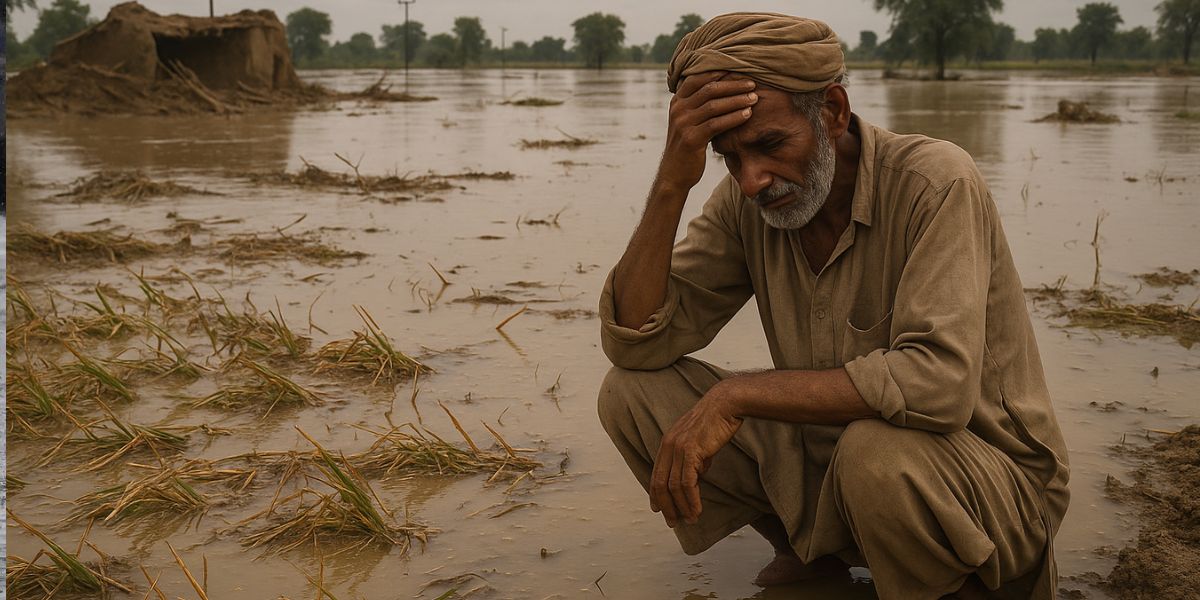
From Sialkot’s struggling fields to the deforested hills of Khyber Pakhtunkhwa, Pakistan’s farmers face another climate season with delayed aid, fading hope, and growing uncertainty about the future of agriculture.
The Water Recedes, But the Wounds Remain
The monsoon floods may have receded, but their muddy scars remain etched across Punjab’s plains and Khyber Pakhtunkhwa’s rugged slopes. What used to be golden fields of wheat and fodder now lie barren, scarred by silt and scattered debris. As the sun rises over the outskirts of Sialkot, farmer Tariq steps into his field, his boots sinking into the damp soil that once promised a good harvest.
“This land gave us everything — milk, wheat, vegetables — but now it only gives us loss,” he says, pointing to a patch of field where his cows once grazed. “The floods took half my livestock last year. The government came, took pictures, wrote reports, and left. We are still waiting for compensation.”
Months after the devastating floods swept through Punjab, Sindh, and Khyber Pakhtunkhwa, thousands of small-scale farmers like Tariq are still waiting for government assistance. With wheat cultivation season already underway, time is running out. The next few weeks are crucial for planting, but without seeds, fertilizer, or financial support, the future of Pakistan’s staple crop hangs in uncertainty.
The Race Against Time
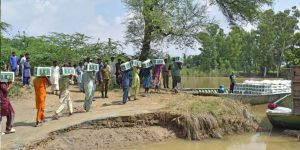
The Punjab government’s relief announcement, made in late August, brought a flicker of hope — promises of rehabilitation funds, seed subsidies, and loans for affected farmers. Yet, as October draws to a close, implementation remains painfully slow. In several tehsils across Sialkot, Narowal, and Hafizabad, local officials say the paperwork is “still under review.”
“Farmers can’t wait for paperwork,” said an agricultural expert at the University of Agriculture Faisalabad. “The sowing window for wheat is very limited — typically between October 15 and November 15. If aid arrives after that, it’s practically useless.”
For many, the wait has already become too long. Without support, farmers are borrowing money from informal lenders at interest rates as high as 20 percent. Others are selling their dairy animals — often their only source of steady income — to buy seeds and tractor fuel.
“It’s not just the loss of crops,” Tariq explained. “The floods destroyed our animal feed, our fodder, and our confidence. We can rebuild our houses somehow, but not our livelihoods.”
A Season Already Slipping Away
In villages near the Chenab River, the fields that should be buzzing with tractors are eerily quiet. The floodwater that submerged the land for weeks left behind thick layers of silt, making it difficult for tractors to plow. Even where the soil has dried, it has lost fertility due to waterlogging and contamination.
“Earlier, we used to start wheat sowing in the first week of November,” said Sajid, a farmer from Pasrur. “But this year, the land is still not ready. And without government help, it’s impossible to recover in time.”
The Punjab Agriculture Department claims it has distributed “some relief funds and input vouchers,” but farmers across central Punjab report delays and limited coverage. In reality, most affected areas have only seen assessment teams visiting once — with no follow-up.
Tariq’s Dilemma: “We’re Thinking of Leaving Farming Altogether”
For Tariq and many like him, the uncertainty is unbearable. Farming was not just a profession but a way of life passed down through generations. Now, with climate disasters hitting year after year, that heritage feels fragile.
“People are thinking to get out of agriculture and dairy altogether,” Tariq said. “Every year we rebuild, every year we lose again. Some farmers here are planning to build animal shelters 10 to 15 feet high just to save livestock from drowning next time.”
That kind of adaptation, though creative, comes at a cost. Constructing elevated sheds requires significant investment — something small-scale farmers cannot afford without support. Yet, it reflects a growing trend across Pakistan’s flood-prone zones: the desperate effort to adapt to a climate that no longer follows predictable patterns.
A Crisis That’s More Than Just Water
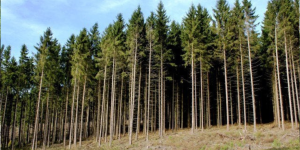
Pakistan’s agricultural crisis is not confined to floodplains alone. In the northern province of Khyber Pakhtunkhwa, deforestation continues unchecked, accelerating soil erosion and flooding. Hillsides once covered with pine and deodar are now bare, their soil loose and unable to absorb heavy rains.
“People in many KPK districts are still cutting trees at the same pace as before,” said a forestry official from Swat, requesting anonymity. “They don’t realize that these trees are their first defense against floods and landslides.”
The official added that despite repeated awareness drives, poverty often forces locals to continue cutting trees for firewood and construction. This, in turn, increases runoff during rainstorms, causing flash floods downstream in the plains.
The link between environmental neglect and agricultural disaster is clear. As glaciers melt faster and forests disappear, Pakistan’s rivers swell unpredictably, devastating communities that depend on them for irrigation and survival.
Delayed Relief, Diminished Hope
In several flood-hit areas of Punjab, government teams have been criticized for their slow response and poor coordination. Farmers who registered for relief claim they were never contacted again. Others say compensation amounts were too small to cover even basic replanting costs.
“We filled forms, stood in lines, gave CNIC copies — nothing happened,” said Khalid from Wazirabad. “They said we’d get cash in our mobile accounts. Weeks passed, but no message came.”
Officials from the provincial Disaster Management Authority (PDMA) admit that the verification process has slowed due to “overlapping reports and lack of district-level coordination.” But for those whose livelihood depends on days, not months, such bureaucratic bottlenecks could mean losing an entire year’s income.
“This is not just a relief issue — it’s a national food security issue,” said Dr. Farah Javed, a climate policy analyst based in Islamabad. “When farmers cannot sow wheat on time, Pakistan ends up importing it at higher prices. That affects everyone.”

Over the past decade, Pakistan has seen an increase in both the frequency and intensity of floods. Scientists attribute this to erratic monsoon patterns, rapid glacial melt, and poor land management practices. Yet, the country’s climate adaptation strategy remains slow to take shape.
“Adaptation in Pakistan is mostly reactive — we wait for disasters and then respond,” said Dr. Javed. “There’s no systematic long-term planning for climate resilience in rural areas.”
Farmers are beginning to notice the changes firsthand. They speak of shorter winters, hotter summers, and unpredictable rain. “The seasons are no longer what they used to be,” Tariq said. “Sometimes it rains when we’re harvesting, sometimes it doesn’t rain when we’re sowing. We don’t understand what’s happening anymore.”
From Desperation to Migration
The psychological toll of these recurring disasters is also visible. In some villages, young people are migrating to cities in search of non-agricultural jobs. Those who remain behind are mostly older farmers, struggling to sustain traditional ways of life.
“I’ve seen three floods in five years,” Tariq sighed. “My sons say we should leave this land and move to Lahore. But where will we go? Farming is all we know.”
Experts warn that this pattern could accelerate rural-to-urban migration, putting more pressure on already strained urban infrastructure. It also signals the gradual erosion of Pakistan’s agrarian identity.
A Landscape in Transition
Driving through the flood-hit belt between Gujranwala and Sialkot, one sees fields still littered with broken fences and water channels clogged with debris. Some farmers have started sowing wheat early with whatever seeds they could afford, hoping for a miracle. Others have simply left their land fallow, waiting for better days.
Amid all this, there are small signs of resilience. Community-led initiatives in a few villages have started building shared seed banks and storing animal feed for emergencies. Local NGOs are training farmers on flood-resistant crop varieties and soil restoration techniques.
But without government coordination, these efforts remain fragmented.

The Urgency of Action
What farmers across Punjab and KPK need most right now is timely intervention — not afterthought relief. Aid that comes after the sowing season is like rain after harvest: symbolic, but useless.
Immediate release of compensation funds, distribution of certified wheat seeds, and awareness about soil recovery techniques could make the difference between recovery and collapse. Longer term, investments in flood-resilient infrastructure, afforestation, and early-warning systems are essential.
“Climate change doesn’t wait,” Dr. Javed warned. “If we keep delaying our response, our rural economy will collapse faster than we can rebuild it.”
Racing Against Time
As dusk falls over Sialkot’s fields, the faint hum of a tractor echoes in the distance — one of the few still working the muddy land. Farmers know they are racing against time, against weather, and against bureaucracy.
“The floods have gone,” Tariq said, looking at the horizon, “but our fear hasn’t. If the government doesn’t act fast, this might be the last season for many of us.”
For now, Pakistan’s farmers continue their quiet struggle — between resilience and resignation — waiting for a government that seems to move far slower than the changing climate.