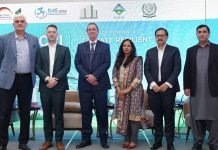
ISLAMABAD: In a landmark move to address the complex challenges of climate change and resource management, the International Water Management Institute (IWMI) unveiled three cutting-edge digital platforms at a national workshop in Islamabad. Held under the theme “Water, Energy, Food, and Environment (WEFE) Nexus Policy under a Changing Climate in Pakistan,” the event brought together policymakers, engineers, researchers, and climate specialists from across the country.
The digital tools—the Water Productivity Atlas, Water Body Inventory of Pakistan, and the Hydro-economic Model for the Indus Basin—aim to transform how Pakistan allocates and conserves its critical natural resources.
“These platforms will help the government plan more effectively using real-time data,” said Dr. Shezra Mansab Ali Khan Khara, Minister of State for Climate Change. “They promote transparency and support balanced decisions between competing sectors.”
A Systems Approach to a Systemic Problem
Pakistan stands at the crossroads of worsening climate vulnerability and increasing demand for water, food, and energy. The workshop, supported by the UK Foreign, Commonwealth & Development Office (FCDO) and CGIAR’s Science Program on Policy Innovations and Climate Action, emphasized the need to shift from siloed governance to an integrated systems approach.
“Water, food, energy, and the environment must no longer be treated as separate problems,” urged Dr. Mohsin Hafeez, Director at IWMI. “They are deeply interconnected, and our policies must reflect this reality.”
Data-Driven Dialogue: The CGE-W Model and Policy Foresight
The event also showcased new research under the banner “Policy to Plate: Climate-Smart Strategies for Water, Food & Nutrition Security in the Indus Basin,” led by IWMI and the International Food Policy Research Institute (IFPRI). Using the updated Computable General Equilibrium-Water (CGE-W) model, researchers demonstrated how strategic reductions in rice and sugarcane cultivation could free up as much as 10 million acre-feet (MAF) of water for higher-value uses by 2030.
Shifting acreage away from these water-intensive crops revealed promising gains in the production of vegetables, fruits, and cotton. Simulations also explored how tax policies and increased productivity could reduce the country’s dependence on imported edible oils.
“Import taxes alone don’t move the needle,” noted the researchers. “What really drives transformation is productivity—through better seeds, improved irrigation, and robust agricultural R&D.”
Bridging National Vision with Local Action
Officials from Punjab, Sindh, Balochistan, and Khyber Pakhtunkhwa shared how the new data tools could improve local planning and resilience. Many highlighted the growing pressure on water systems—exacerbated by regional tensions—and the urgent need for data-informed decision-making.
“These tools will guide us toward more efficient water use and resilient agricultural practices,” said Syed Ali Murtaza, Federal Secretary for the Ministry of Water Resources.
Anna Ballance, Senior Climate Lead at FCDO, emphasized the importance of inter-ministerial coordination. “We’re committed to building a climate-resilient Pakistan through programs like WRAP, which rely on data integration, institutional coordination, and capacity building,” she said.
A Beginning, Not an End
While the workshop marked the official launch of the tools, speakers stressed that real change would depend on continued use, collaboration, and policy reform.
“These innovations must become embedded in the government’s regular planning and investment cycle,” said Dr. Muhammad Ashraf, IWMI’s Country Representative in Pakistan.
Dr. Mark Smith, Director General of IWMI, concluded the event with a forward-looking message: “This is just the beginning of building a more informed, connected, and resilient policy environment for Pakistan.”
Tools Launched
• Water Productivity Atlas: Tracks agricultural productivity across different regions in relation to water use, helping identify where efficiency improvements are possible.
• Water Body Inventory of Pakistan: A geospatial database that maps and monitors the country’s rivers, lakes, and reservoirs to support water management and conservation efforts.
• Hydro-economic Model for the Indus Basin: A simulation tool that integrates hydrological and economic data to evaluate trade-offs in water usage and guide policy decisions.