
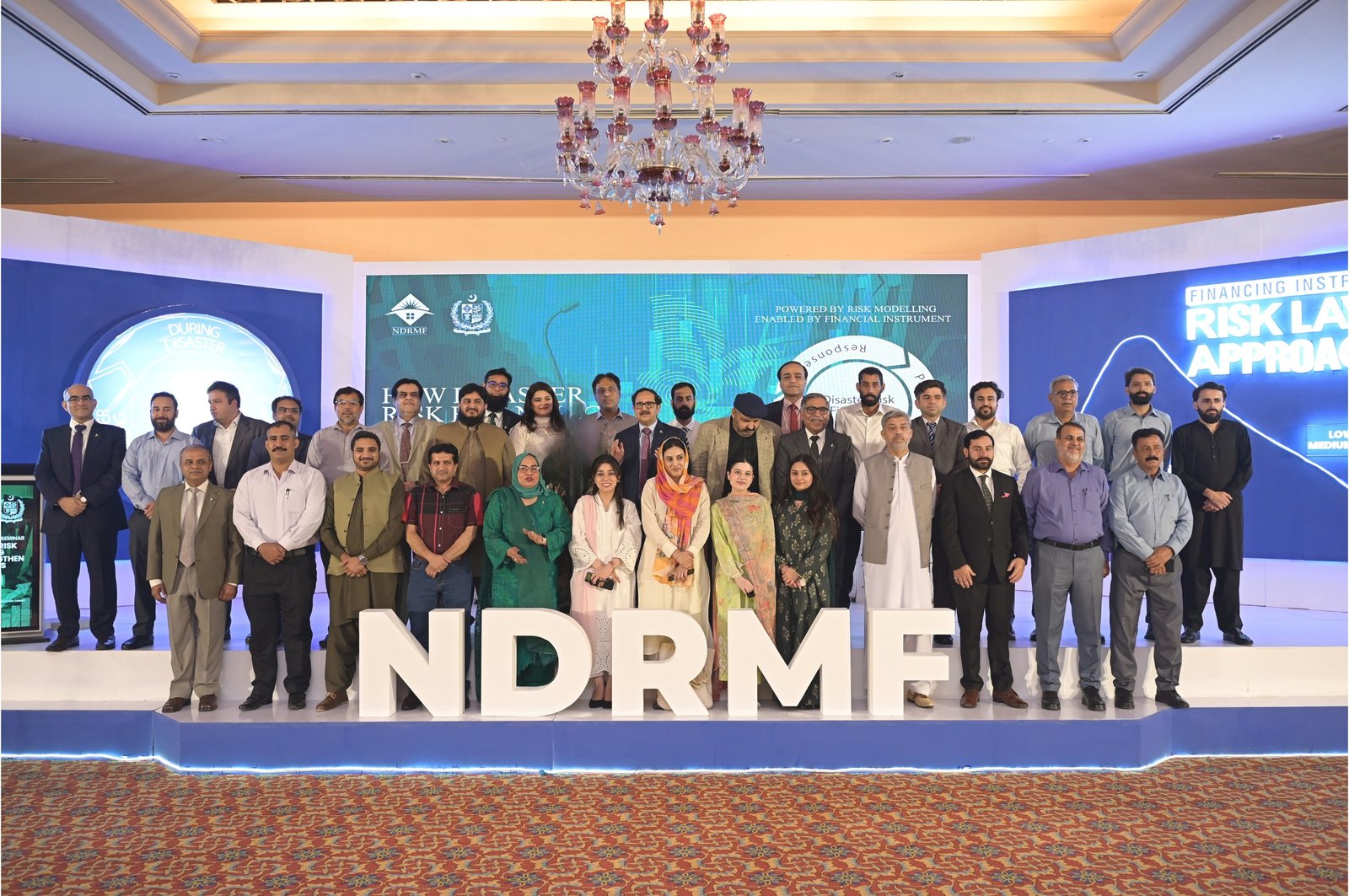
ISLAMABAD: Inside the Sheesh Mahal Hall at Serena Hotel, the chandeliers glittered as sunlight filtered through tall windows. The air hummed with the quiet anticipation of an audience that knew the stakes. Ministers, diplomats, economists, disaster managers, insurance executives, and climate specialists had gathered not to dwell on Pakistan’s past disasters — but to change the way the country faces the ones to come.
The occasion was the International Seminar on “Disaster Risk Financing (DRF) to Strengthen Pakistan’s Financial Resilience”, hosted by the National Disaster Risk Management Fund (NDRMF) under the Ministry of Planning, Development & Special Initiatives and the Ministry of Finance.
It was a day of numbers and narratives, of hard policy talk and hopeful visions, all centered on one truth: Pakistan’s climate challenges are no longer seasonal events, but a permanent condition.
Ahsan Iqbal: DRF as Pakistan’s National Insurance Policy
Professor Ahsan Iqbal, Federal Minister for Planning, Development and Special Initiatives, took the podium as Chief Guest and cut straight to the heart of the matter.
“Disaster Risk Financing,” he said, “is not just a funding mechanism for future catastrophes — it is Pakistan’s national insurance policy.”
Iqbal placed DRF firmly within the framework of URAAN-Pakistan, the country’s national transformation vision built on five pillars: exports, e-Pakistan, environment and climate change, energy and infrastructure, and equity and empowerment. DRF, he said, “by design and necessity, cuts across all five.”
Without resilience, he warned, there can be no sustainable growth, without financial preparedness, no secure future. And Pakistan’s climate vulnerability is not theoretical. “This year, Pakistan has been ranked the most climate-vulnerable country in the world,” he reminded the audience.
A Catalogue of Hard Lessons
The minister’s words traced a sobering history: the 2005 earthquake, the 2010 super floods, and destructive floods in 2011, 2014, 2020, and 2022 — each inflicting billions of dollars in damage and uprooting millions of lives.
He drew attention to Pakistan’s northern glaciers, the source of 75% of its river water, now melting at alarming rates — a fact underscored by the United Nations’ declaration of 2025 as the International Year of Glacial Preservation. Erratic monsoon patterns and glacial lake outburst floods, he warned, are no longer distant threats.
For decades, Pakistan’s disaster recovery depended on the public exchequer and international aid. While these “critical lifelines” helped in the past, Iqbal said, they are neither sustainable nor timely. “This reactive approach is not fit for the future. We must shift from reaction to readiness, and from fragility to resilience.”
The Promise of Proactive Financing
A strengthened DRF, the minister explained, would ensure immediate availability of resources after disasters, enabling targeted relief and reconstruction within days, not months.
He acknowledged the NDRMF’s leadership in building tools like the National Catastrophe Risk Model (NatCat), integrating risk into public investment frameworks, and exploring innovative instruments like insurance, contingent credit, and risk-layering. “We are making meaningful progress,” he said, pledging full implementation of the seminar’s recommendations.
His closing ambition was bold: transforming Pakistan into a $1 trillion economy by 2035 — a future, he stressed, that depends on resilience as much as growth.
A Provocative Question from Keynote
If Ahsan Iqbal provided the national vision, Arup Kumar Chatterjee, Unit Head for Capital Markets and Insurance at the Asian Development Bank, provided the challenge.
“What if Pakistan had a $500 million Disaster Risk Buffer in place before the 2022 floods?”
That question framed the entire day’s discussions. Chatterjee compared DRF to a fire extinguisher — “ready, reliable, and rapid” — and laid out the layered DRF approach:
• Budget reserves for frequent, low-impact events.
• Contingent credit lines for medium-scale disasters.
• Insurance or catastrophe bonds for rare, high-impact shocks.

Beyond Budgets: Trust, Technology, and Inclusion
Chatterjee emphasized that DRF is more than fiscal architecture; it’s a social contract. “Even the best tools fail without trust,” he cautioned. Strong institutions, inclusive design, and community engagement are essential for DRF to work.
He championed technology — mobile payouts, digital platforms, satellite monitoring — as well as inclusion, from micro-insurance for farmers to gender-responsive financing. DRF, he said, must secure not just assets but “food, incomes, and dignity.”
Pakistan’s Blueprint for Resilience
At the core of the seminar was the unveiling of the 10-Year Disaster Risk Financing Strategy (2024–2034). Developed by NDRMF with government guidance, the strategy integrates DRF into national fiscal planning, adopting a risk-layering model to match funding tools to disaster severity.
Its twin engine is the NatCat Model, a first-of-its-kind probabilistic catastrophe risk tool built with SUPARCO. Covering nine major hazards, it uses spatial data to calculate potential losses, set insurance premiums, and guide investments in risk reduction.
Other Voices of the Day
• Bilal Anwar, CEO of NDRMF, noted that Pakistan has lost over $50 billion to climate-induced disasters in the past 20 years, over 10% of GDP, and said the deeper human costs often go unmeasured.
• Xiaoqin Fan, ADB Country Director, commended Pakistan for being the first in Asia — and second globally — to complete the Global Shield Against Climate Risks process.
• Samuel Rizk, UNDP Resident Representative, stressed the need for community-based and gender-inclusive approaches.
• Amjad Ali, DG SUPARCO, showcased how satellite technology can improve risk assessment and early warning systems.
• Abid Sulehri, Executive Director of SDPI, reminded that no DRF strategy can work without credible, verifiable data.

Panels: Converting Vision into Action
Three panel discussions explored:
1. Challenges in Financing Disaster Resilience — institutional gaps, market readiness, and low insurance penetration.
2. Current DRF Initiatives and Lessons Learned — micro-insurance pilots, sovereign risk pools, and donor partnerships.
3. Way Forward — Sovereign & Market-Based Instruments — from catastrophe bonds to integrating DRF into national budgets.
Experts from the World Bank, SECP, GIZ, Pakistan Microfinance Network, and Climate Change Authority shared global best practices and local solutions.
A Closing Note of Hope
In his final words, Chatterjee returned to the human side of resilience:
“Hope is the essence of resilience. Despair dims knowledge, but faith and optimism empower nations to rise, rebuild, and lead.”
That sentiment echoed through the hall — a reminder that while DRF is a technical framework, its ultimate purpose is profoundly human: protecting lives, livelihoods, and the nation’s future.

From Victim to Vanguard
If the 2005 earthquake and the 2010 and 2022 floods were painful lessons in reactive disaster management, the 2025 DRF seminar marked a turning point — a bid to shift Pakistan from victimhood to leadership in climate resilience.
By marrying data with discipline, finance with foresight, and policy with people, Pakistan is preparing not just to endure the next storm — but to meet it ready, resilient, and resolute.