President Donald Trump’s decision to impose a naval embargo on sanctioned Venezuelan oil tankers marks one of the most dramatic escalations in US–Latin America relations in decades. Framed as a national security response to drug trafficking — after the administration classified fentanyl and its precursors as “weapons of mass destruction” through an executive order — the move signals a fundamental shift from counter-narcotics cooperation to maritime coercion. While officially described as a limited action targeting sanctioned vessels, the practical effect resembles a partial blockade, carrying economic, geopolitical and humanitarian consequences far beyond its stated purpose.
Had the United States extended this naval action to all Venezuelan shipping, it would have amounted to a de facto declaration of war. Even in its current form, the message is unmistakable: Washington is prepared to use sea power to choke Venezuela’s primary economic lifeline — oil exports — under the banner of law enforcement. Caracas, unsurprisingly, responded by ordering its navy to escort oil tankers through territorial and international waters, asserting sovereignty through symbolism rather than strength.
The imbalance is stark. Venezuela’s modest naval capabilities — largely coastal patrol vessels and a handful of ageing combatants — cannot be meaningfully compared with the global reach of the US Navy, with its aircraft carriers, nuclear submarines, destroyers and unmatched logistical infrastructure. The escort order is not about deterrence; it is about dignity and survival.
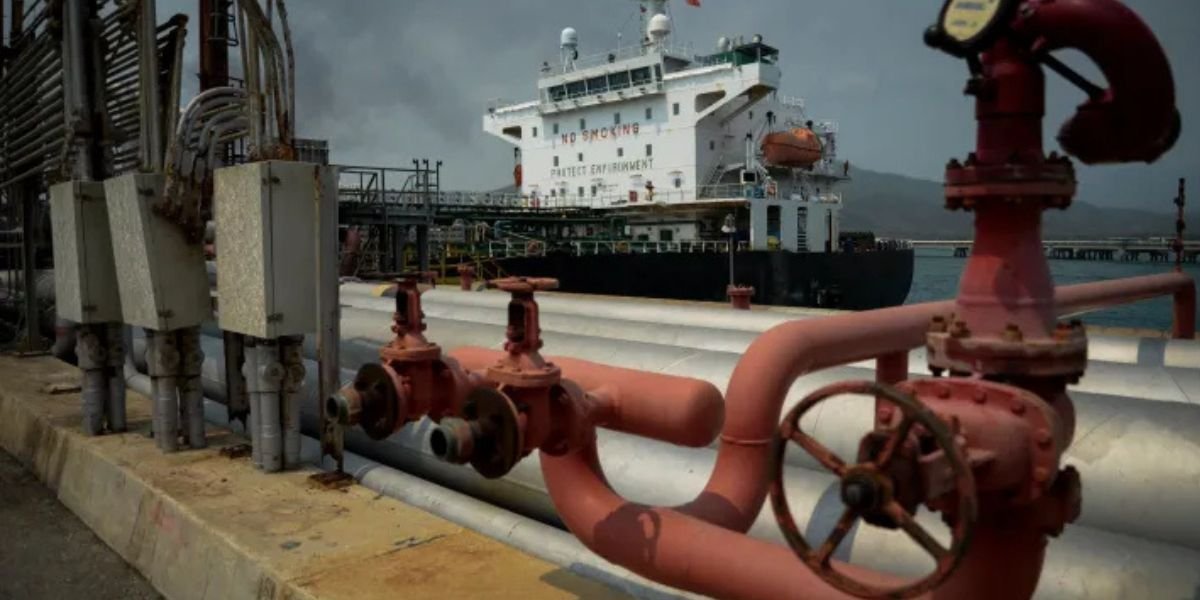
The real battlefield, however, is not the Caribbean Sea but the global energy market. By late 2025, Venezuela was exporting roughly 900,000 barrels of oil per day — its highest level in years following partial sanctions relief and creative logistics. Around 70–80 per cent of this oil moved through a shadow fleet: ageing tankers, opaque ownership structures, ship-to-ship transfers and insurance arrangements designed to bypass sanctions. US enforcement has now focused precisely on this network. More than 30 tankers operating around Venezuelan waters are already sanctioned, and the fear of seizure has caused many loaded vessels to remain anchored, unable — or unwilling — to sail.
This paralysis matters. If even two-thirds of Venezuela’s exports are disrupted, roughly 600,000 barrels per day could be removed from the global market. On paper, that represents less than one per cent of global supply. In reality, oil prices are driven not by averages but by expectations and risk premiums. Markets respond sharply to uncertainty, especially when shipping routes become contested. Even modest disruptions can trigger disproportionate price movements, particularly for import-dependent economies. A sustained squeeze could force Venezuela to shut in production due to storage constraints, turning a logistical problem into structural collapse.
The consequences would not stop at oil prices. Venezuela’s economy remains overwhelmingly dependent on crude exports. Further strangulation of this sector would reduce state revenues, weaken the currency, worsen inflation and deepen shortages of food and medicine. The burden would fall not on political elites but on ordinary citizens already exhausted by years of crisis.
History offers a grim forecast: economic collapse fuels migration. Venezuela has already produced one of the largest displacement crises in modern history, with nearly eight million people leaving the country over the past decade. Another severe shock could push hundreds of thousands more onto regional migration routes — first into neighbouring states, then northward towards the United States.
Ironically, the very policy justified as a defence of American security may intensify pressures on US borders. Colombia, already hosting millions of Venezuelan migrants, lacks the capacity to absorb another wave without destabilisation. Other regional economies, strained by inflation and debt, would struggle as well. Migration does not occur in isolation; it cascades.
Geopolitically, the naval embargo accelerates Venezuela’s alignment with US rivals. Russia and China have condemned the move, framing it as a violation of sovereignty and maritime norms. While neither is likely to engage militarily, diplomatic, financial and logistical support to Caracas could deepen, transforming Venezuela into another node in a growing network of states resisting US pressure.
Even traditional US partners are uneasy. Canada and several Latin American countries, themselves affected by trade disputes and tariffs, see the normalisation of gunboat diplomacy as a dangerous precedent. Rather than strengthening alliances, Washington risks reinforcing the perception that it creates more enemies than partners.
This raises a fundamental question: does maritime coercion actually reduce drug trafficking into the United States? Evidence suggests otherwise. The narcotics trade is demand-driven. As long as millions of Americans consume cocaine, fentanyl and other drugs, suppliers will find routes — by sea, land, air or digital networks. Interdiction may raise prices temporarily, but it rarely eliminates supply. Instead, it increases profitability, incentivising smugglers to innovate and diversify.
The United States has alternatives — more effective, less destructive and more humane. The first is demand reduction. Large-scale investment in prevention, education and treatment can shrink the market that fuels trafficking. Decades of research show that public health approaches are more cost-effective than interdiction alone. Recent declines in overdose deaths, though fragile, demonstrate that progress is possible without militarisation.
The second option is dismantling domestic trafficking infrastructure. Drugs rely on financial networks, logistics hubs, corrupt intermediaries and money-laundering systems operating within US borders. Aggressive enforcement against these networks, combined with financial transparency and asset seizures, would strike at the heart of the trade without destabilising foreign societies.
The third is smarter border security integrated with humanitarian policy. Borders can be controlled without turning neighbouring countries into failed states. Technology, intelligence sharing and legal migration pathways reduce chaos far more effectively than economic strangulation abroad.
By contrast, collapsing Venezuela’s economy would likely increase, not decrease, drug flows over time. Unemployment and desperation are fertile ground for illicit activity. When formal economies implode, informal and criminal ones expand. Smuggling becomes not just profitable but necessary for survival. The result is a vicious cycle: sanctions breed collapse, collapse breeds crime, crime justifies further sanctions.
At its core, the naval embargo reflects an old reflex dressed in new language. The rhetoric has changed — from communism to drugs, from ideology to security — but the method remains coercion. History warns where this path leads. Iraq was once sanctioned into ruin in the name of global safety; the outcome was regional instability, humanitarian catastrophe and long-term insecurity.
Sovereignty is not a privilege reserved for powerful states. Smaller and weaker nations possess it as well, along with the right to economic survival. Using drug smuggling as a pretext to weaponise hunger, unemployment and migration risks undermining the very international order the United States claims to defend.
If Washington’s objective is fewer drugs, fewer refugees and a safer hemisphere, it must look inward as much as outward. Gunboats can seize tankers, but they cannot cure addiction. Blockades can choke economies, but they cannot build stability. Real security lies not in dominating seas, but in addressing the human systems — demand, inequality and governance — that drive crisis in the first place.
The choice before the United States is not between strength and weakness, but between wisdom and repetition. History is watching.