
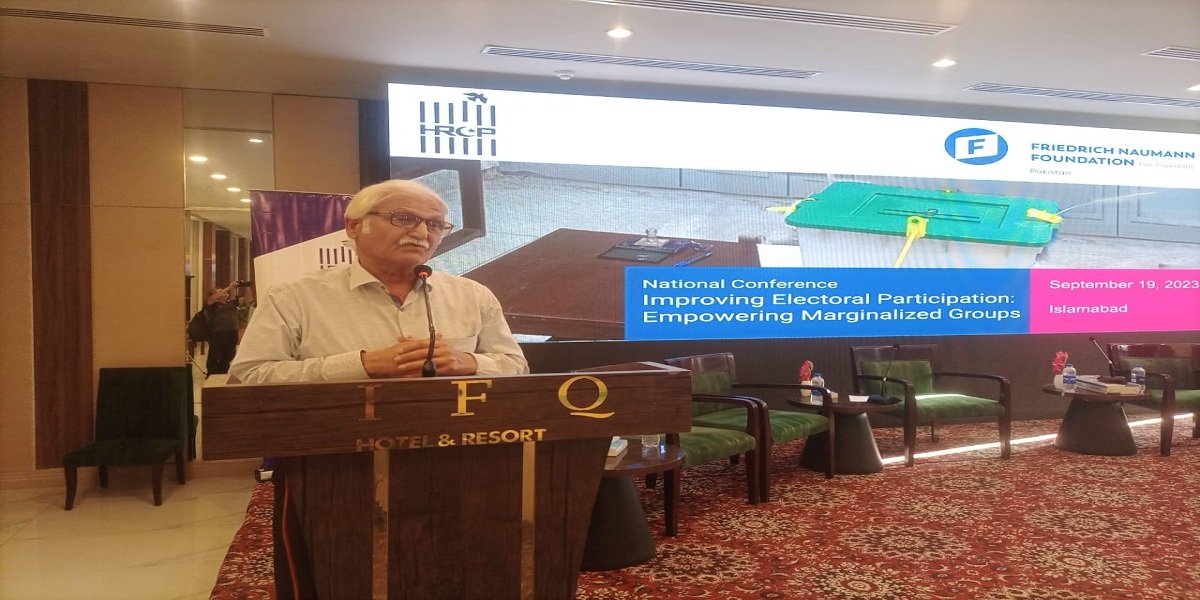
ISLAMABAD: Human Rights Commission of Pakistan (HRCP), has called for extensive reforms to improve the political and electoral participation of marginalized groups, including women, transgender persons, people with disabilities and religious minorities.
These were the unanimous views of participants of the national conference jointly organized by HRCP and Friedrich Naumann Foundation for Freedom – Pakistan (FNF).
In his welcome address, HRCP secretary-general Harris Khalique emphasized that all marginalized groups must be brought into the political mainstream to move towards empowerment. He also underscored the necessity of a level playing field for voters as well as candidates.
Birgit Lamm, head of FNF’s Pakistan office, introduced the conference by highlighting the importance of free and fair elections to underpin the legitimacy of governments.
In the first session, Ahmadiyya community representative Amir Mahmood highlighted the faith-based discrimination embedded in separate voters’ lists for Ahmadis, undermining their right to vote on the basis of citizenship.
Transgender rights activist Dr Mehrub Moiz Awan said that electoral participation for marginalized groups must be grounded in genuine solidarity rather than in the politics of sympathy.
Former speaker of the Balochistan Assembly Rahila Durrani recommended special political academies to empower women to contest general elections and encourage political engagement.
In the second session, former HRCP chairperson Afrasiab Khattak shed light on the duality in Pakistan’s constitutional and legal frameworks regarding marginalised groups, whereby the principle of equality is contradicted by laws that undermine it.
Researcher Dr Naazir Mahmood expanded on the role of educational curriculums in peddling skewed perspectives of Pakistan’s political history, thus steadily depoliticising the electorate.
Discriminatory laws must also be revoked, and constitutional guarantees instituted for marginalized groups to be adequately represented in parliament.
The panelists agreed that linking the right to vote with the possession of national identification cards effectively disenfranchises marginalized groups by shifting the burden of responsibility from the state to citizens.
Peshawar High Court lawyer Sangeen Khan recommended progressively increasing the minimum 10 per cent stipulation of women’s votes in a constituency’s total polled votes, compelling political parties to increase women’s representation in their own ranks to secure more votes.
Checks and balances must also be imposed to ensure the 5 per cent quota for women legislators is not misused.
In the final session, the panelists discussed the impact of elite capture on marginalized citizens.
Academic Dr Asim Bashir Khan pointed to the indirect gerrymandering of constituencies through overinflated population figures, effectively discounting constituents’ interests.
Ewajee Alliance chair Sana Durrani and former finance minister Aisha Ghous Pasha also recommended extensive political reforms and a new social contract that safeguards citizens’ rights.
In his concluding address, HRCP Council member Farhatullah Babar criticised the depoliticisation of the electorate, stating that the demonisation of politics had effectively diminished the political will to engender change. Reforms must be brought about by politically engaged young activists, he said.
Read more: Cash-starved Pakistan gets ready for bumper cotton crop