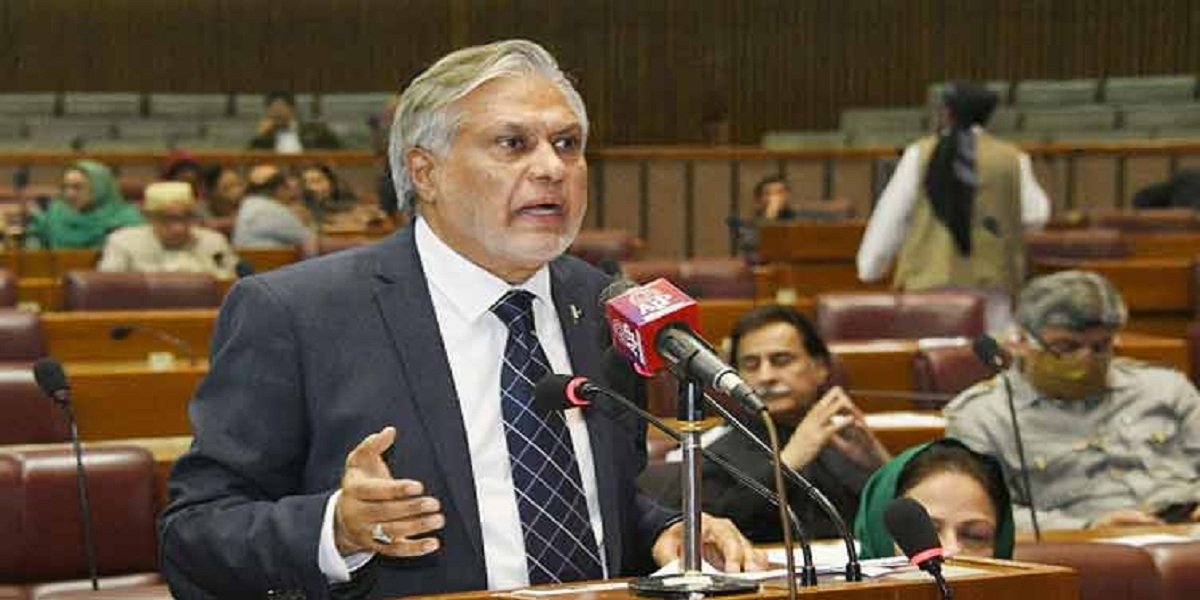
ISLAMABAD: Amid ongoing political and economic crises, Finance
Minister Ishaq Dar on Friday tabled the federal budget for fiscal
year 2023-24 with an estimated outlay of more than Rs14.4 trillion
The federal budget drafted cautiously by the coalition government,
which is caught between the hard place of fiscal reforms and the rock
of International Monetary Fund’s (IMF) un-populist terms, with a
total outlay of over Rs14.5 trillion months ahead of elections.
The federal budget has been formulated while considering the
existing challenges being faced by the economy at domestic and
international fronts.
Finance Minister Ishaq Dar while presenting the second budget of the
Pakistan Democratic Movement (PDM) Government, which came
into power in April last year, returned to the podium to announce the
federal budget after a hiatus of five years.
At the outset of his budget speech, which began after a delay of
almost two hours, the finance minister recalled that the country
was “headed towards” economic prosperity during the Pakistan
Muslim League-Nawaz’s (PML-N) previous government.
However, he said, a “conspiracy” was hatched against then-prime
minister Nawaz Sharif and the Pakistan Tehreek-e-Insaf (PTI) was
“installed” as the country’s ruling party.
Because of the PTI’s “dismal governance” during its nearly four-year
tenure, the finance minister said, the country was now facing one of
the “worst economic crises”.
Government has earmarked Rs1,150 billion for annual development
programme and Rs1,800 billion for defense. The levy on petroleum
products may be increased.
Under the fiscal year 2023-24 budget the salaries of Government
employees of Grade1-16 have been increased by 35 per cent and
Grade 17-22 as much as 30 per cent. Offering relief to the retired
government servants, the finane minister announced 17.5 per cent
increase in pensions.
The finance minister in his speech stated that Rs7,300 billion have
been allocated for paying debts and loans and Rs1,300 billion for
subsidies.
The tax collection target for the Federal Board of Revenue (FBR) is
Rs9,200 billion and for non-tax revenue is Rs2,800 billion.
Hence, mitigating people’s sufferings, transforming agriculture
sector, promoting Information Technology (IT), boosting exports,
promoting industrial growth and bolstering businesses, would be the
main focus of the document, the finance minister revealed.
On the revenue side, the government would introduce measures for
bringing improvements in the system of tax collection, broadening
the tax base, and facilitation to tax-payers.
Keeping in view the robust growth of revenues during the current
fiscal year (2021-22), the government is likely to set the revenue
collection target at over Rs9 trillion for the fiscal year 2023-24.
The government is firmly committed to presenting a pro-people,
business-friendly and progressive Federal Budget FY 2023-24. It
will pursue policies aimed at fiscal consolidation to contain budget
deficit.
The finance minister in the floor of house mentioned that the country
faced numerous internal and external challenges over the last year.
Still, the government upped its efforts and tried to provide relief to
the people.
He also mentioned that although the nation suffered massive losses
of $30 billion due to unprecedented floods, the government is
bidding to resume the IMF programme and take the country on the
road of development.
“We have completed all the prerequisites of the ninth IMF review […]
we are hoping to reach an agreement with the IMF,” the minister told
the members of the lower house.
In addition to fiscal management, revenue mobilization, measures
for economic stabilization and growth, reduction in non-
development expenditures, job creation and people-friendly policies
for the socioeconomic prosperity of the country, would feature in the
budget.
Current account deficit
Pakistani economy’s second major problem is the current account
deficit, which he said, swelled to $17.5 billion during the fiscal year
2021-22.
The finance minister mentioned that due to the “prudent decisions of
the incumbent government” — majorly due to the import curbs —
the CAD has been reduced by 77% to $4 billion.
Likewise, he said, the trade deficit has been reduced by $21 billion.
“The threat of default has been averted due to the tough decision of the government and the fall in foreign exchange reserves has been slowed down,” the finance minister said.
Increasing remittances
The finance minister said remittances are a crucial part of foreign exchange reserves, representing 90% of the country’s exports.
In a bid to promote remittances through formal channels, the government has proposed the following steps:
Abolishment of 2% final tax on the purchase of immovable property.
Introduction of a “diamond card” for people sending over $50,000 — through which they can get one non-prohibited bore license, gratis passport, preferential access to Pakistani embassies and consulates, fast-track immigration at Pakistani airports, special prizes through draws.
Education
Highlighting the importance of education, the finance minister said that although this falls under provincial jurisdiction, the federal government always plays its part.
For the Higher Education Commission (HEC), the federal government has proposed an allocation of Rs65 billion under the current expenditure, while Rs70 billion have been allocated for under the development expenditure.
It was also revealed that Pakistan Endowment Fund would be established for the financial aid of the sector, for which Rs5 billion have been allocated in the budget.
Meanwhile, under the Prime Minister Laptop Scheme, the federal government has decided to distribute 100,000 laptops to merit-based deserving students, and for this, the cabinet has proposed to allocate Rs10 billion.
PSDP
The finance minister said that through the Public Sector Development Programme (PSDP), the government proposed an allocation of Rs1,150 billion (including Rs200 from PPP) mode, while for the provincial programme, Rs1,559 have been proposed.
Salient features of the proposed allocation of PSDP:
80% partially completed projects will be prioritised.
52% PSDP allocated for attracting foreign direct investment.
For balanced growth among various cities, Rs108 billion have been allocated.
Moreover, the government has decided to pay special attention to the projects in Balochistan.
Construction
Dar mentioned that the construction sector is vital in economic output.
And in order to incentivise the construction sector, Dar said the 10% or Rs5 million, whatever amount is less, will be charged on construction enterprise income.
Those individuals who will construct their own property will be given a 10% tax credit or Rs5 million for the next three years as part of the concessions to the construction sector.
Real Estate Investment Trust (REIT)-related tax exemptions have been extended till June 30, 2024.
Energy needs
The minister said Pakistan depends on imported fuel to meet energy requirements, and the government is determined to promote solar energy and the use of local coal.
Several measures have been proposed to meet the energy needs:
Coal-powered power plants have been instructed to use local coal.
Raw materials of solar panels, inverters, and batteries are being exempted from custom duties.
To resolve of issue of fuel shortage due to disruption in global fuel supply chain, “Bonder Bulk Storage Policy” is being introduced under which foreign suppliers using their own resources will import the fuel to store it in the fuel storage.
Refinery and oil marketing companies will be allowed to buy oil from the storage facility.
FBR figures
The finance minister said Rs7,200 billion are likely to be collected in tax revenue — and the provinces’ share would be Rs4,129 billion during the next fiscal year.
He said FBR is expecting to collect Rs1,618 billion from non-tax revenue, and federal tax collection will be Rs4,689, while total expenditure is estimated at Rs11,090 billion.
‘No new tax this year’
The Finance Minister also revealed that no new tax is being imposed this year, and all efforts were being made to provide relief to the masses.
He said the government was trying to increase employment opportunities and introduce policies to promote the ease of doing business.
Dar said industries and exports should be encouraged to play their part in increasing the country’s foreign exchange reserves.
he said imposing taxes on the rich is the leading principle of the taxation policy of the government, and the tax was imposed on high-earning individuals.
Besides, the 10% super tax was imposed on 15 businesses and sectors earning up to Rs150 million in the last budget, he added.
He said measures had been proposed to convert the super tax into progressive taxation by increasing its tax percentage.
Ministry of Finance has proposed the imposition of a 10% withholding tax on the bonus shares (in-kind dividend) as the finance minister said that some companies, in order to skip taxes, issue bonus shares instead of cash dividends.
Read more: Cabinet approves up to 35% raise in salaries, 17.5% in pensions amid trying times