
GAZA: Israeli Defence Forces (IDF) announced that ten of its soldiers were killed in battle with Hamas in a fierce battle in Southern Gaza amid reports that Israel’s spy chief proposed Hamas leaders leave Gaza as part of broader ceasefire talks as Israeli PM Netanyahu has been under immense pressure from domestic to stop the war for early hostages release along with the US insisting on the two-state solution in the wake of imminent post-war day.
Reports said that Israel has proposed that Hamas senior leaders could leave Gaza as part of a broader ceasefire agreement, two officials familiar with the ongoing international discussions.
The extraordinary proposal, which has not been previously reported, comes as Israel has struggled to achieve its stated goal of completely destroying Hamas. Despite its nearly four-month war in Gaza, Israel has failed to capture or kill any of Hamas’s most senior leaders in Gaza and left around 70% of Hamas’ fighting force intact, according to Israel’s own estimates.
Combat raged in Khan Yunis in the southern Gaza Strip on Tuesday, against a backdrop of negotiations aimed at bringing about a pause in fighting between Israel and Hamas in the absence of a long-term peace plan.
The Palestine Red Crescent Society said early Tuesday that Israeli forces had targeted its headquarters in Khan Yunis “with artillery shelling on the fourth floor, coinciding with intense gunfire from Israeli drones, resulting in injuries among internally displaced individuals who sought safety on our premises”.
The UN humanitarian agency OCHA reported that “ground operations, fighting and attacks intensified” over the preceding day around the main southern city, with the Israeli army saying its forces had conducted multiple raids and taken control of Hamas command centres there.
The fierce fighting came as a White House official was due in the region for talks aimed at securing more hostage releases, and as US media reported a new Israeli proposal for a deal that would involve a two-month pause in fighting.
UN agencies and aid groups have sounded the alarm about the growing threat of disease and famine in Gaza, where 1.7 million people are estimated to have been displaced from their homes.
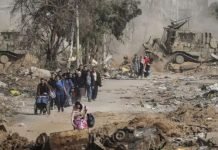
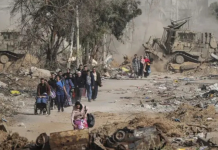
Abu Iyad, his belongings piled on a donkey-drawn cart, has said that he was moving for the seventh time, fleeing Khan Yunis for Rafah on the Egyptian border, where hundreds of thousands of displaced Palestinians have settled, many in makeshift tents.
“I’m heading to the unknown,” he said. “They told us to go to Rafah — where to go in Rafah? Is there any space left?”
Read more: Faiz Hameed denies allegations of influencing judiciary