
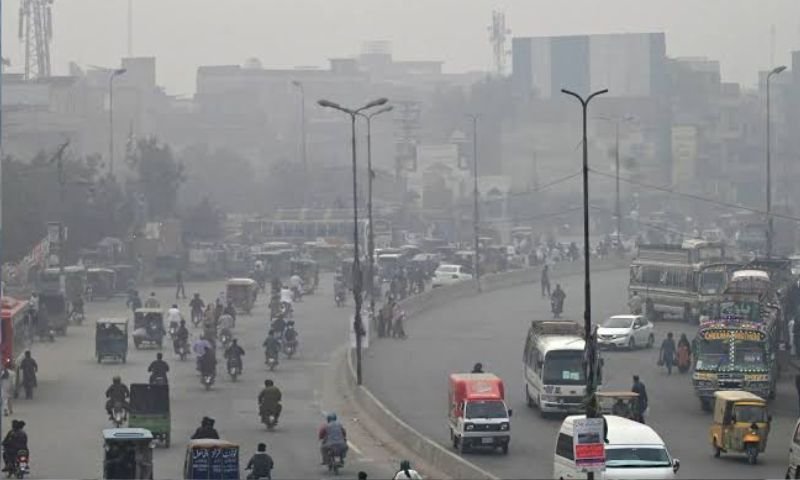
LAHORE: Air pollution worsened in the provincial capital on Monday, with the Air Quality Index (AQI) reaching 535 and fine particulate matter (PM2.5) rising to 343 micrograms per cubic metre at 8am, exposing millions of residents to hazardous air quality.
The reading, reported by IQAir and confirmed by the Punjab Environmental Protection Department (EPD), was among the most alarming pollution spikes recorded during the 2026 smog season.
Smog and air pollution also covered several parts of the city and its surrounding areas.
The deterioration was not confined to the provincial capital. IQAir’s live ranking of Pakistani cities on Monday morning placed five Punjab cities among the country’s six most polluted urban centres.
The situation was similarly concerning in other parts of the region. Gujranwala recorded an AQI of 606 in the morning, while Faisalabad and Multan each registered 310 and Sialkot recorded 260. Lahore also ranked as the world’s most polluted major city in an early-morning snapshot by IQAir, although the international rankings fluctuated throughout the day.
Agricultural fires
The deterioration in air quality comes amid a significant rise in satellite-detected agricultural fires across Punjab.
According to an analysis published by environmental monitoring website HamariHawa, NASA satellites detected 13,241 fire hotspots in Pakistani Punjab between October 1 and 29, compared with 3,158 in Indian Punjab, around 4.2 times as many.
About 92 per cent of the detected hotspots in Pakistani Punjab were located on farmland and were likely linked to crop-residue burning.
Gap in reported improvements
Another concern was the gap between reported improvements in air quality and actual progress in reducing pollution levels.
A recent assessment by the Pakistan Air Quality Initiative (PAQI) found that average PM2.5 concentrations across 26 monitoring sites in Lahore fell by 27 per cent in October compared with the same month last year. However, its weather-adjusted analysis showed that the improvement attributable to factors other than weather was only around four per cent.
The assessment also found that PM2.5 concentrations had remained above Pakistan’s prescribed daily limit on every day of October.
The findings suggested that favourable atmospheric conditions had contributed substantially to the comparatively better air quality, rather than indicating a decisive structural reduction in pollution sources.
Pollution affects daily life
The pollution also affected everyday economic and social activities, including outdoor employment, school attendance, public transport and commercial operations.
Residents who spent long hours commuting on motorcycles or working on roads faced prolonged exposure to polluted air.
Environmental experts have repeatedly emphasised that controlling smog requires more than temporary restrictions and emergency operations.
Industrial emission monitoring, cleaner transport, effective construction dust management, restrictions on open waste burning, modernised brick kilns and alternatives to agricultural residue burning need to form part of a sustained strategy.
Also read:Ukraine evacuates 167 people from Kherson as local ceasefire expires