
“The war on Islam is a war on you,” declares Matthew Cooke, an American filmmaker, writer, and author of several books.
In his podcast, which has been watched by millions of followers and subscribers, he describes an “industrial-scale, billionaire-funded campaign” operating through advocacy, media, and political influence. He argues that hostility toward Muslims has been cultivated and amplified to the point that suspicion of an entire faith has become an accepted starting point for public policy.
According to his account, these efforts serve a broader political purpose: normalising hostility toward Palestinians and providing ideological cover for what he describes as Israel’s genocidal campaign in Gaza and the displacement of Palestinians from their homeland. The activities of the organisations involved can be scrutinised through their funding, public statements, campaigns, and legislative proposals targeting Islam and Muslim Americans.
There is documented evidence that organised advocacy against Muslims has received substantial financial support. The Center for American Progress’s report Fear, Inc. traced $42.6 million from seven foundations to organisations it identified as promoting Islamophobia between 2001 and 2009.
The report described networks connecting donors, advocacy groups, media figures, and political actors who helped circulate anti-Muslim messages. The broader warning is that money and institutional access can give prejudice a reach far beyond that of an isolated opinion.
The controversy in Oklahoma illustrates how such concerns have entered the political arena. In 2010, an amendment was approved that specifically sought to prevent Sharia law from being considered by state courts. The campaign has since extended beyond that controversy.
By June 2026, the Sharia-Free America Caucus, led by Representatives Keith Self and Chip Roy, claimed 68 members from 25 states. Senator Tommy Tuberville also participated in the caucus’s press conference in February.
An analysis published on October 8 counted 39 anti-Sharia proposals introduced during 2025 and 2026, with six measures passing in six states. On October 2, Representative Mike Simpson announced support for legislation targeting foreign nationals who observe Sharia. This political mobilisation portrays a small religious minority as a potential threat to constitutional government.
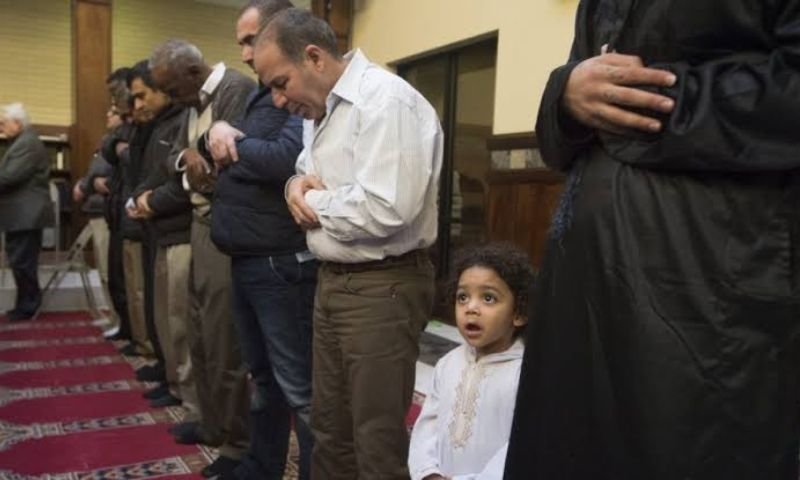
According to Pew Research Center, approximately 5.5 million Muslims live in the United States. Its 2026 research estimates that Muslims account for about 1.2% of American adults.
The scale of the political alarm raises a fundamental question: is there evidence of a corresponding threat? Meanwhile, the community portrayed as threatening faces substantial hostility itself.
In a 2026 survey, 59% of Muslim Americans said there was “a lot” of discrimination against Muslims. These findings direct attention towards the community’s security and equal citizenship—the everyday concerns that can be obscured by political warnings of a Sharia takeover.
This is why the opening declaration addresses every American. When fear of one community becomes a political instrument, shared citizenship suffers. Attention that should be directed towards public welfare, the cost of war, and government accountability is instead redirected towards suspicion of neighbours.
Cooke’s second argument concerns religious coexistence. He refers to “Umar’s Jerusalem,” “Saladin,” and “the Ottoman community system,” describing them as examples of administrations that guaranteed freedom of worship and religious practice. The historical lesson he draws is that Muslim rule included traditions of protecting Christian and Jewish religious life.
His description of Christianity is equally direct: “The Christian message is love and unity and peace between people.” He interprets Christian devotion through these obligations and challenges the idea that support for a government should be treated as a test of faith.
The moral principle is straightforward. Christians can respect Jewish religious freedom and care about Jewish lives while questioning military aid, territorial policies, civilian suffering, or the actions of the Israeli government. Such scrutiny can be part of moral responsibility.
The distinction between Judaism and Israel is therefore essential. Judaism is a religion with an ancient place in the Abrahamic tradition. Israel, by contrast, is a modern nation-state with a government, political parties, armed forces, and foreign policies.
Respect for Judaism means respecting the dignity, beliefs, and freedom of Jewish people. Support for an Israeli government concerns political decisions that citizens are entitled to assess, endorse, oppose, or seek to change.
The same standard applies to foreign influence in American affairs. Lobbying, campaign financing, financial relationships, and defence commitments all require public scrutiny based on evidence and American law.
Americans can question the influence of the Israeli government on United States policy just as they can question the influence of any foreign government. The focus should remain on the conduct of identifiable states and institutions. Maintaining this distinction makes public debate clearer while helping protect religious freedom.
Another American speaker describes his own change of perspective explicitly: “I don’t see Islam as a threat to the United States, and that’s what I was seeing it as.” His words describe a personal movement away from suspicion.
He redirects attention towards political relationships that affect American decisions and resources. Change begins when a familiar public voice is willing to distinguish inherited fear from a judgement that can withstand scrutiny.
Tucker Carlson’s own admission gives this reconsideration a personal dimension. Carlson is a prominent American political commentator and broadcaster with a large audience in the United States and internationally.
Recalling his former suspicions of Muslims, he said: “I was hysterical about Islam and Muslim and had a profound view that all Muslims are terrorists and they hate us.”
He then rejected the sweeping beliefs he had once accepted: “Now, that’s not true. Nothing about this is true. But I believed it.”
Carlson offers a principle by which such prejudice should be judged: “There are universal standards that apply to everybody.” This is the moral change at the centre of his testimony. People should be judged by their conduct according to standards that apply across religious and national boundaries.
His admission invites others to examine what they, too, may have absorbed without sufficient understanding.
Other podcasters and online commentators, including Tucker Carlson, Sarafino Fazio—widely known online as SonnyFaz—and Bek Lover, host of The Bek Lover Podcast, have discussed connections between Islamic and Christian beliefs. They have highlighted that Muslims revere Jesus as the Messiah and a messenger of God, believe in his miraculous birth, and honour Mary.
The Quran recognises the Torah and the Gospel as divine revelations and describes the Gospel given to Jesus as containing guidance and light. These teachings give Christian audiences substantial reasons to approach Islam with interest and respect.
The podcasters also explored another connection through a direct question: “Muslims believe Jesus is coming again?” The answer was immediate: “They do.” Mainstream Islamic teaching anticipates the return of Jesus, a belief explicitly described in hadith literature.
For Christian audiences unfamiliar with Islam, this discovery can change the starting point of the conversation. Jesus and Mary already occupy places of profound reverence within the faith they are being invited to understand.
For years, I have believed that familiar and influential Western voices could help communicate these connections to audiences otherwise reluctant to listen. The testimonies discussed here give that hope a human dimension.
Some Americans are challenging hostility towards Islam, defending freedom of worship, and questioning the conversion of religious devotion into political obedience.
Traders who travelled to Malaysia and Indonesia are often remembered for helping make their faith understood through their conduct. These American speakers are helping make Islam more intelligible through explanation and public self-examination.
I see the light of Islam warming American souls wherever such encounters replace inherited suspicion with knowledge, foster respect for a neighbour’s faith, and bring the shared demands of mercy, justice, and peace into clearer view.