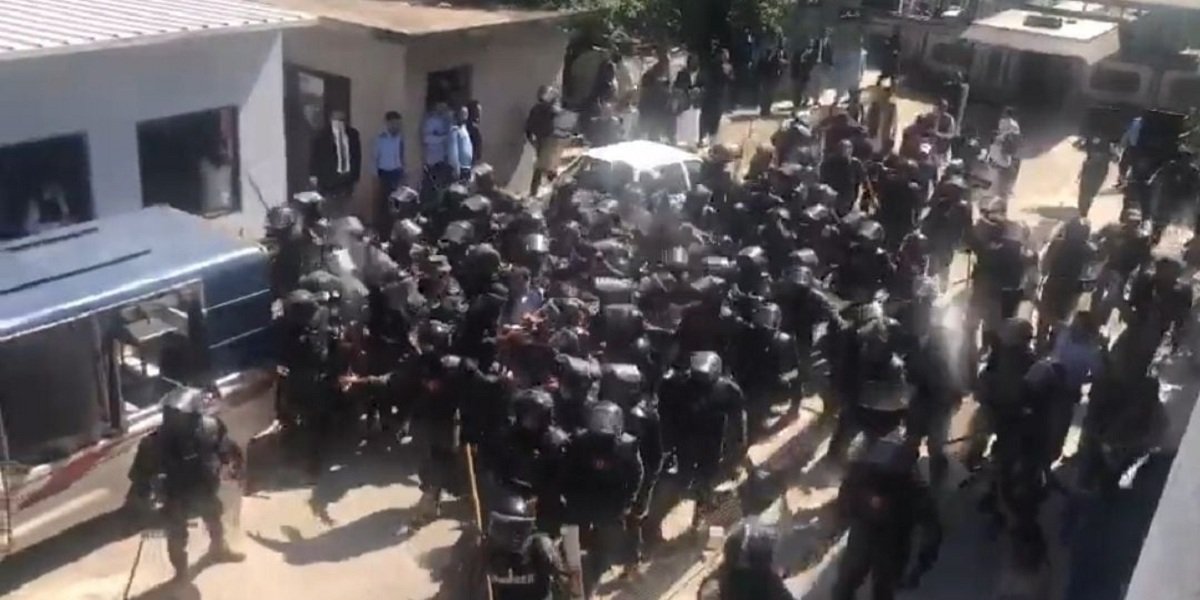
I am certain that Imran Khan’s arrest by the rangers, an army offshoot commanded by army officers and staffed by army Jawans is a coincidence and not the result of a deliberate effort to exclude police from this operation. Moreover, the entire operation was conducted with IG police on the driving seat against what has been alleged by certain quarters. The allegations were also not true that he was arrested by the order of the Accountability Court because the government this time around was not able to arm twist the judiciary to do what they wanted.
His arrest was portrayed by certain sections as breaking in and disgracing the high court and its chief justice, forcing and dragging a wounded and frail Imran Khan by defying the court’s sanctity. While doing so, it invited visible wrath of annoyed sitting Chief Justice, who took immediate action but at the end declared the arrest in accordance with law, and by doing so put the entire nation on a razor’s edge.
According to the Pakistani Constitution, every citizen has the right to a fair trial and due process of law, including the right to be free of arbitrary arrest or detention. Article 10 of the Constitution expressly states that no one shall be detained without being informed of the reason for their detention, nor shall anyone be denied the right to consult and be defended by a legal practitioner of their choice.
Section 17(2) of the Criminal Procedure Code (CrPC) similarly prohibits police officers from entering the court’s precincts to arrest an accused person who is attending or about to attend a high court hearing. This provision is intended to safeguard the judiciary’s independence and the rights of the accused.
While there were over 140 cases against him being heard by the courts around the country, he was arrested on the spurious pretext of a six-year-old and forgotten case of Al-Qadir Trust, in which a petitioner had alleged the taking over of a piece of land by the KP government, without the consent of the trust, and held Imran Khan responsible for the takeover.
The case is subjudice with Peshawar High Court since 2017 awaiting final ruling in which no instance of corruption or corrupt practices as yet proven with finality, no financial transaction between the trust and Imran Khan was involved, and the case was primarily between the KP Government and a trustee of the Al Qadir trust.
In addition, the PHC was seized to determine whether the KP government acted within the law in acquiring the land and whether the Al-Qadir Trust’s rights had been violated. Even if Imran Khan is ultimately found to have committed no wrongdoing, the Court was also investigating whether the case was used as a diversion from other issues in order to damage his reputation and credibility.
According to a country’s legal system, a trial court cannot assume a case that is being heard by its appellate court due to distinct jurisdictions and functions as trial court at first instance hears and decides cases and if it is dissatisfied with the trial court’s decision, it can appeal to a higher court, such as an appellate court.
The arrest also attracted recent amendment made to the NAB ordinance, in which private transactions were excluded from NAB’s purview, the NAB’s pecuniary jurisdiction was limited to mega-scandals involving over Rs. 500 million, and the statute of limitations for filing a case was reduced to one year, with court permission.
While the contested case is six years old, it is between a private trust and the government, and no government funds are involved. In fact, the government appeared to be the beneficiary, and land was acquired in the public interest. In addition, the case has not been classified as a mega scandal because no monetary value has been assigned to it to qualify it as such.
The arrest hits Section 16 of the NAB Act which stipulates that an accused will be tried for an offense under the ordinance in the court under whose territorial jurisdiction the alleged offense was committed, as previously there were no territorial limits. This section specifies the territorial jurisdiction of the court, which means that the trial will take place in the area where the alleged offense occurred.
This is intended to make it easier for the accused to defend themselves, reduce the burden on the accused and their families, and eliminate the need to travel long distances. Before this amendment, Section 16 did not specify any territorial limitations, and the accused could be tried in any accountability court in Pakistan. I hope while arresting Imran in Islamabad, all legal aspects were taken care of.
It is also said in certain sections of the civil society that Imran Khan at the time of arrest was attending a high court hearing, at the orders of the said court and was under “judicial immunity” or “protection.” This means that he could not have been arrested by any law enforcement agency while he was inside the court premises or during his transit to or from the court, unless there was a specific order from the court authorizing his arrest.
Even if the law enforcing agencies had an arrest warrant issued by a lower court – such as a trial court that was subordinate to the high court – the law enforcement agencies were required to seek permission from the high court judge in session to execute the arrest warrant. If the high court grants permission, then he could be arrested and taken into custody as the judicial immunity only applies to the jurisdiction of the high court and not to other courts. However, these apersions were set to rest by the order of Islamabad high court which termed the arrest in accordance with the law.
In any case, if an accused person is arrested without proper authorization or in violation of their judicial immunity while attending a high court proceeding, it is a serious matter and can lead to legal and administrative consequences for the law enforcement officials involved.
For example, in India in 2019, the Delhi High Court reprimanded the Delhi Police for arresting a man within the court premises while he was attending a hearing in a case. The court stated that the arrest was a clear violation of the fundamental right to access justice and the independence of the judiciary.
Similarly, in the United States, in 2019, a federal judge in Massachusetts ruled that the U.S. Immigration and Customs Enforcement (ICE) violated the constitutional rights of an undocumented immigrant by arresting him inside a courthouse. The judge stated that the arrest undermined the court’s ability to provide access to justice and maintain the integrity of the judicial process.
The LAE, may have already set in place the damage controlled mechanism which includes deployment of additional police forces, rioting units and specialized units to areas where protests are taking place. It was done to prevent violence and maintain public order, arrest protesters engaging in violent behavior and charge them with offenses such as assault, destruction of property, or disorderly conduct. The use of force to disperse the crowds or prevent them from causing harm to property or people by the use of non-lethal weapons such as tear gas or water cannons initiating legal action against the opposition leaders was done on account of violating the laws and inciting violence – and above all curb of freedom on assembly, speech, movement and expression.
This included ban on all communication and information means such as stopping cell phone services and banning conventional & social media to stop spread of rumours, heresy and false and fabricated information to incite violence. However, they must do this by taking in account that it can have significant economic and social effects, particularly on small businesses and entrepreneurs who rely on these platforms to market their products and services, and on vulnerable populations who rely on these platforms for support and information.
If Imran Khan – or any other leader for that matter – has committed any wrongdoing, financial bungling, misappropriation of public funds or used illegal means of acquiring money, like all other such persons, no laxity should be shown to him but while living within the confines of constitution and law of the land and without any fear or favor.
Trespassing the constitution or law of the land especially by the Law Enforcing Agencies means socio economic disaster and breaking down of social order which is in no one’s interest.
Permit me to quote the concluding remarks of a TV anchor who stated that he had never seen such an alarming and dangerous political situation in his professional career, and let us join him in pleading with all leaders, politicians, and influential stakeholders to have mercy on the unfortunate people, this country, and themselves. All of this to stop leading the nation towards total collapse and catastrophe. (Edited by Khadijah Kamili)
Opinions in this piece are based on personal observations of the writer.
Also Read: Breaking vicious economic nosedives