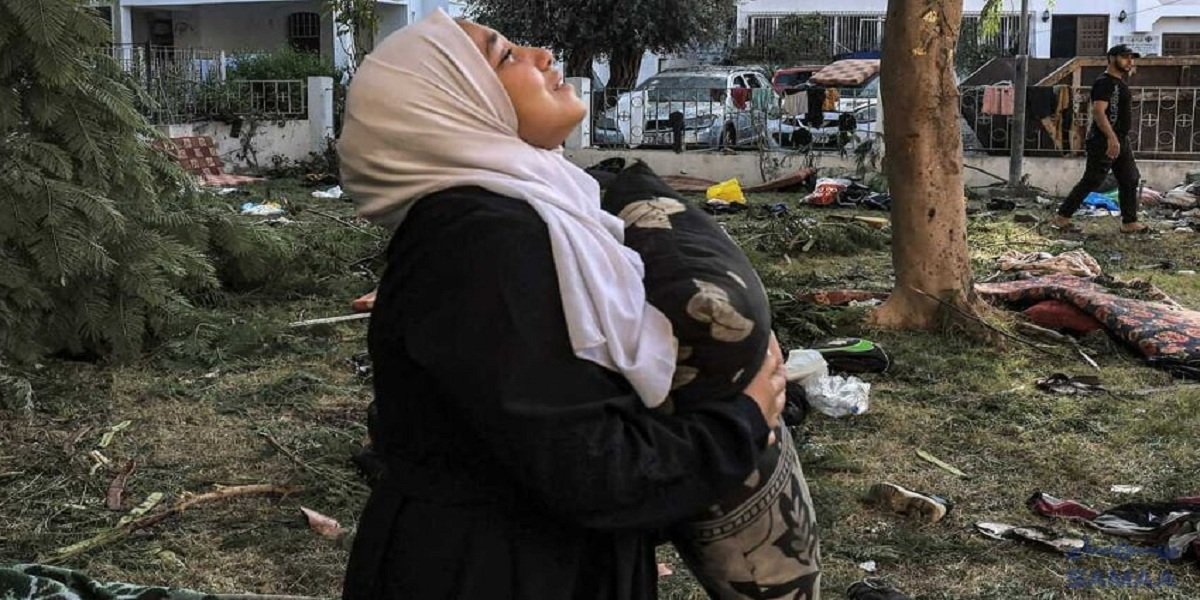
JEDDAH: The Organization of Islamic Cooperation (OIC) has issued a strong condemnation of Israel’s recent attack on the Al-Ahli Baptist Hospital in central Gaza, describing it as an act of “organized state terrorism” and a “war crime.”
In a statement released late on Wednesday, the OIC expressed its outrage at the “brutal Israeli massacre” that occurred in the Baptist Hospital within the Gaza Strip.
The OIC, which represents a 57-member bloc of Muslim nations, held the Israeli occupation responsible for the severe consequences of its actions, including what it deemed “terrorist practices and brutal attacks against the Palestinian people.”
The organization highlighted that these actions not only contradicted fundamental human values but also constituted a blatant violation of international humanitarian law.
In its statement, the OIC emphasized the urgent need for accountability and punishment for such instances of “organized state terrorism.” It called on the international community, particularly the United Nations Security Council, to swiftly intervene and put an end to the war crimes committed by the Israeli occupation in Gaza. The organization also called for the provision of international protection for the Palestinian people who have been caught in the crossfire.
Meanwhile, Pakistan’s Caretaker Foreign Minister, Jalil Abbas Jilani, has strongly condemned Israel’s actions in Gaza and called for an immediate ceasefire, along with the lifting of the siege of Gaza. He expressed his concerns during an urgent open-ended Ministerial Meeting of the Executive Committee of the Organization of Islamic Cooperation (OIC) held in Jeddah, which was co-convened by Pakistan and Saudi Arabia.
Foreign Minister Jilani denounced the Israeli aggression and the humanitarian blockade of Gaza, which have led to death, destruction, and displacement. He stressed that Israel’s actions are in clear violation of international humanitarian and human rights law, constituting war crimes and crimes against humanity. He called on the international community to hold Israel accountable for these crimes.
Jalil Abbas Jilani also highlighted the urgent need for an immediate ceasefire, the prevention of forced evacuations of Palestinians from their homes, and the establishment of humanitarian corridors to ensure the safe and unrestricted delivery of humanitarian and relief supplies to Gaza.
The foreign minister pointed out that the root cause of the recent conflict lies in the non-implementation of the two-state solution. He reaffirmed Pakistan’s unwavering support for the Palestinian people and their right to self-determination, advocating for the establishment of a viable, secure, contiguous, and sovereign state of Palestine based on the pre-June 1967 borders, with Al-Quds Al-Sharif as its capital.
Meanwhile, the United States exercized its veto power in the United Nations Security Council, blocking a resolution, drafted by Brazil, that called for humanitarian pauses in the ongoing conflict between Israel and Palestinian Hamas militants. The intended purpose of these pauses was to enable the delivery of much-needed humanitarian aid to the Gaza Strip.
Despite extensive discussions and two previous delays, the US remained determined to secure aid access to Gaza through diplomatic efforts. The vote saw twelve members of the Security Council voting in favor of the draft resolution, while both Russia and Britain abstained from the vote.
US Ambassador to the United Nations, Linda Thomas-Greenfield, emphasized the importance of diplomacy in the region. She stated, “We are on the ground doing the hard work of diplomacy. We believe we need to let that diplomacy play out.” She highlighted the significance of actions aligning with facts on the ground and supporting direct diplomatic initiatives to save lives.
Traditionally, Washington has used its veto power to shield its ally, Israel, from Security Council actions. This was another instance of that practice.
Russia’s UN Ambassador Vassily Nebenzia criticized the US veto, pointing to what he perceived as hypocrisy and double standards. A Russian-proposed resolution seeking a humanitarian ceasefire also failed to pass earlier.
UN Secretary-General Antonio Guterres joined the call for an immediate humanitarian ceasefire to facilitate the release of hostages and humanitarian aid access to Gaza.
Russia has requested an emergency special session of the 193-member UN General Assembly to discuss the conflict. Unlike the Security Council, the General Assembly does not have veto-wielding members. Although its resolutions are non-binding, they carry political significance.
UN Middle East peace envoy Tor Wennesland expressed deep concern about the situation, stating that there is a very real and extremely dangerous risk of the conflict expanding. He warned of a potential shift in the trajectory of the Israeli-Palestinian conflict and the broader Middle East.
China’s UN Ambassador Zhang Jun criticized the US for leading other council members to believe the resolution was likely to be adopted, only to exercise a veto. He described the situation as “unbelievable.”
The US Ambassador reiterated their disappointment that the draft resolution failed to address Israel’s rights of self-defense and placed blame on Hamas for the humanitarian crisis in Gaza. The focus of international diplomacy remains on achieving a humanitarian pause near the Rafah border crossing to facilitate aid delivery.
UN aid chief Martin Griffiths emphasized the urgent need for a mechanism agreed upon by all relevant parties to ensure the regular provision of emergency necessities throughout Gaza.
Iran’s Ambassador to a UN, Reza Amiri Moghadam, has criticized the United States’ use of its political veto power at the United Nations Security Council (UNSC), claiming that it is employing the UNSC as a tool for its political objectives. Ambassador Moghadam voiced concerns over the US’s unwavering support for Israel and its obstruction of a “ceasefire for humanitarian goals” in Gaza and Palestine.
In a statement on a social media platform, Ambassador Moghadam asserted that the US’s actions highlight the inefficiency of the United Nations in upholding international law, human rights, and humanitarian rights. He questioned the UN’s role in such circumstances and whether more innocent lives must be lost before it takes appropriate action.
He emphasized that the US’s veto at the UNSC effectively gives Israel the green light to continue its actions in Gaza, which he referred to as a genocide. Ambassador Moghadam called for Israeli war criminals to be brought before the International Court of Justice to ensure justice for the innocent Palestinian people. He urged the Muslim world not to wait for further loss of life but to take action.
Read more: World reacts to brutal Gaza hospital bombing