
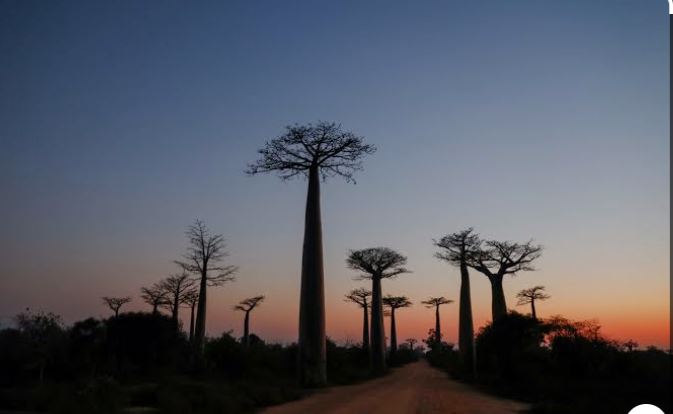
ISLAMABAD: The famous baobab tree, also known as the upside-down tree, has always been of interest to botanists and locals. A new study has now traced its origins and how it crossed the world, solving a long-standing botanical mystery.
The study, which was published in the journal Nature, used genomic data of all eight recognized species of baobab, ecological and geological information. The results indicate that the lineage of the baobab originated in Madagascar 21 million years ago. Its seeds then traveled to mainland Africa and Australia at some point in the last 12 million years.
Madagascar, with its high biodiversity, used to have several lineages of baobab, two of which became extinct. But, prior to disappearing, these lineages were able to settle in Africa and Australia.
Scientists are of the opinion that the trees seed pods were carried far by ocean currents. It is probable that baobabs were carried to Africa on floating material across the 400-kilometre-wide Mozambique Channel. What is even more remarkable is that the pods could have travelled as far as 7,000 kilometres to Australia through the Indian Ocean gyre, a strong current that flows around Madagascar and out to the Australian coast.
It is most probable that the plants were transported on floating vegetation rafts, said botanist Tao Wan of the Wuhan Botanical Garden in China, who was part of the study. The gyre offered a natural pathway, and the seeds were transported to new continents.
The baobabs grow in dry savannahs, providing shelter and food to animals like birds, bees, bats and primates. They have large sweet-smelling flowers that open at night and are pollinated by fruit bats, hawk moths, lemurs in Madagascar and bush babies in Africa. The trees also benefit the local communities, as they can use the leaves as food, the fruit as nutritious food, the leaves as traditional medicine, and even as a source of emergency water storage.
The trees may live thousands of years and grow to massive sizes with some Australian trees containing more than 100,000 litres of water, said Professor Andrew Leitch of Queen Mary University of London.
Their giant, hollow trunks are not only biologically distinct but also have entered the folklore of the region. In one of the African legends, four maidens took refuge under a baobab. The tree fell in love with them and put them in its trunk out of jealousy. Locals say that you can still hear their voices inside
Nonetheless, baobabs are threatened by modernity. In Africa, elephants destroy trunks when they are in search of moisture and climate change is another rising issue.
Although the baobabs are ancient and resilient, their survival in the future is subject to whether they will be conserved or not. Their story, once more clearly understood, gives their legacy of endurance, history, and life in arid landscapes even greater depth.