By Irfanullah khan
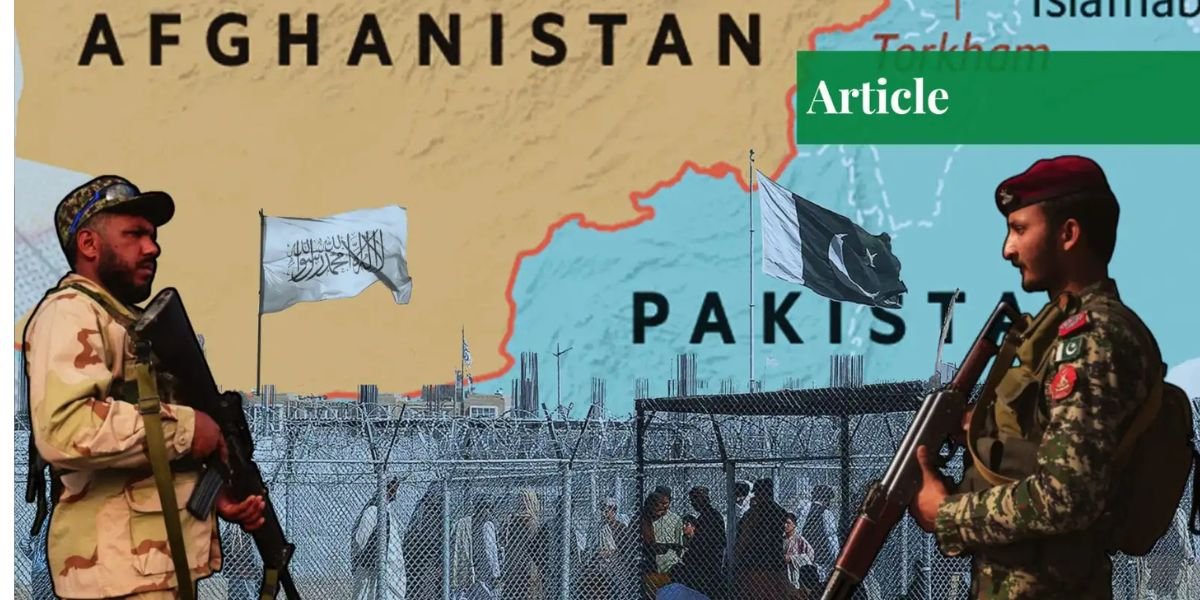
Pak-Afghan military hostilities may have ceased for the moment, but the war of narratives is in full swing. It is natural for a country’s media to support its government in times of war. However, Afghan media is displaying an abnormal degree of myopic hatred, jingoistic fervor, and a lack of logical argumentation. To educate Afghan media professionals and the general public, this article aims to objectively and systematically debunk the myths perpetuated by pseudo-intellectuals associated with the Taliban regime.
A standard deflection strategy of Afghan propaganda is to blame Pakistan’s governments and military for the rise and crimes of the Tehrik-e-Taliban Pakistan (TTP). Afghan propagandists conveniently forget that in the aftermath of 9/11, as an international consensus emerged against the Afghan Taliban, Pakistan was obligated to take kinetic action against armed groups moving back and forth across the porous Pak-Afghan border.
The ensuing emergence of the TTP became a convenient cover for the Afghan Taliban to wage their own struggle while taking shelter in TTP-controlled tribal areas. It appears that the Afghan regime remains indebted to the TTP for its support against ISAF forces and, therefore, refuses to condemn the diabolical atrocities committed by the TTP against Pakistani civilians and armed forces.
It is a laughable attempt to conflate Pakistan’s support for the Afghan jihad against the Soviet Union with the emergence of extremist groups after 9/11. There is no denying that the Soviet invasion unleashed a cycle of radicalization and militarization in the region. However, it is intellectually dishonest to blame the consequences of the mujahideen’s infighting and the post-9/11 upheavals solely on Pakistan. Common sense dictates that the current Afghan leadership should avoid the slippery slope of attributing militancy to Pakistan, given its own militant credentials and extensive networks with militant groups.
This theme has been repeated ad nauseam by Afghan commentators without sufficient evidence. On the other hand, Mufti Taqi Usmani has categorically revealed details of his negotiations with Noor Wali Mehsud in Kabul, explaining that Mehsud was focused on reversing the integration of FATA rather than enforcing Sharia. Noor Wali also had no answer to Mufti Taqi Usmani’s assertion that Pakistan already has an Islamic constitution and that militant struggle against Pakistan is haram (forbidden). To date, no senior Afghan Taliban elder has attempted to approach or consult Mufti Taqi Usmani on this issue. Neither the Taliban regime nor the TTP has been able to refute Mufti Taqi Usmani’s statements.
This shallow claim falls flat simply because of the vociferous and jingoistic defense of the TTP and the Balochistan Liberation Army (BLA) being promoted by Afghan propagandists. This narrative includes turning a blind eye to attacks on polio teams, girls’ schools, innocent bystanders, government contractors, and ordinary laborers.
The complete refusal to condemn terrorist acts by the TTP and BLA is further reinforced by hysterical appeals to the people of Pakistan to take up arms against their own government. Afghan regime propagandists also boast about the strength and numbers of the TTP and BLA while predicting the inevitable victory of these groups. Why is the Taliban regime so determined to become an unofficial spokesperson for the TTP and BLA while simultaneously claiming that these groups are solely Pakistan’s concern?
This stance is an unfortunate reflection of the mindset of the Afghan leadership, which refuses to learn from the disastrous obstinacy of the late Mullah Omar regarding Osama bin Laden. Furthermore, it reflects a distasteful disregard for the thousands of civilians allegedly murdered by the TTP and its affiliates. Does the Afghan regime expect Pakistan to forget the TTP’s murderous brutality, its opposition to democratic institutions and constitutional governance, or its attacks on girls’ education and polio vaccination?
The Afghan regime also fails to understand that by consistently advocating dialogue with TTP militants, it is exposing its own lack of popular mandate and its insistence on ruling Afghanistan through force.
It is an admitted position of the Afghan regime that it has given shelter to some “Waziristani migrants” because of the alleged “atrocities” committed by Pakistan’s military. Taking this claim at face value, one is forced to wonder about the extreme secrecy surrounding the Afghan authorities’ handling of these “Waziristani migrants.” Why are these so-called “beleaguered” and “persecuted” people not being presented to the world so that they can narrate their stories of the alleged “cruelty” of Pakistan’s military?
To this day, Taliban-controlled media has not aired footage, interviews, or pictures of these “Waziristanis,” who are apparently present in the thousands. The lack of transparency surrounding this shadowy group of “migrants” raises questions about the Afghan regime’s claims that they are ordinary people with no links to militancy.
Afghan regime propagandists proudly claim that they have the liberty to criticize any action of the Taliban regime. Since systematic tracking began in 2007, the United Nations Assistance Mission in Afghanistan (UNAMA) estimates that more than 40,000 Afghan civilians were killed directly by Taliban actions. If Afghan intellectuals feel so strongly about war crimes committed by other countries, can they also dare to remind the Taliban regime of its own alleged abuses?
The reported beatings and incarceration of Afghan journalists and civil rights activists are constant reminders of the restrictions facing critical discussion of the regime’s governance.
Nothing could be further from the truth than the claim that the Taliban regime listens to criticism. The fact is that the Afghan Taliban have repeatedly refused to heed the concerns of even friendly regimes. Russia and Central Asian countries have repeatedly raised concerns about extremist groups operating from Afghan soil. Similarly, advice from Gulf countries regarding credible action against militant groups has largely been ignored.
The Taliban regime also faces questions over the financial assistance it has received over the past five years. Zalmay Khalilzad has openly stated on an Afghan television channel that the United States would continue drone surveillance of Afghanistan for ten years under an agreement with the Afghan Taliban.
A reign of fear and terror can hardly be described as the establishment of peace. Reports of killings of security officials from the former Republic era, severe restrictions targeting women, and limitations on media, civil society, and Shia communities also contradict claims of maintaining law and order.
Despite claims of effective law enforcement, the Taliban regime has faced criticism over its inability to resolve several high-profile attacks, including the attempt on the life of Pakistan’s ambassador in December 2022, the killing of Khalil Haqqani, the murders of foreign tourists in Bamyan, attacks targeting members of the Shia community in Herat, and the bombing of a Chinese restaurant in Kabul.
Now, propagandists are attempting to externalize the brewing unrest in Badakhshan, again contradicting their own claims of firmly controlling their territory and borders.
Pakistan and Afghanistan are bound by history, culture, faith, trade, and an extensive shared border. It is therefore in the interest of both nations to prevent misunderstandings from hardening into permanent hostility. The first step in this direction should be to tone down rhetoric on both sides, particularly in Afghanistan. Blatant support for the TTP and BLA in official or unofficial narratives is a zero-sum strategy that will only fuel further hostilities between the two nations.
The Afghan authorities, for their part, have an opportunity to demonstrate statesmanship by replacing accusatory rhetoric with practical cooperation. Meaningful action against terrorist groups operating from Afghan soil, coupled with regular bilateral dialogue, intelligence cooperation, and effective mechanisms for border management, would contribute significantly to restoring mutual trust.
Ultimately, responsible neighbors do not have the luxury of permanent disengagement. The challenges confronting Pakistan and Afghanistan — including terrorism, cross-border crime, refugee management, and economic underdevelopment — can only be addressed through cooperation founded on mutual respect, sovereign equality, and adherence to international commitments.
The writer is an MPhil scholar in International Relations.