
In a country where the ocean has long been treated as an afterthought, a historic initiative is now placing Pakistan’s seas, rivers, and the communities that depend on them at the heart of national policy.
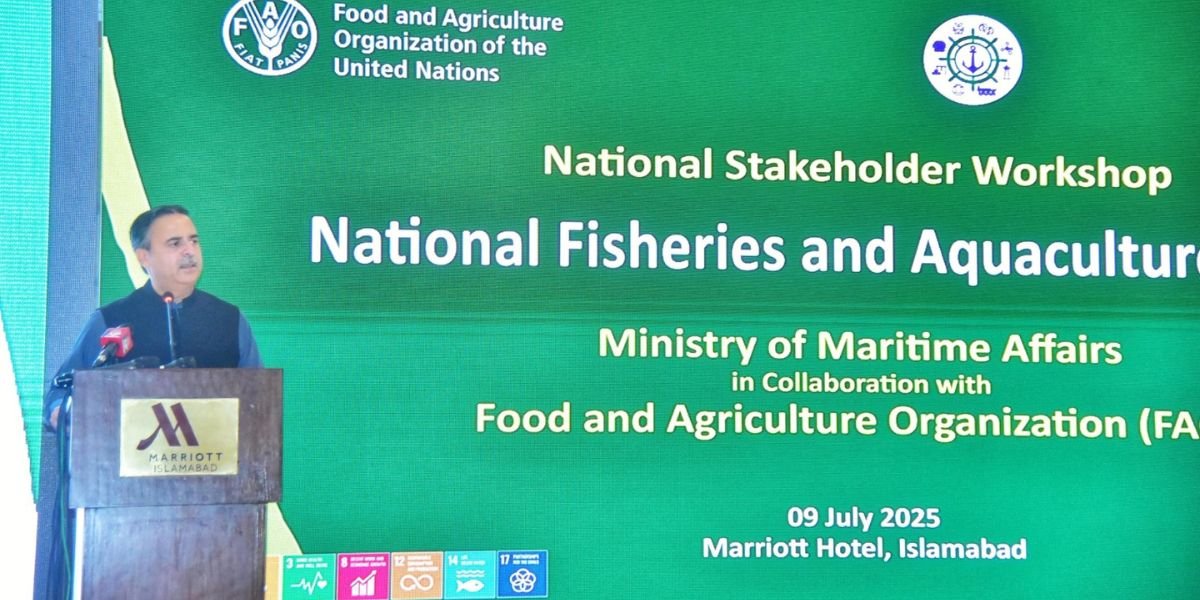
For the first time in Pakistan’s history, a nationwide consultation has been held to shape the National Fisheries and Aquaculture Policy (2025–2035). Convened under the leadership of the Prime Minister and organized by the Ministry of Maritime Affairs with technical support from the Food and Agriculture Organization (FAO), the event brought together a wide cross-section of voices — policymakers, industry leaders, academics, and coastal communities.
Federal Minister for Maritime Affairs, Muhammad Junaid Anwar Chaudhry, called the consultation a ‘milestone moment’ and emphasized the urgency of federal-provincial coordination.
‘Despite Pakistan’s vast marine and inland water resources, the sector has remained underutilized,’ he said. ‘This policy will set a national direction for responsible growth, sustainability, and inclusion.’
Currently, Pakistan’s fisheries sector contributes less than 0.5% to the national GDP. Hampered by limited infrastructure, outdated fishing techniques, and weak regulation, its performance in both domestic and export markets remains far below potential.
The government’s slow response to these structural challenges — especially in coastal cities like Karachi — has only worsened the crisis.
Over 90% of Karachi’s sewage and industrial waste flows untreated into the Arabian Sea, devastating marine ecosystems, endangering public health, and undermining the livelihoods of local fishing communities.
Despite years of promises, no fully functional wastewater treatment system has been implemented. Activists and industry stakeholders blame bureaucratic inertia, overlapping responsibilities, and a lack of political will. While the new national policy does mention environmental protection and pollution control as core priorities, experts warn that without clear enforcement mechanisms, such provisions may remain unfulfilled.
The draft policy is built on cross-cutting themes such as climate resilience, gender inclusion, child protection, safe working conditions, and fiscal incentives for sustainable fisheries and aquaculture.
‘Fisheries are often neglected and highly climate-sensitive,’ said Dr. Syed Murtaza Hassan Andrabi, Animal Husbandry Commissioner at the Ministry of National Food Security. ‘If this policy is to work, it must be both ambitious and rooted in the specific ecological and cultural realities of each province.’
FAO Representative Florence Rolle emphasized that inclusive stakeholder workshops held across the country played a key role in shaping the policy framework. She also commended Balochistan’s leadership in drafting its own provincial fisheries policy and pointed to the potential of sustainable practices to unlock international climate financing.
Meanwhile, Dr. Kanwar Muhammad Javed Iqbal, FAO’s Senior Policy Specialist, presented the operational roadmap: responsible resource governance, ecosystem conservation, support for women entrepreneurs, pollution mitigation, and job creation across the aquaculture value chain.
One of the most powerful moments of the consultation came from Younas Anwar of Mahigir Itehad Gwadar, who passionately criticized how coastal communities have been systematically ignored.
‘Policies must come from our lived realities — not just from air-conditioned rooms,’ he said.
Similar concerns were voiced by Nasir Rahim Sohrabi of RCDC Gwadar and Syed Daim Shah, President of the Aquaculture Farmers Association. They called for fair market access, investment in cold chain infrastructure, and strict enforcement against illegal trawling, which continues to deplete local fish stocks.
Secretary for Maritime Affairs, Syed Zaffar Ali Shah, estimated that with coordinated planning and value addition, the fisheries sector could contribute up to $10 billion to Pakistan’s economy — an exponential leap from current figures.
But realizing this potential requires more than policy drafts. It demands transparent implementation, inter-agency collaboration, and visible, measurable action — especially on environmental compliance and marine protection.
As Pakistan moves toward finalizing the National Fisheries and Aquaculture Policy 2025–2035, it does so under both promise and pressure. The blue economy can no longer afford to be sidelined — not by policymakers, not by polluters, and certainly not by those whose livelihoods and futures depend on it.