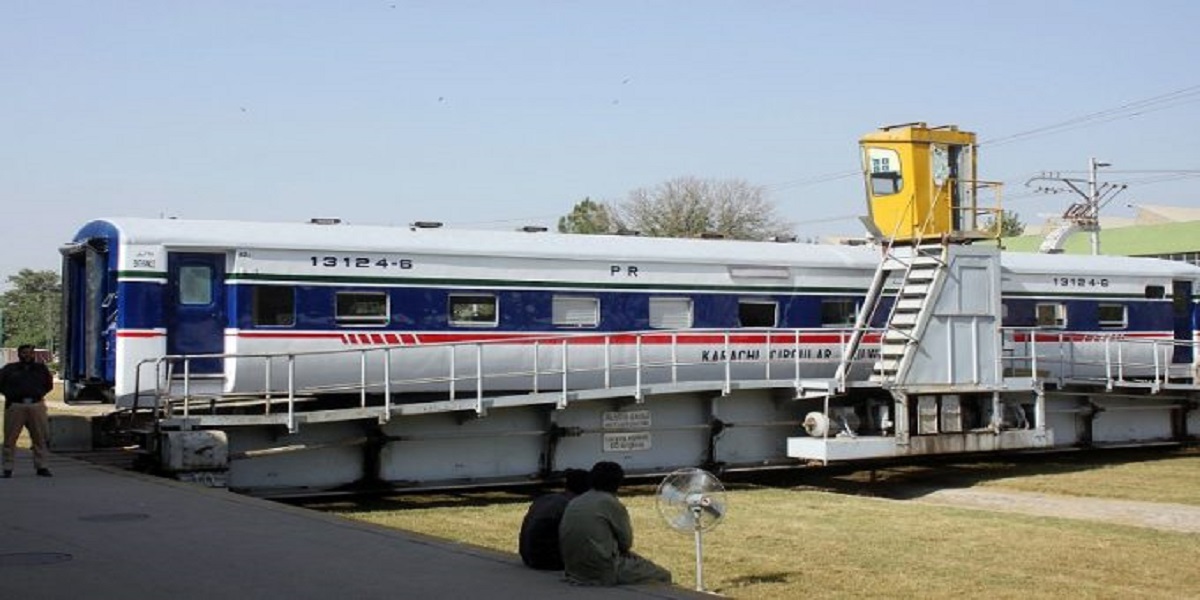
KARACHI: Pakistan Railways has announced that it will partially resume the inner-city Karachi Circular Railway service from next Monday, November 16—after a 21-year closure.
A spokesperson said that four trains will leave from Landhi and four from Orangi town in the first phase. They will depart at 7am, 10am, 1pm and 4pm.
The KCR is expected to provide relief to commuters and solve the transport crisis in the city.
This comes after the Supreme Court issued on Tuesday a contempt notice to the Sindh chief secretary over his failure to ensure the removal of encroachments from the Karachi Circular Railway track.
A show-cause notice has also been issued to the Railways secretary. The two senior officials have been summoned in person at the next hearing along with the FWO DG.
The project’s complete track will start from Drigh Road station, going through Gulistan-e-Jauhar and heading to Gulshan-e-Iqbal. From there it will turn towards Nazimabad going through Yaseenabad and Liaqatabad. The track then heads to Manghopir and SITE before going taking a turn towards Baldia and going through Lyari, Mereweather Tower, City Station and onward to PIDC and Karachi Cantt.
The KCR would then run parallel to Sharae Faisal and go through Chanesar Goth, Shaheed-e-Millat, and Karsaz before completing a round trip at the Drigh Road station.
Initially, KCR was supposed to help factories send boxes of shipments to the Karachi port. But because the train used to pass through neighbourhoods, people started using it to move around. By the 1970s, the KCR had grown to a 44km route and in the next ten years it had six million people using it. The trains were running 80 trips a day.
Sadly though, the KCR started suffering for many reasons by the mid-80s. At one point it was down to only 12 daily trips. By 1999 it was shut down because of losses. Grass grew over its tracks and slowly people started building homes and shops on the space where the trains ran.
Since then, the authorities have tried to get it back up to give the people of Karachi some relief from traveling like crushed khajoors in a box in busted minibuses.
The KCR is not a magic bullet that will miraculously change the entire system. It is, however, the base of a master plan that will make it easier for people from all over Karachi to hop on and off trains and buses. That big picture is laid out in the Transport Master Plan 2030.
That project, known as Karachi Breeze, is made up of five bus rapid transit lines (Green, Red, Yellow, Purple and Aqua), a mass rapid transit (Brown) and a separate BRT line (Blue). The Green, Red, Yellow and Blue lines will meet at Numaish on MA Jinnah Road. All of them connect to the KCR at some point or the other and this entire public transport network would ideally cover enough of Karachi. That project, known as Karachi Breeze, is made up of five bus rapid transit lines (Green, Red, Yellow, Purple and Aqua), a mass rapid transit (Brown) and a separate BRT line (Blue). The Green, Red, Yellow and Blue lines will meet at Numaish on MA Jinnah Road. All of them connect to the KCR at some point or the other and this entire public transport network would ideally cover enough of Karachi.