
Pakistan steered its ship with admirable composure during the “twelve-day war,” which began with Israel–U.S. strikes on Iranian military and nuclear-linked targets in mid-June 2025 and escalated into sustained exchanges that lasted nearly two weeks, ending with a ceasefire around June 24. What made those twelve days unforgettable was not only the intensity, but the symbolism: Iran’s missile and drone barrages repeatedly penetrated Israeli airspace, challenging the psychological aura surrounding Israel’s multi-layered defense architecture—systems such as Iron Dome and David’s Sling that the world had come to view as near-absolute protection.
During that first phase, Tehran discovered that many relationships celebrated in peacetime become conditional in wartime. India—despite years of strategic engagement with Iran and the economic logic of connectivity projects designed to reach Central Asia—did not step forward in a manner Tehran expected. For Iranian observers, this was not merely silence; it felt like calculated distance, shaped by India’s wider strategic alignments and its concern that any global momentum toward a Palestinian two-state framework could echo into renewed international scrutiny of Kashmir. The war thus exposed not only military fault lines, but diplomatic ones, revealing how quickly geopolitics can reorder loyalties when the costs of association rise.
Pakistan, in that first phase, stood out as a notable exception. Islamabad’s political and diplomatic signaling leaned toward defending Iran’s sovereignty and opposing external aggression, a posture framed by regional media as meaningful support and a source of goodwill. Pakistan appeared willing to risk diplomatic discomfort to stand with a neighbor under direct attack, reinforcing a narrative of fraternal ties rooted in geography, culture, and shared historical memory. That moment, however, belonged to a specific kind of conflict—short, explosive, and bounded by the logic of rapid escalation and de-escalation.
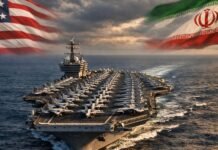
The second phase is of a different character altogether. On January 23, 2026, President Donald Trump publicly confirmed that a U.S. armada was moving toward the Middle East, with major naval assets shifting into the Persian Gulf and the Indian Ocean, as Washington framed the deployment around Iran’s internal unrest and the regime’s response to protests. This was not the sudden blaze of a twelve-day exchange; it was the slow, visible architecture of pressure—presence, signaling, and endurance.
In this new moment, Pakistan’s dilemma sharpens. The cost of being misunderstood becomes higher, and the penalties of miscalculation more enduring. Islamabad must now decide how to protect its neighborhood, its economy, and its strategic credibility without turning itself into a battlefield, a base, or a bargaining chip in a contest far larger than any single state.
This complexity is deepened by Pakistan’s Middle East relationships. Beyond Saudi Arabia, Pakistan’s economic and financial space has long been underpinned by Gulf cooperation through investment flows, energy arrangements, and vast remittance networks tied to Qatar, Kuwait, and the United Arab Emirates. Yet this support exists within a regional context in which many Gulf states view Iran not only as a strategic competitor but also as a religious and political rival, accusing Tehran of deepening sectarian divides and projecting influence through proxies in Lebanon, Iraq, Syria, Yemen, and Palestine. In this environment, overt Pakistani alignment with Iran would be more likely to unsettle Gulf capitals than reassure them, potentially narrowing Pakistan’s economic and diplomatic room for maneuver.
Against this backdrop, Pakistan’s first choice is open support for Iran—diplomatic, material, and, if forced by circumstances, kinetic. The appeal lies in moral clarity and neighborhood logic. Iran is a neighbor whose stability directly affects Pakistan’s western frontier, border security, and internal cohesion. Open support would reassure Tehran that it is not alone again, strengthening long-term trust and potentially discouraging any future strategic drift that could expose Pakistan’s flank. The cost, however, is immediate and tangible. Visible alignment against Washington risks economic retaliation, pressure through international financial channels, and political isolation in forums where U.S. influence remains decisive, while also unsettling Gulf partners that see Iran through a lens of rivalry rather than fraternity.
The second choice is alignment with the United States and Israel—offering cooperation that could include intelligence sharing, logistical facilitation, or strategic access. This path promises short-term diplomatic favor and potential financial relief, but it is the most combustible domestically and regionally. It would inflame public sentiment, sharpen sectarian and political tensions, and almost certainly provoke Iranian hostility in ways that could destabilize Pakistan’s western borderlands. The strategic blowback could be generational, recasting Pakistan’s image across the Muslim world and entangling it in a conflict whose objectives and endgame are not of its own making.
The third choice is declared neutrality. Pakistan would step back, deny its soil and airspace for conflict, and consistently call for de-escalation. The advantage is immediate insulation. Neutrality reduces the risk of becoming a direct target and preserves working channels with all parties. Yet neutrality in a pressure campaign can become a quiet punishment. Iran may still feel abandoned and revise its trust calculus. Washington may interpret restraint as passive resistance and still apply economic pressure. India could frame Pakistan as irrelevant or opportunistic while consolidating its own partnerships. Neutrality can be a shield, but it can also become an empty space that others fill with their own narratives.
The fourth choice is a calibrated dual-track strategy. Pakistan avoids loud, provocative rhetoric that triggers U.S. retaliation while quietly extending the maximum permissible support to Iran behind the curtain of diplomacy. This is survival statecraft in a world where economies can be choked without a single missile being launched. The advantage is strategic breathing room: Pakistan preserves its financial and diplomatic channels while preventing Iran from feeling strategically orphaned. The risk is fragility. If exposed, secrecy can produce the worst of both worlds—U.S. anger without the protection of honesty, and Iranian disappointment if the help appears too cautious or insufficient.
The fifth choice is multilateral internationalization—pushing the crisis into formal global forums such as the United Nations, the Organization of Islamic Cooperation, and ad hoc contact groups involving China, Russia, Turkey, and key European states. Instead of positioning itself as a bilateral actor between Tehran and Washington, Pakistan frames itself as a convener and agenda-setter, shifting the burden of mediation, legitimacy, and pressure onto a wider coalition. The advantage is the dilution of risk. Decisions and outcomes no longer rest on Pakistan’s shoulders alone, and the crisis is embedded in a global framework that makes unilateral escalation politically costlier. The downside is the loss of speed and influence. Multilateral processes are slow, consensus-driven, and often shaped by great-power rivalries that can stall momentum at the very moments when urgency is greatest.
These five paths do not exist in isolation; they overlap, collide, and constrain one another. Pakistan cannot fully embrace one without partially touching the others. Open support for Iran strains Gulf and Western ties. Alignment with Washington risks regional backlash. Neutrality invites suspicion from all sides. A dual-track strategy demands discipline and secrecy. Multilateralization trades immediacy for legitimacy. The art of statecraft lies not in choosing a single lane, but in sequencing these options in a way that preserves room to maneuver as circumstances evolve.
The most sustainable course for Pakistan lies in a disciplined blend of the fourth and fifth choices, anchored by the language of the third. Declared neutrality in public posture provides a shield against direct retaliation. Active, quiet stabilization with Iran preserves neighborly trust and reduces the risk of border spillover, refugee flows, and proxy escalation. Multilateral engagement internationalizes the crisis, embedding it in legal and diplomatic frameworks that slow the march toward unilateral coercion. At the same time, Pakistan must maintain cordial, pragmatic, and economically constructive relations with Washington, carefully calibrating its actions and rhetoric to avoid triggering sanctions or financial pressures that could further strain an already fragile economic landscape.
The twelve-day war proved that old myths can break and that “friends” can vanish when bombs fall. The January 23 mobilization proves something else: pressure campaigns are built to last, and nations survive them through balance, not bravado. Pakistan’s success will not be found in loud slogans or reckless entanglement. It will be measured by its ability to protect its economy, preserve its Gulf lifelines, prevent western-border chaos, stand close enough to Iran to preserve brotherhood, far enough from provocation to deny adversaries a pretext for retaliation, and remain engaged enough with the world to ensure that, when the region’s future is negotiated, Pakistan is not merely present, but heard.