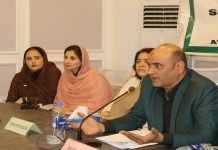

LAYYAH: Istehkam-e-Pakistan Party (IPP) President and federal minister Abdul Aleem Khan, delivered a passionate address at the Marka-e-Haq Convention in Layyah, paying rich tribute to the Pakistani armed forces for their valor and dedication.
He praised the army, navy, air force, and marines, declaring that Pakistanis are proud of their defenders, especially following the recent confrontation with India.
Speaking to a large and enthusiastic crowd, Abdul Aleem Khan said, “We thank Field Marshal Syed Asim Munir who gave us respect and dignity on the global stage. His leadership and courage have made every Pakistani proud.”
He extended heartfelt gratitude to the people of Layyah for their overwhelming support and applauded party leader Rafaqat Gilani for organizing the convention, calling it the first of its kind to honor the Pakistani forces. “You are fortunate to have hosted this historic Marka-e-Haq Convention,” he remarked.
Reflecting on recent tensions with India, Abdul Aleem Khan highlighted the unity and patience of the Pakistani military. “People used to question the need for an army. But on May 6, they received a powerful answer,” he said. He recalled how, despite initial restraint, the military launched a decisive response that stunned the world. “We didn’t attack secretly in the night. We told the world — after Fajr prayer — what Islam says and what we stand for.”
The minister told the crowd that when India fired missiles at Pakistani airports, the whole world saw how the Pakistani army, which had been silent for three days, responded. “We waited very well for three days, but the enemy thought we were weak. After three days, we did not attack quietly, but made sure they knew we were striking.”
He revealed that six major Indian attacks were thwarted during the escalation and praised the military’s resolve. “India, with a force seven times larger, could not withstand our army for even an hour and a half,” he claimed. “They were forced to seek help from America.”
Abdul Aleem Khan also lauded Field Marshal Asim Munir for personally leading the Fajr prayer before commanding the retaliatory strike. “This was not just a military response, it was a message of faith, unity, and honor.”
Reinforcing the theme of national pride, he emphasized that India’s hatred against Pakistan has persisted since 1947 but will always be defeated by unity and the courage of Pakistan’s armed forces.
Aleem Khan also paid heartfelt tribute to the brave personnel who laid down their lives for the country. “As long as we live, the nation will remain forever indebted to the sacrifices of our martyrs,” he added. He condemned the enemy’s brutal actions, stating, “The cowardly enemy even took the life of a six-year-old child — a heartbreaking reminder of their inhumanity.”
Taking a direct jab at Indian Prime Minister Narendra Modi, Abdul Aleem Khan said, “Those who once took pride in Modi saw that arrogance shattered within just an hour and a half.”
Highlighting Pakistan’s regional allies, he stated, “Our neighbour China and our brotherly Islamic country Türkiye stood by us in difficult times. China provided us with the technology to shoot down enemy aircraft, while Turkey equipped us with drone defense systems. These are our true partners.”
Furthermore, the minister vowed that in the coming days, work will officially begin on the Layyah-Taunsa Bridge, with Rafaqat Gilani scheduled to inaugurate the project. Simultaneously, development will also be initiated on the Multan-Mianwali Road, which will also be inaugurated by Rafaqat Gilani, accompanied by Chaudhry Yasir Arafat, he added.
Speaking on the longstanding neglect of the region, Aleem Khan emphasized, “South Punjab has suffered from years of injustice and deprivation.” He clarified that while he supports administrative reforms, he does not support changing the name of Punjab. Instead, he proposed a division into north and south Punjab, a model he believes should also apply to other provinces — suggesting north and south Sindh, as well as north and south Khyber Pakhtunkhwa and Balochistan.
Khan outlined his party’s vision, stating, “Our party will move forward with this manifesto. The demand for a separate south Punjab province is essential for political stability and economic progress.” He added that the establishment of a new province would open doors to thousands of job opportunities for the people of the region.
Promising educational reforms, the minister declared, “If I receive [the health] ministry, my priority will be to establish a medical college. And if someone else from our party gets the ministry, I will urge them to do the same.”
He also pledged to improve infrastructure, stating, “I will build the best roads in Layyah. Once South Punjab becomes a province, the need for the Gaya division will disappear, and this region will emerge as a model of development and beauty.”
Read more: Premier Foresees Pakistan As Economic Power