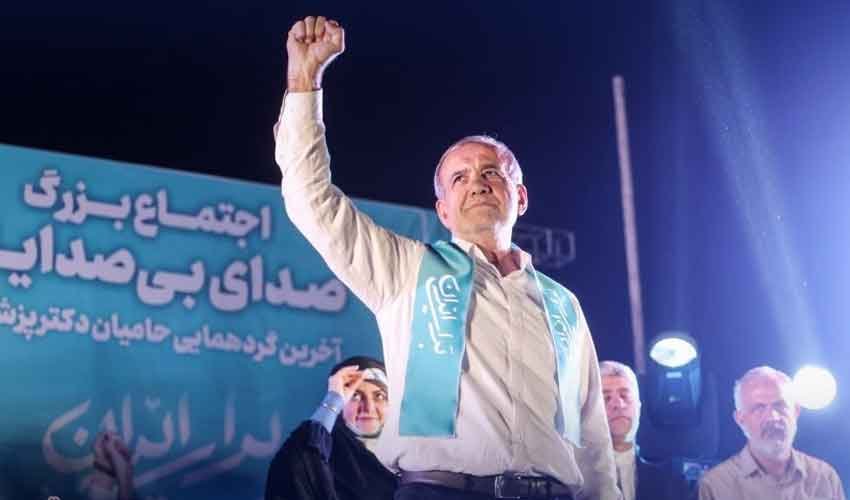
TEHRAN: Masoud Pezeshkian, a very low profile moderate has bagged 53.7 per cent votes and got elected of Iranian President.
Pezeshkian, who has pledged to open Iran to the world and deliver freedoms its people have yearned for, has won the country’s run-off presidential vote, the interior ministry said on Saturday.
“By gaining majority of the votes cast on Friday, Pezeshkian has become Iran’s next president,” it said.
The participation was around 50% in a tight race between Pezeshkian, the sole moderate in the original field of four candidates, and hardline former nuclear negotiator Saeed Jalili, a staunch advocate of deepening ties with Russia and China.
According to the official count, Pezeshkian obtained 53.7% of the votes, or 16.3 million. Jalili received 44.3%, or 13.5 million.
Pezeshkian expressed his gratitude to those who voted “with love and to help” the country in his first public comments after the results were declared.
“We will extend the hand of friendship to everyone; we are all people of this country; we should use everyone for the progress of the country,” he said on state television.
Pezeshkian supporters took to the streets of Tehran and other cities before dawn on Saturday to celebrate as his lead over Jalili grew, reports said.
Videos on social media showed his supporters dancing in the streets in many cities and towns across the country, and motorists honking car horns to cheer his victory.
The run-off on Friday followed a June 28 ballot with historically low turnout, when over 60% of Iranian voters abstained from the snap election for a successor to Ebrahim Raisi, following his death in a helicopter crash.
People in the northwestern city of Urmia, Pezeshkian’s hometown, were handing sweets out on the streets, witnesses said.
While the election is expected to have little impact on the Islamic Republic’s policies, the president will be closely involved in selecting the successor to Ayatollah Ali Khamenei, Iran’s 85-year-old Supreme Leader, who calls all the shots on top matters of state.
Voter turnout has plunged over the past four years, which critics say underlines that support for clerical rule has eroded at a time of growing public discontent over economic hardship and curbs on political and social freedoms.
Only 48% of voters participated in the 2021 election that brought Raisi to power, and turnout was 41% in a parliamentary election in March.
The election coincides with escalating Middle East tensions due to the war between Israel and Iranian allies Hamas in Gaza and Hezbollah in Lebanon, as well as increased Western pressure on Iran over its fast-advancing uranium enrichment programme.
The next president is not expected to produce any major policy shift on the nuclear programme or change in support for militia groups across the Middle East, but he runs the government day-to-day and can influence the tone of Iran’s foreign and domestic policy.
A triumph by Pezeshkian might promote a pragmatic foreign policy, ease tensions over now-stalled negotiations with major powers to revive a 2015 nuclear deal, and improve prospects for social liberalisation and political pluralism, analysts said.
However, many voters are sceptical about Pezeshkian’s ability to fulfil his campaign promises as the former health minister has publicly stated that he had no intention of confronting Iran’s power elite of clerics and security hawks.
Read more: Pak, IMF Close to Agreement on $8 Billion Bailout Package