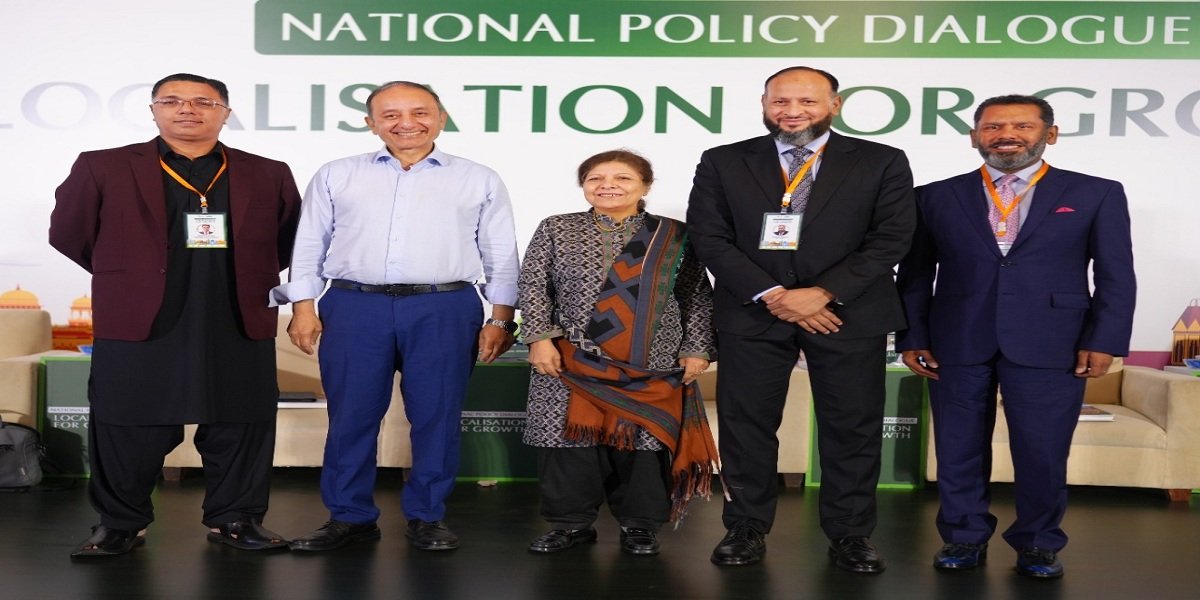
KARACHI: K-Electric Limited, in collaboration with Nutshell Group, jointly hosted a National Policy Dialogue on Localisation for growth at a local hotel in Karachi.
The dialogue addressed the urgent need to explore options for indigenization and sourcing materials from local avenues for Pakistan to build a resilient economy.
As the world’s 4th most populous country, Pakistan’s reliance on imported fuels for its energy needs tends to pose a hurdle for consistent economic growth against commodity shocks.
Founder & CEO, Nutshell Group, Muhammad Azfar Ahsan, welcomed the guests and reiterated the dire need for Pakistan to prioritize work on the Charter of Business to enable local businesses to enhance impact through local empowerment.
The Dialogue was well attended by the public, private stakeholders and government figures including Senator Dr. Musadik Malik, Minister of State, Ministry of Energy, Khurram Dastagir Federal Minister for Power, Governor Sindh Kamran Tessori, representing the Government and elaborating on public initiatives.
Dr. Malik’s address focused on the need to understand the ground realities as well as the potential and why localization is not a demand but a need. He felt that instead of relying only on one-time solutions, we should strive for a strong indigenous footprint.
“We can only become competitive on a global scale when we achieve a local edge. When we talk about localization, we must develop clusters, where several economic activities are taking place in one geographic area.
Amalgamations are also required where we involve academia, so that we can upgrade our education system as well. Soon, we aim to bring down the UFGs (unaccounted for gas) and the circular debt to zero, but that doesn’t mean all the problems would vanish, rather we still have a long way to go. Above all, we need to build a level playing field where competition is on productivity and innovation alone”, said Senator Dr. Musadik Malik, Minister of State, Ministry of Energy.
“Electric vehicles initiatives will cut emissions in half and imported fuel consumption by half; it will save us dollars and provide expanded opportunities for employment and infrastructural development in Pakistan”m said Khurram Dastagir, Federal Minister for Power,
“Pakistan is 75 years old, and we have had so many talks but no solutions. In order to achieve progress, we have to identify the problems, and then work together to fix them instead of working to fix each other. Localization begins with everyone coming together under one common identity as well. I agree that the State is responsible for the direction, but so is the nation,” Kamran Tessori, Governor Sindh said.
Syed Moonis Abdullah Alvi, CEO K-Electric, shared some impressive numbers of investments being made by the company to increase the number of customers, reduce the percentage of power outages, and, most importantly, increase the contribution of renewable resources to generate power.
K-Electric has invested Rs. 474 billion across the value chain, and soon (by 2030) the company will be generating 2172 MW of indigenous energy.
“Our conviction is to base our generation on indigenous fuels and lower our reliance on imported fuels. Our ambition is to invest PKR 484 billion in the value chain over the next 7 years. When we have this predictability and a projected demand of equipment, we believe it is best to buy local and encourage domestic growth. Predictability of policies will support this vision, and collectively reduce the pressure on the national exchequer. I request we collaborate and produce avenues for local resources; everybody needs to work on all fronts, the government needs to focus on policy formulation, and investors need to invest and make things better for Pakistan.” Syed Moonis Abdullah Alvi, CEO, K-Electric.
The discussion was carried forward by Tauseef H. Farooqui, Chairman NEPRA. He said, “Localisation is the only way forward; the world is progressing with zero asset policy. Assets should be zero to minimize liability, and for Pakistan, I feel localisation will be a game-changer for the coming generations.”
Read more: ‘End of US influence’: Mideast rivals Saudi Arabia, Iran restore ties