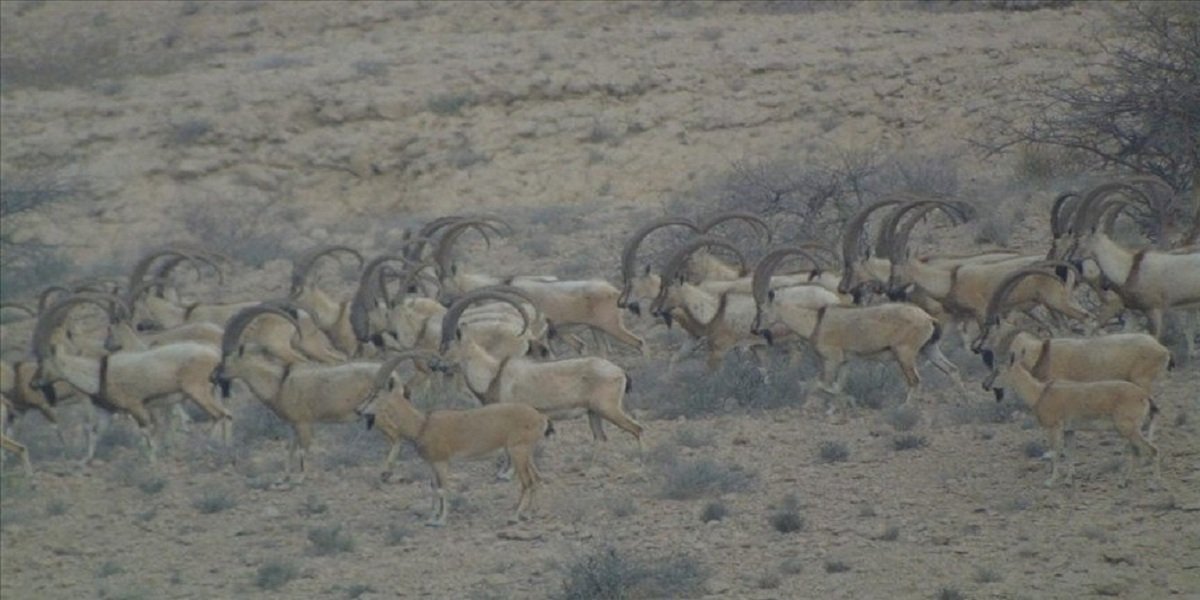
KARACHI: Sindh ibex, (also known as Turkman wild goat), once an endangered species, now the population of the wild goat in Pakistan has shown significant growth in the last decade due to a blanket ban on hunting and the protection provided by local communities.
The wild goat, which is endemic to southwest Pakistan, and also found in southeast Iran, is still viewed as vulnerable, although its number has shot up to 20,000 from less than 2,000 over the past four decades.
Its habitats include the Kirthar mountain range, which falls in the southern Sindh and southwestern Balochistan provinces, and the adjoining Makran range.
A few kilometres before entrance to Sun, a small city in southern Sindh province, located some 156 kilometres (95 miles) from the provincial capital and the country’s largest city Karachi, a narrow metaled road leads to the Kirthar National Park, home to scores of rare species, and Sindh ibex’s largest habitat.
After a few kilometres, the road turns bumpy but remains drivable up to the historic Ranikot Fort, which is known as the Great Wall of Sindh due to its structural resemblance with China’s Great Wall.
As the fort’s stretched wall ends, the unpaved road converts into a rocky terrain, where only 4/4 wheelers could move.
Unfazed by the risks of life-threatening accidents, locals also use motorbikes to travel on the terrain that overlooks hundreds of feet deep ravines.
A two-hour bone-shaking journey ends at a round valley stretching for miles and encircled by untamable mountains, home to majestic Sindh ibex.
Dotted with mesquite, sidr, kikar (Acacia), and other wild trees, which are home to scores of rare birds, the barren valley, at the first sight, offers a rugged look.
However, sipping cold lassi (yoghurt drink) offered by the locals, and resting under the trees gives a totally different feeling. The otherwise warm wind turns cool here to dry up the rolling sweat, and the sound of chirping birds gives a healing touch.
Established in 1974, and sprawling over 3,087 square kilometres (1,192 square miles), Kirthar National Park, the second largest national park after Karakoram National Park in the northern Gilgit-Baltistan region, stretches from Jamshoro district to Karachi.
According to wildlife authorities, the last 10 years were crucial in terms of the increase in the population of the wild goat, which is the national animal of Sindh, a 5,000 years old civilization.
“Over 10,000 animals have been added to the population of Sindh ibex (at Kirthar National Park) during the past 10 years, which is a highly encouraging sign, considering the previous records,” Wali Mohammad Birahmani, a conservator of the Kirthar National Park.
The task to improve the wild goat population was assigned to the park authorities in 1978 when their number was nearly 2,000.
In the initial years the population growth was mediocre due to hunting and poaching and a lack of awareness among the local communities vis-a-vis the threat to this animal.
Read more: Pakistan Railway operating second largest public railway system in South Asia