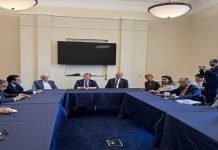
BEIJING: Chinese President Xi Jinping on Tuesday met with Prime Minister Shehbaz Sharif in Beijing where both leaders reaffirmed their commitment to strengthening the all-weather strategic cooperative partnership between China and Pakistan.
The meeting was attended by a high-level Pakistani delegation comprising Army Chief Field Marshal Asim Munir, Deputy Prime Minister Ishaq Dar, Planning Minister Ahsan Iqbal, Interior Minister Mohsin Naqvi, and Information Minister Atta Tarar.
President Xi emphasized that as the world undergoes “changes unseen in a century,” a stronger China-Pakistan relationship is vital to safeguarding regional peace, stability, and development.
He called for accelerating the building of “an even closer China-Pakistan community with a shared future in the new era,” adding that both sides should work toward upgrading the China-Pakistan Economic Corridor (CPEC) and the China-Pakistan Free Trade Agreement (FTA).
Xi also expressed hope that Pakistan would take effective measures to ensure the safety of Chinese personnel, projects, and institutions operating in the country.
In his remarks, Prime Minister Shehbaz Sharif congratulated President Xi on the successful hosting of the SCO Summit and the 80th anniversary of the victory in the Anti-Fascist War.
“Thanks to the leadership of President Xi Jinping, China has made great strides. Pakistan is proud of China’s achievements and remains ready to work together in this great journey,” the Prime Minister said.
He hailed Xi’s Global Governance Initiative, calling it “of great significance for world peace, stability, and development,” and pledged Pakistan’s full support for its implementation.
Premier Shehbaz Sharif reaffirmed Pakistan’s resolve to continue working with China to launch the next upgraded phase of CPEC, which he described as a flagship of the Belt and Road Initiative (BRI).
The Prime Minister revealed that five new development corridors have been added to CPEC’s next phase, aimed at strengthening connectivity and building a stronger Pakistan-China community with a shared future.
He further appreciated China’s unwavering support for Pakistan’s sovereignty, territorial integrity, and economic development, pledging that Pakistan would “spare no effort in ensuring the safety of all Chinese personnel and projects.”
Both leaders stressed that their partnership goes beyond bilateral ties and serves as a model of cooperation for the wider neighborhood. They also vowed to strengthen coordination in regional peace efforts, counter-terrorism, and global development initiatives.
The meeting followed Shehbaz Sharif’s address at the Shanghai Cooperation Organization (SCO) summit in Tianjin a day earlier, where he stressed Pakistan’s belief in dialogue and diplomacy amid regional instability.
He emphasized respect for sovereignty among SCO members and urged cooperation on equitable access to water resources.
The PM highlighted China’s global leadership as an example of stability and growth, with CPEC serving as a model of shared prosperity.
He also congratulated Uzbekistan and Kyrgyzstan on their national days during his remarks.
Shehbaz Sharif strongly rejected all forms of terrorism, calling out those who exploit it for political ends.
“The world no longer accepts this fictional narrative,” he said, citing evidence of foreign involvement in recent terrorist attacks in Balochistan and Khyber Pakhtunkhwa, including the Jafar Express train incident
Read more: Death Toll Rises To 41 As Punjab Braces For Fresh wave Of Floods