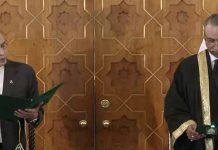
ISLAMABAD: President Asif Ali Zardari on Monday approved the appointments of chief justices of the four high courts. Law Ministry has issued notifications of appointment of chief justices after approval by the President.
The Law Ministry has issued notification of appointment of Justice Sarfraz Dogar as the new chief justice of the Islamabad High Court (IHC).
The notifications of appointment of justice SM ttique Shah as chief justice of the Peshawar High Court (PHC), Justice Rozi Khan as the chief justice of the Balochistan High Court (BHC) and Justice Junaid Ghaffar as the chief justice of the Sindh High Court (SHC) have also been issued.
It is pertinent to mention here that the Judicial Commission of Pakistan (JCP) has last week nominated the chief justices of the four high courts. The new chief justices will take oath of the office this week.
President Zardari would administer the oath to Justice Sarfraz Dogar, while the chief justices of the other high courts would take the oath from the respective governors.
The Judicial Commission of Pakistan (JCP) last week approved the appointment of permanent chief justices for four high courts.
Justice Sarfraz Dogar was approved as Chief Justice of the Islamabad High Court, Justice SM Attique Shah of the Peshawar High Court, Justice Rozi Khan as Chief Justice of the Balochistan High Court, and Justice Junaid Ghaffar as Chief Justice of the Sindh High Court.
The meeting of the Judicial Commission was chaired by Chief Justice of Pakistan Justice Yahya Afridi to consider appointments for permanent chief justices of the high courts of Sindh, Balochistan, Peshawar, and Islamabad. The names of the three most senior judges from each court were reviewed during the session.
The Judicial Commission comprises 13 permanent members. However, in the case of High Court Chief Justice appointments, the number of commission members rises to 16, and a majority of at least nine members is required for the approval of a nomination.
The Judicial Commission includes the Chief Justice of Pakistan, four judges of the Supreme Court, the Attorney General, two government representatives, and two opposition members.
In addition, Ahsan Bhoon represented the Pakistan Bar in the commission, while Roshan Khursheed Bharucha, nominated by the Speaker of the National Assembly, also participated. For the appointment of provincial Chief Justices, the relevant Provincial Law Minister, a representative of the High Court Bar, and a former High Court judge were also present at the meeting.
Read more: Pakistan Faces Population Crisis Amid Health Alarms