
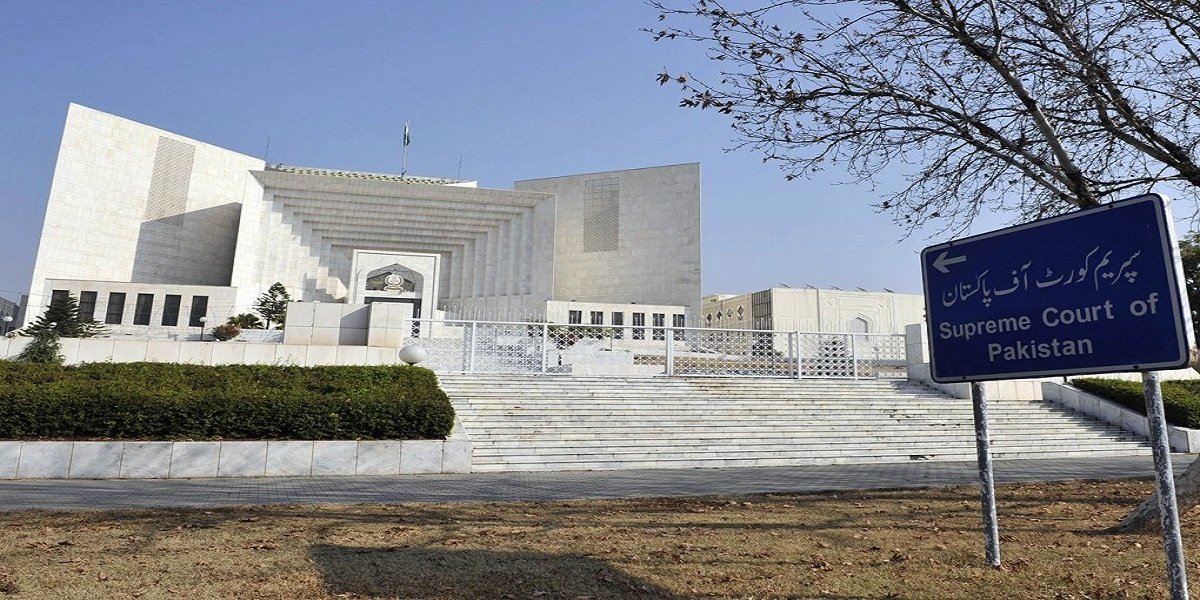
ISLAMABAD: After a scathing dissenting note from Justice Syed Mansoor Ali Shah and Justice Jamal Khan Mandokhail on the March 1 verdict on Punjab and Khyber Pakhtunkhwa polls, Chief Justice of Pakistan (CJP) Umar Ata Bandial remarked that it was their “opinion” and had no link with the ongoing case.
The CJP passed the remarks when the Supreme Court of Pakistan (SCP) resumed the hearing on Pakistan Tehreek-e-Insaf’s (PTI) petition challenging the Election Commission of Pakistan’s (ECP) decision on Punjab and Khyber Pakhtunkhwa elections.
CJP Bandial is heading the five-member larger bench hearing the plea. Apart from the CJP, the bench includes Justice Ijaz Ul Ahsan, Justice Munib Akhtar, Justice Amin-Ud-Din Khan and Justice Jamal Khan Mandokhail.
The Imran Khan-led party had challenged the Election Commission of Pakistan’s (ECP) decision to defer the Punjab polls till October 8.
The electoral body’s announcement came after financial and security authorities expressed their inability to support the electoral process.
Following this, Khyber Pakhtunkhwa Governor Haji Ghulam Ali also urged the electoral body to hold general elections on the same date (October 8) as the Punjab polls given the growing security threats from terror groups operating from the Pakistan-Afghanistan border regions.
At the outset of the hearing, CJP Bandial welcomed newly appointed Attorney General for Pakistan Mansoor Usman Awan. While seeing “good friend” Farooq H Naek, the CJP remarked that the court would need assistance of the senior lawyer on the matter.
The CJP remarked that the court does not want to drag this matter.
He said that ECP’s jurisdiction as per yesterday’s order will be seen by the court, while the request of the ruling coalition parties to become party in the case will be looked into later.
“Rule of law and democracy are two sides of a same coin. There should be mutual tolerance, patience and law and order” CJP Bandial observed.
Meanwhile, Naek interjected and told the bench that they were also stake holders in the case.
At this, the CJP assured the senior lawyer that no one denied Naek’s importance but he personally believed that they shouldn’t engage in a legal controversy.
He said that the parties had to decide the direction of circumstances while the court had to keep the facts in view.
“On the March 1 verdict my stance is that the law empowers the president to give a date for the elections. If you want clarification on the March 1 decision then file a separate petition,” said the CJP. He added that the “simple question” in the case was whether the ECP can change the election date or not.
“If ECP has the power then the matter will be resolved,” said the CJP
On the other hand, attorney general contended that if the court decision was 4-3 then there is no order. He added that if it was not a court order then the president cannot give the election date.
“The March 1 decision should be decided first,” said the AGP.
At this, CJP Bandial remarked that right now the case was not of giving the election date but of the delay. He added that elections were necessary for a democracy.
“Two honourable judges gave a decision. It’s the opinion of those two judges but is not related to the current case. Do not bypass a sensitive matter,” remarked the CJP.
The AGP responded that that current petition was seeking the implementation of the court orders in the March 1 judgment.
At this, CJP Bandial remarked that the bench members were there to review the questions raised in the petition. Apex court’s jurisdiction wasn’t limited to just the petition, he added.
On this point, AGP interjected and appealed for the formation of a full court on the matter.
“It is a request that this is an important matter and if the bench deems it appropriate then a full court should be formed,” said the AGP.
However, Justice Mandokhail remarked that the number of judges who favoured the March 1 ruling was an internal matter of the apex court.
“Just tell if the Constitution requires conducting elections in 90 days or not, and whether the ECP can postpone the date of election,” he asked.
Upon hearing Justice Mandokhail, the CJP thanked the judge for clearing the matter.
Meanwhile, PTI’s lawyer Ali Zafar maintained that every institution has to work while staying in its constitutional bounds.
At this, CJP Bandial remarked that he expected the PTI’s senior leadership to have the same behaviour as expressed by the lawyer. He also asked the lawyer whether he talked to the senior party leadership.
“PTI would have to be the first [one to speak] because they have approached the court,” the chief justice stated. He advised the parties of the case to avoid differences saying that there was violence, intolerance and economic crisis in the country.
At this, Barrister Zafar maintained that these crises would intensify if the elections are delayed.
CJP Bandial then remarked that it would order the government only if PTI takes the initiative.
Ruling alliance decides to become party in case
Hours before the hearing resumed on Tuesday, the ruling alliance decided to become a party in the case.
The Pakistan Muslim League Nawaz (PML-N), Pakistan Peoples Party and Jamiat Ulema-e-Islam-Fazl (JUI-F) have filed the pleas in the SC to become a party, and will present their stance when the hearing resumes.
Taking up the plea on Monday, the SC issued notice to the Election Commission for dragging its feet on polls in Punjab, and sought guarantees from the government and PTI to bury the hatchet for free, fair, and transparent elections.
Chief Justice of Pakistan Umar Ata Bandial had observed that timely general elections held “honestly, justly, fairly and in accordance with law” are crucial for democratic system of government mandated by our Constitution.
“Any flaw, deficiency or failing in the holding of general elections is, prima facie, a matter of public importance that affects the fundamental rights of the voting public,” he said.
The court had raised questions over the legality of the March 22 order of the ECP postponing the election, observing that the order was a blockade in the way of its judgement for the enforcement of fundamental rights of the people of the two provinces.
The top court had that ruled in a suo motu case earlier this month that the elections for Punjab and KP assemblies should be held within 90 days.
In light of the split ruling, President Arif Alvi had announced the date for the Punjab polls after consulting with the ECP.
Apart from sending notices to all parties in yesterday’s hearing, the SC also sent notices to the governors of both provinces through chief secretaries seeking their replies today over the legal points raised by the petitioner.
It also asked the ECP to come prepared to assist with the legal questions and the factual points in today’s hearing.
Read more: Supreme Court sends notice to ECP over delay in Punjab polls