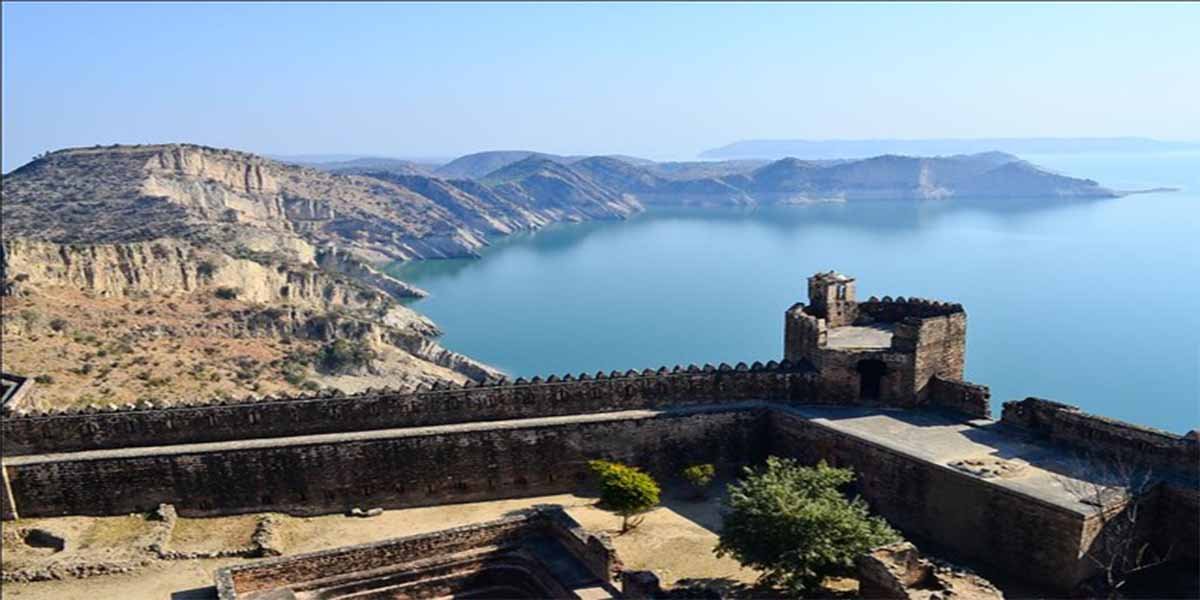
On the occasion of World Tourism Day, September 27, the local administration of Dadyal Tehsil of Azad Jammu and Kashmir (AJK) took an initiative to explore the lost glory of Ramkot Fort bringing it to the limelight as an attraction for people.
Though on the verge of collapse, it still offers everything to those having interest in tourism, nature-exploring and past history.
The masterpiece of the glorious architecture of 12th Century AD, the fort was built in 1186 by Sultan of Ghurid clan namely Ghiyath al-Din Muhammad, at top of a hill surrounded by blue waters of river Jhelum on three sides.
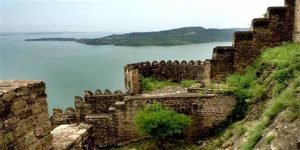
Ramkot Fort presents a beautiful landscape with blue river in the background and a majestic view from the top. The fort is located near the confluence of two rivers-Jehlum and Poonch and seems like a crown on a vertical cliff. Both these rivers now fall in Mangla Lake.
Due to its peculiar architecture, the Ramkot Fort is distinct among fortresses built in the Kashmir region. The architectural characteristics of Ramkot Fort suggest that it was also built in the period the Mangla and Muzaffarabad Forts were built.
A large number of tourists and nature-lovers from AJK and different parts of Pakistan came here to celebrate the World Tourism Day with the officials of Teshsil Dadyal present there to welcome them.
The families also, came to see this architectural glory of yesteryears and know about its historic importance. People, including men, women, children, who reached here to explore history found the fort’s location strategically more important than the forts as Lahore Fort (Shahi Qila), Peshawar Fort (Qila Bala Hisar) and Rohtas Fort.
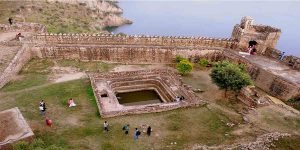
However, the visitors were perturbed after seeing that dilapidated condition of the ancient building which can be one of the best tourist attraction. The walls are falling with roofs already not in place. Neither Azad Jammu and Kashmir government nor government of Pakistan, or any organization paid any heed towards restoration of this dying glory.
Today, one can see that the whole complex has reduced to ruins and with the passage of time, the process will expedite, if immediate steps were not taken. The renovation of the fort can be a big attraction for tourists, nature-lovers, hikers and water sports lovers and earn huge revenue for the government.
Ramkot Fort was built on the bank of river Jehlum; is now surrounded by waters of Mangla Dam, the second largest water reservoir of Pakistan and 16th largest in the world.
Shortest approach to the site thorough boats from Haveli Bhathar village of Siakh area of Dadyal Tehsil of Mirpur district. A local notable of village Chaudhry Muhammad Younas has been eager facilitate tourists. He was one of the sponsors of Sunday’s event. Those fond of hiking and tracking can approach it by foot from a nearby Bhatar village that has land link with the fort.
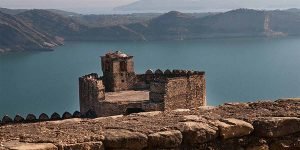
The other route is from Mirpur city; one can approach the fort by hiring boat from military’s water sports club Mangla. A relatively longer but smooth sail through Mangla Lake takes the visitors to the south-east side of gigantic structure located on the summit of the hill.
A short but steep climb uphill takes you inside the fort. This location must have been a strategic for a fort in the past, but these days, it has become the reason for its isolation and wilderness. The Structure of Ramkot Fort epitomizes the Muslim military architecture. The single entrance to the fort demonstrates smart war strategy. There is a water tank at the front against the background of a building on a raised plinth.
People visiting the fort on the World Tourism Day praised for the efforts made by Dadyal local administration, especially the young and energetic Assistant Commissioner Sardar Zeeshan Nasir and asked the governments of AJK and Pakistan to grab this opportunity and ensure the renovation of this historical fact of yesteryears.