ISLAMABAD: The Supreme Court of Pakistan (SCP) has declared null and void the election commission’s anouncement of postponement of elections in Punjab to October 8.
The three-member special bench delcared the Election Commission of Pakistan’s March 22 verdict unconstitutional and illegal.
It has ruled that the Constitution and law do not allow the ECP to postpone the elections.
Altering the election schedule slightly, the Supreme Court has announced that the elections in Punjab will be held on May 14 instead of April 30.
The six-page verdict ruled that as much as the election schedule has been complied with will be maintained.
Appeals against the nomination papers can be filed by April 10, the SC decision stated, adding the election commission’s report will be reviewed in-chamber.
The federal and provincial governments have been asked to assist the election commission under Article 243, and authorities ordered to release Rs21 billion to the ECP by April 10.
The verdict further stated that election commission must submit a report regarding receiving the funds to the Supreme Court. If the funds are not received, the court will issue an order to the relevant authorities, it added.
“If there is a shortage of funds for the KP Assembly, the commission can approach the court,” the court said.
The Punjab caretaker cabinet has been ordered to submit a security plan to the election commission by April 10, and the federal government to submit a similar plan by April 17, the verdict added.
The SCP ruled that the argument that the verdict was 4-3 is against the law. It added that the recent judgement of Justice Qazi Faez Isa does not apply to any pending case.
It further said the KP governor’s lawyer had excused himself from following up on the case, adding if a separate petition is received on the KP polls, it will be dealt with as per the law.
The decision further said the federal government should ensure the deployment of forces, including the Pakistan Army and Rangers.
If the federal and provincial governments violate the order, the commission can approach the court, the court order said.
Meanwhile, lawyers associated with the PML-N held a protest demonsration outside the Supreme Court against its verdict.
The demonsrators shouted slogans, and were carrying placards. Interior
PM’s Special Assistant Atta Tarar and other officials were also reported to have participated in the demonstration.
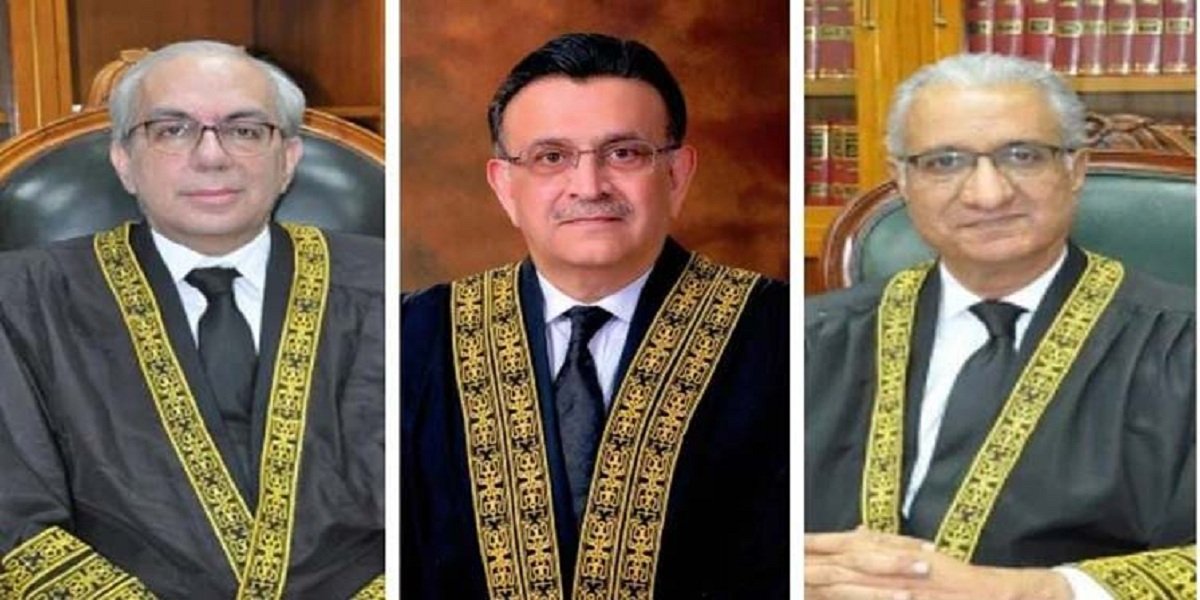
The bench comprising Chief Justice of Pakistan Umar Ata Bandial, Justice Ijazul Ahsan and Justice Muneeb Akhtar heard the Pakistan Tehreek-e-Insaf’s (PTI) plea in a lengthy hearing challenging the order of the Election Commission of Pakistan (ECP) for postponing the Punjab election to October 8, citing security reasons.
The bench later reserved its verdict. It had also allowed till today the defence secretary to file his report on the overall security situation.
On Tuesday morning, the Defence Ministry submitted its report that is being reviewed by the three-judge bench in their chambers.
Sources say the report includes details of internal and external threats to the country, as well as the reasons for the ongoing intelligence-based operations and non-availability of forces.
It also includes details of terrorist incidents in Punjab, election campaign in the province, and details of threats to the political leadership.
The top SCP judge is also set to read the reasons of the Ministry of Defense and the Ministry of Finance for not providing security and allocation of funds for the polls in two provinces.
The attorney general for Pakistan (AGP) said a lot of development budget has been spent, to which the CJP said the law officer has to explain his statement. “We don’t want to trouble the people,” the CJP remarked.
“If there is a scandal in the election, the debris will come to the court. That is why the option of political negotiations was given but there was no response to the negotiation option,” he said.
The Constitution is clear on when elections are to be held within 90 days, the CJP noted.
“When there is a crisis, a political solution should be found,” he remarked.
After a whirlpool of intra-court developments, things have snowballed into a serious duel between Chief Justice of Pakistan Umar Ata Bandial and the ruling PDM coalition, as the incumbent rulers have expressed ‘reservations’ over the three-member bench set to hear the case on the delay in holding of elections in Punjab and Khyber Pakhtunkhwa.
The court had also summoned the secretaries of interior and finance on Monday’s hearing. The AGP told the court the finance secretary is present along with a report.
The attorney general noted that there are rules for applications under Article 184(3), adding there was an SC verdict by a five-member bench on suo motu notice.
The CJP observed that the March 29 verdict of Justice Qazi Faez Isa suggests it would be appropriate to halt hearing of all cases under Article 184(3), adding the verdict did not contain a directive, but a wish.
Justice Munib noted that on one hand the political parties wanted a full court to hear the case and on the other, they want the hearing to be halted.
“The plea for a full court was rejected on Friday,” the AGP noted.
At this, Justice Akhtar asked the AGP to first decide if the hearing can be conducted or not. The CJP observed that the plea for a full court was rejected for the time being.
The maximum you can plead for is a larger bench, the CJP told the AGP.
“A larger bench will be requested at a later stage,” AGP Awan said.
CJP Bandial said no judge has been removed from the bench nor has anyone recused voluntarily. He added that nine members had sent the matter to the chief justice.
According to the court record, no judge recused from hearing the case, adding a full court hearing can be beneficial, but not full bench.
CJP Bandial said that during the last three days he had met with senior judges, and asked the AGP to argue on a larger bench, if he wanted.
“The judges who were not part of the nine-member bench should hear the case,” the AGP argued, adding the matter of a 3-2 and 4-3 verdict should be decided by the remaining two judges.
‘ECP was bound to implement the court verdict’, Justice Munib
Justice Ahsan observed that if the order of the Election Commission of Pakistan is upheld, the remaining appeals will be dismissed.
He further said the ECP was bound to implement the court verdict.
The CJP said the law did not allow anyone to delay elections, adding only the court can extend the date. In 1988 also, the polls were delayed on court orders, and it issues such orders considering ground realities, he noted.
Addressing PPP counsel Farooq H Naek, Justice Akhtar said that on the one hand, objections have been raised on the bench, while on the other the political parties have become part of the proceedings.
He asked the senior lawyer to read out the declaration of the coalition partners’ meeting and the language used.
‘Reservations on jurisdiction of the bench’ PPP lawyers apprises court
JUI-F lawyer Kamran Murtaza said the reservations were only on the bench, while Mr Naek said there were reservations about the admissibility of the petitions and the jurisdiction of the bench.
The CJP told the counsel not to become part of the proceedings if they wanted to boycott the case. “If you don’t want to boycott, give it in writing,” CJP Bandial suggested the political parties.
On being asked, the AGP told the court the federal government cannot boycott the proceedings. “The government works according to the Constitution.”
“For the last 48 hours, the media has been saying that political parties have no confidence over the bench,” Justice Munib Akhar observed, adding, “If you don’t trust us, how can you present arguments before us?”
The AGP said that according to the observations of four judges, the petitions against the ECP decision have been rejected.
“No clear order has been given in Justice Isa’s judgement,” the CJP observed.
AGP Awan then argued that the question was whose opinion should be deemed the majority decision. “The solution is that the judges who have heard the case before should be removed from the bench,” he suggested.
The CJP observed that security concerns were the main issue. The AGP observed it is a sensitive issue, and sought an in-camera briefing.
The issue of forces is not only about the army, but also of navy and air force, the CJP observed, adding if the army is busy, then help can be sought from the navy and air force.
“The election commission says 50 percent of the polling stations are safe,” the CJP noted, adding someone should at least come forward with the number of personnel required.
The AGP said the election commission had detailed some reasons in its verdict.
CJP Bandial asked the defence secreatary if the current security situation in Punjab is sensitive. The secretary responded in the affirmative, but said he could not divulge the details in an open court.
As PTI lawyer Ali Zafar appeared on the rostrum, he told the court the ECP says it can conduct the elections if adequate security was provided.
The CJP questioned how the security situation will improve by October 8, adding if the ECP required combative soldiers.
The defence secretary said reserve force can be utilised in certain cases, adding rules existed about summoning the reserve force.
The CJP asked for identification of the sensitive areas, adding the election commission had declared 45 percent polling stations sensitive.
The court allowed the defence secretary to submit a written report by tomorrow on the security situation.
Read more: Supreme Court reserves verdict in Punjab, KP polls delay case