ISLAMABAD: The seven-member constitutional bench of the Supreme Court of Pakistan (SCP), headed by Justice Aminuddin, has adjourned the hearing on the intra-court appeal against the trial of civilians in military courts.
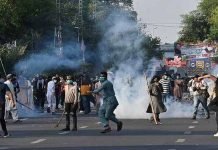
The case pertaining to the military trial of individuals involved in the May 9 incidents, with the bench questioning the legal grounds and rationale for these proceedings.
At the outset of the hearing, the bench posed critical questions regarding the military trials, specifically focusing on the inconsistencies in the handling of cases related to the May 9 events.
Justice Naeem Akhtar Afghan addressing the lawyer of the Ministry of Defense Khawaja Harris remarked, “You are carrying a basket full of questions,” as the lawyer attempted to present his arguments.
Justice Mussrat Hilali raised concerns about the authority to decide which accused individuals should be tried in military courts, questioning the basis for such decisions without suspending the Constitution.
“Give us an example where a military trial of a civilian has taken place without suspending the Constitution,” she remarked.
Justice Muhammad Ali Mazhar, noting that the FIR for all May 9 accused was identical, inquired how the distinction was made between those being tried in military courts and those in anti-terrorism courts. “Give us one FIR of all these cases,” he requested.
Further pressing for clarification, Justice Naeem Akhtar Afghan asked, “How many accused were there on May 9, and can you show any order of the anti-terrorism court regarding the accused sent to military courts?”
Justice Hassan Azhar Rizvi delved into past cases involving terrorism, asking Khawaja Haris to clarify where trials had occurred for attacks on various installations, including the GHQ and Karachi base. “Where were the trials held for incidents like the attempt to hijack an army chief’s plane?” he questioned, referring to similar acts of terrorism that had been tried in general courts.
The bench also revisited the landmark case involving Indian spy Kulbhushan Jadhav, highlighting concerns about the impact of the Supreme Court’s decision to declare Section 2D of the Army Act null and void.
“What will be the overall effect of declaring this section null and void? Can a case like that of Kulbhushan Jadhav be tried in military courts now?” Justice Muhammad Ali Mazhar asked.
Khawaja Haris argued that even in the case of an anti-national spy like Jadhav, a military trial would not be possible under the Supreme Court’s ruling. However, Justice Jamal Khan Mandokhel raised a counterpoint, emphasizing the need to strengthen Pakistan’s prosecution system rather than relying on military courts.
In a bid to understand the legal framework better, Justice Hassan Azhar Rizvi inquired whether the May 9 incident was considered a more serious crime than terrorism. “If we have good investigation officers and prosecutors, there will be punishments from the courts,” he remarked.
Earlier, Khawaja Haris had argued that Article 233 of the Constitution had no relevance to the military court case and emphasized the correct interpretation of Article 8(5). Justice Muhammad Ali Mazhar referenced previous Supreme Court decisions during Pervez Musharraf’s era, during which fundamental rights could not be enforced, to highlight the Court’s authority in such matters.
Justice Aminuddin, presiding over the bench, reiterated that fundamental rights can be defended in courts, though their implementation may be temporarily suspended. Justice Musarrat Hilali clarified that, in the present case, the accused had not had their fundamental rights suspended nor had an emergency been imposed.
The debate also touched on the powers of the President and the executive to suspend fundamental rights, with Justice Jamal Mandokhel quoting former Chief Justice Ghulam Muhammad Mirza. “I also have the same complaint with you,” Justice Mandokhel remarked to Khawaja Haris, suggesting that while the arguments were strong, they did not fully convince the bench.
The hearing concluded with the defense ministry’s lawyer Khawaja Haris pledging to continue his arguments in tomorrow’s session, as the court adjourned the hearing until then.
Read more: SCP Asks Why Military Courts Not Taking Cases of Martyred Soldiers