Brussels: Speakers at a conference reaffirmed their commitment to continue raising the Kashmir issue before the international community and to support the rights of the Kashmiri people, particularly their internationally recognized right to self-determination.
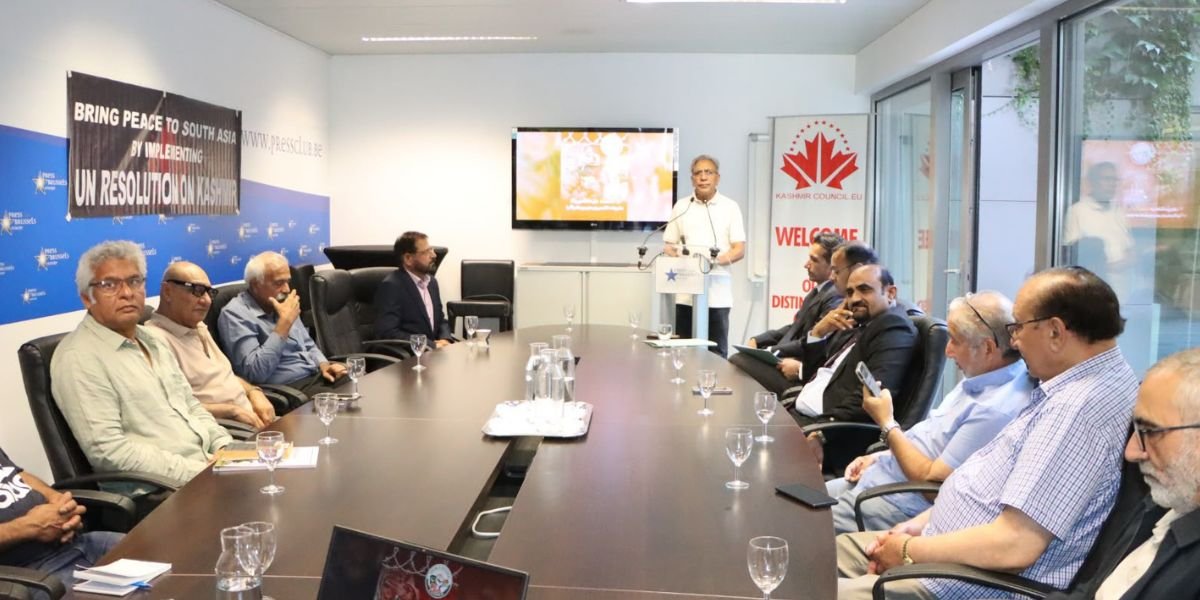
The conference was organized by the Kashmir Council Europe (KCEU) at the European Press Club, Brussels, to mark Youm-e-Istehsal (Exploitation Day/Black Day) observed on 5 August. The event was attended by intellectuals, experts, and representatives from various segments of society.
The conference was addressed by Ali Raza Syed, Chairman of Kashmir Council Europe (KCEU); Faisal Fayyaz, Deputy Head of Mission at the Embassy of Pakistan in Belgium; and Chaudhry Khalid Joshi, President of the World Kashmir Diaspora Alliance Europe.
Speaking on the situation in Azad Jammu and Kashmir, Chair of KCEU Ali Raza Syed said that despite the internal challenges facing Azad Kashmir, the people of Azad Kashmir and Pakistan could never forget the suffering of their brothers and sisters in Indian Illegally Occupied Jammu and Kashmir (IIOJK).
He said history must always remember the dark chapters of 27 October 1947, when India deployed its forces in Jammu and Kashmir and occupied a large part of the territory, and 5 August 2019, when India unilaterally revoked the special constitutional status of the occupied territory in an attempt to alter its internationally disputed status.
He stressed that the Jammu and Kashmir dispute remains an internationally recognized dispute under the relevant resolutions of the United Nations Security Council, and that its final settlement should be made in accordance with the wishes of the Kashmiri people.
He added that India’s unilateral action not only undermined the fundamental rights of the Kashmiri people but also created serious concerns regarding regional peace and stability.
Ali Raza Syed noted that for decades the people of Jammu and Kashmir have been struggling for their fundamental right to self-determination while continuing to face political repression, human rights violations, and various restrictions by the Indian occupation authorities.
He also emphasized that the current situation in Azad Jammu and Kashmir should also be addressed with patience, mutual understanding, and within the framework of the law and democratic norms adding that a peaceful settlement to address the concerns of people of Azad Kashmir through negotiations is particularly essential. A socially united and political stable Azad Kashmir will enable the Kashmir issue to be presented more effectively on the global stage.
In his address, Deputy Head of Mission Faisal Fayyaz said that the participants had not gathered merely to commemorate a day, but to express their solidarity, commitment, and unwavering support for a people whose sacrifices, struggle, and aspirations form an integral part of their shared history.
He said that on Youm-e-Istehsal Kashmir, tribute should be paid to the Kashmiri mothers who sacrificed their sons, to the sisters who demonstrated extraordinary patience and resilience, and to the children who have continued to hold on to the hope of a better future despite growing up in an atmosphere of fear and uncertainty.
He reiterated that no unilateral action could alter the internationally recognized disputed status of Jammu and Kashmir. Pakistan, he added, would continue its political, diplomatic, and moral support for the Kashmiri people and would keep highlighting the human rights violations committed by India in the occupied territory.
Addressing the conference, Chaudhry Khalid Joshi, President of the World Kashmir Diaspora Alliance Europe, stated that peace, stability, and unity in Azad Jammu and Kashmir are indispensable for strengthening the Kashmir cause.
He said that if political harmony, public confidence, and a peaceful environment are maintained in Azad Kashmir, it would enable Kashmiris and their supporters to present the Kashmir issue before the international community in a more effective, organized, and credible manner. He urged all political forces, state institutions, and public representatives to demonstrate responsibility, restraint, and foresight while giving priority to the broader national interest.
He further said that on 5 August, they once again renewed their commitment to continue supporting the people of Indian Illegally Occupied Jammu and Kashmir struggling for our common goal of right to self-determination, human dignity, and fundamental rights. At the same time, he emphasized that promoting peace, justice, unity, and mutual trust in Azad Jammu and Kashmir remains one of the most effective ways to strengthen the Kashmir freedom movement.
The speakers collectively reaffirmed that they would never forget the suffering, sacrifices, and unwavering struggle of their Kashmiri brothers and sisters for the right to self-determination. They pledged to continue raising the voice of the Kashmiri people before the world, exposing the realities on the ground, and playing a constructive role in promoting peace, justice, and human dignity.
On the occasion, a documentary film highlighting the situation in Indian Illegally Occupied Jammu and Kashmir, particularly the human rights violations committed against the Kashmiri people, was also screened.
Also read:Iran warns Gulf States of retaliation if U.S. launches fresh strikes