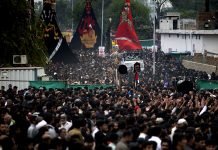

Every year, as the sorrowful days of Muharram dawn, my mind journeys into the past. Not only toward the universal grief of Imam Hussain (AS) and the tragedy of Karbala, but also to the dusty lanes of Ahmed Pur East, beneath the shade of the ancient Bohar (Imambargah), and along the weathered walls of Kattra Ahmed Khan. Here lie my family’s roots, intertwined with the profound, tolerant culture of Ashura that once flourished in the heart of the Wasaib (Saraiki region).
When my grandfather, Ahmed Nawaz Khan, settled in Ahmed Pur East due to his job, his home stood near the Bohar Imambargah, renowned for its ancient banyan tree. The stories passed down by my father and the elders paint a picture of a society deeply different from the fragmented tales one hears today. Tolerance was not a slogan; especially during Muharram, it was the lifeblood of society.
The elders spoke of a time when sectarian labels would blur, especially during worship. Members of the respected Syed family recall how my grandfather served them out of deep moral duty (farz-e-imani), sending food prepared in our home daily to their houses without distinction between Shia and Sunni. This was not charity; it was honor. Remarkably, the food sent to the Syeds took priority; only after it was distributed would the children in my grandfather’s house eat. It was a steadfast routine, testifying to the ingrained respect for the Ahl-e-Bait (AS) in daily life.
Ashura was not a spectacle but a deep, shared mourning. “It was as if a death had occurred in every home,” my father would recount. The grief for the household of Prophet Muhammad (PBUH) was felt everywhere, personal and collective. A solemn hush prevailed.
When my grandfather retired, he moved not to his ancestral city of Bahawalpur but to his maternal city of Rahim Yar Khan, settling near Takia Lal Faqir, adjacent to another Imambargah. There too, the spirit of tolerance found unique expression. The same land that served as a Sunni funeral ground throughout the year transformed into a sacred Imambargah during the ten days of Muharram. This seamless sharing of space reflected mutual respect.
The family’s devotion was deeply personal. My maternal uncle, Muhammad Khan Durrani, the only son born after five daughters, fulfilled my grandmother’s vow by becoming Faqir-e-Hussain during Ashura, offering Niaz-e-Hussain with reverence. The tradition continued for me, as the only son born after three sisters. My paternal aunt vowed to offer a dupatta (veil) to Syeda Zainab (SA) during the Ashura procession, while another of my father’s aunts vowed that my first cloth be an utran (worn garment) of a Syed, acquiring it respectfully from the custodian of Darbar Maa’u Mubarak.
My grandmothers actively participated in Muharram rituals, offering food (langar) and water (sabeel). I recall serving water to mourners outside Takia Lal Faqir under the scorching sun as a child. The sanctity of Muharram was paramount. Radios and TVs were locked away, and even children’s laughter was restrained. Elders would remind us: “What face will you show the Prophet (PBUH) when his family suffered such tragedy, and you choose to laugh during these days? Feel the grief, share the pain.”
Sadly, this tapestry of shared grief and tolerance began to unravel. A smog of suspicion and hate speech clouded the air. Leaders bridging sectarian lines were targeted. Ashura processions came under heavy security, fear replacing trust. Even within families, elders began abandoning traditions. Offering food and water was viewed by some as “promoting Ashura culture,” deviating from the inclusive reverence of the past. Shared spaces became tense, and the spirit of openness seemed lost.
Yet traditions rooted in love and respect have resilience. Today, whispers of the old tolerance are rising again. Sunnis are once again seen offering water and food during Ashura. They attend Majalis to hear Hussain’s (AS) message. Shared spaces like Takia Lal Faqir function openly as both funeral grounds and Imambargahs, echoing past harmony. The Bohar Imambargah is now open year-round to people of all sects. The distribution of Haleem on Ashura day symbolizes shared giving and remembrance.
Most notably, people from all sects now participate in Ashura processions. Hate speech has decreased, and targeted killings of bridge-building leaders have stopped. While vigilance remains essential, society appears to be moving toward renewed tolerance, where coexistence is once again a living reality.
The spirit of Hussain (AS) transcends sect. His message of revolution for truth, justice, and mercy is universal. The tolerance of our elders was not weakness; it was strength rooted in faith. Seeing this spirit’s revival brings hope. Mourning Hussain (AS) together can unite us in shared humanity and reverence for the sacred.