By Saharyab Afridi
Ahmad had done everything right. He applied to the University of Leeds, completed every requirement, submitted bank statements and enrollment paperwork, and began preparing for a move he hoped would change his life. In September 2024, at the final stage, his visa application was rejected. He lost Rs550,000. He reapplied in 2025 and succeeded, but the damage had already been done.
“It was a tiring and stressful process, and being rejected without a clear reason was painful,” Ahmad said. “We lost time and money. My family could not support a second application, but I applied again and got lucky.”
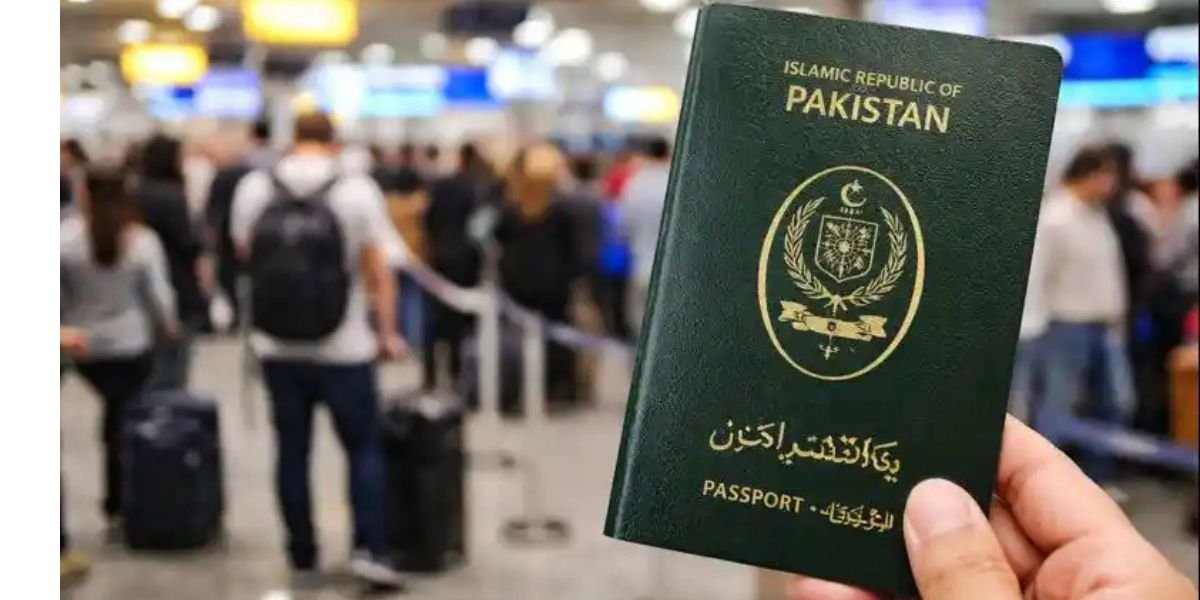
Ahmad’s story is not an exception; it is a pattern. For millions of Pakistanis, a passport is less a symbol of mobility than a reminder of fragility. It determines not only where one can travel, but how one must plan, spend, and then wait. From embassy queues to opaque online portals and last-minute refusals, the passport often becomes the instrument through which ordinary hopes are quietly taxed and, at times, derailed.
According to the Henley Passport Index 2025 (Henley & Partners), Pakistan remains among the world’s weakest passports, offering visa-free or visa-on-arrival access to just over 30 countries. Neighbouring states fare better: India has access to more than 60 destinations, the Philippines to 66, and Bangladesh to around 40. These figures are not mere trivia. Visa-free access is not generosity; it is confidence. It reflects an assessment that a state can vouch for its citizens, manage risk, and take responsibility when things go wrong. Pakistan’s low standing reflects a prolonged deficit of trust in the institutions behind the document. This is not merely a diplomatic embarrassment; it is a failure of predictable public service at home.
A passport is best understood not as a badge of identity, but as a proxy for administrative credibility. Strong passports signal that a state can reliably document its people, manage exits and returns, share accurate data with other governments, and enforce migration rules. Weak passports signal unpredictability. Borders do not open out of sympathy; they open to systems that appear stable, accountable, and enforceable.
This is not an abstract problem. Years of visa overstays, document fraud, and inconsistent enforcement have eroded international confidence. Even where such issues involve a minority, the consequences are collective. In global mobility regimes, reputations travel faster than reforms—and take far longer to recover.
The contrast with regional peers is instructive. India has invested heavily in passport facilitation as a core state function. It operates numerous offices and service centres, offers urgent processing routes that deliver passports in days rather than weeks, and uses outsourced biometric services abroad to reduce queues and discretion. Bangladesh adopted e-passports early and operates a hybrid system that speeds processing for citizens overseas. The Philippines treats mobility as a development policy, deploying mobile passport units and professionalised consular services to reduce delays for overseas workers.
Pakistan’s system is large but uneven. While it operates many domestic offices and an online application portal, overseas processing can stretch into weeks or months. Digital forms remain difficult for many to navigate, particularly blue-collar workers in the Gulf. Brokers fill the gap, charging fees and increasing the risk of fraud. In the Gulf, a Pakistani construction worker may quietly pay a broker $30–$60 to book an embassy slot and expedite a passport renewal—a modest sum that buys weeks of time and avoids long consular queues. What should be routine bureaucracy often becomes a prolonged arc of uncertainty.
That uncertainty carries real costs. Students like Ahmad lose fees and academic time. Professionals miss contracts and relocation opportunities when travel timelines become unpredictable. Families endure prolonged separations because documents do not move on time. These losses are personal, but their effects are cumulative. Friction in passport facilitation limits overseas employment, depresses remittance flows, and weakens engagement with the Pakistani diaspora. Remittance inflows fell to about $27 billion in 2023 and were forecast to recover to roughly $28 billion in 2024, underscoring how fragile external earnings remain when mobility is constrained, according to the World Bank’s Migration and Development Brief 40.
Security narratives have further complicated matters. Since 2001, borders have tightened, and Pakistan’s passport has struggled to shed associations with instability, irregular migration, and document misuse. Isolated incidents of fraud or undocumented travel reinforce suspicion. Once a passport’s reputation is damaged, even genuine reforms do not immediately translate into eased mobility. Border regimes reward consistency over correction.
Pakistan has taken necessary technical steps. Machine-readable passports were introduced in the early 2000s, and e-passports have begun rolling out more recently. These upgrades are important—but insufficient. Technology can improve documentation, but it cannot replace coherent policy, consistent enforcement, or patient diplomacy. The deeper shortfall is strategic. Pakistan lacks a long-term mobility policy that aligns domestic facilitation with international confidence-building. Other states negotiate labour agreements, student pathways, and data-sharing frameworks; Pakistan has too often reacted to crises rather than shaping outcomes.
The path forward is clear and achievable. Grant the Directorate General of Immigration and Passports greater administrative and financial autonomy so it can invest in staff, training, and infrastructure that meet overseas demand. Redesign online systems for low-literacy users, backed by multilingual helpdesks and local outreach, so citizens are not forced to rely on brokers and costs fall. Professionalise consular services and adequately staff missions in high-demand regions—particularly the Gulf—to shorten queues and speed verification. Tighten identity verification in coordination with national databases to close loopholes that harm credibility. Treat mobility as a strategic diplomatic priority and pursue incremental bilateral arrangements that build reciprocal trust.
These reforms will not produce instant miracles. Trust is built slowly and tested repeatedly. But the alternative is to keep exporting uncertainty. Each delayed passport, each opaque refusal, and each family pushed into financial distress over a visa decision compounds public cynicism and erodes the state’s moral standing.
A passport should not be an exercise in justification. It should be a simple declaration that the state stands behind its citizens when they travel, study, and work abroad. Ahmad eventually succeeded on his second attempt. Many others do not have the resources, resilience, or luck to try again. The true cost of a weak passport is measured not only in rankings, but in delayed lives and narrowed horizons.
If Pakistan wishes to be taken seriously in the corridors where mobility is negotiated, it must begin at home. Fix the administrative bottlenecks, professionalise facilitation, and pursue credibility through consistent practice. Trust cannot be marketed; it must be earned—decision by decision. Until then, ordinary Pakistanis will continue to plan around uncertainty, pay for it, and sometimes lose everything to it.
Saharyab Afridi is a master’s student of Mass Communication at NUST and writes on media and public affairs.