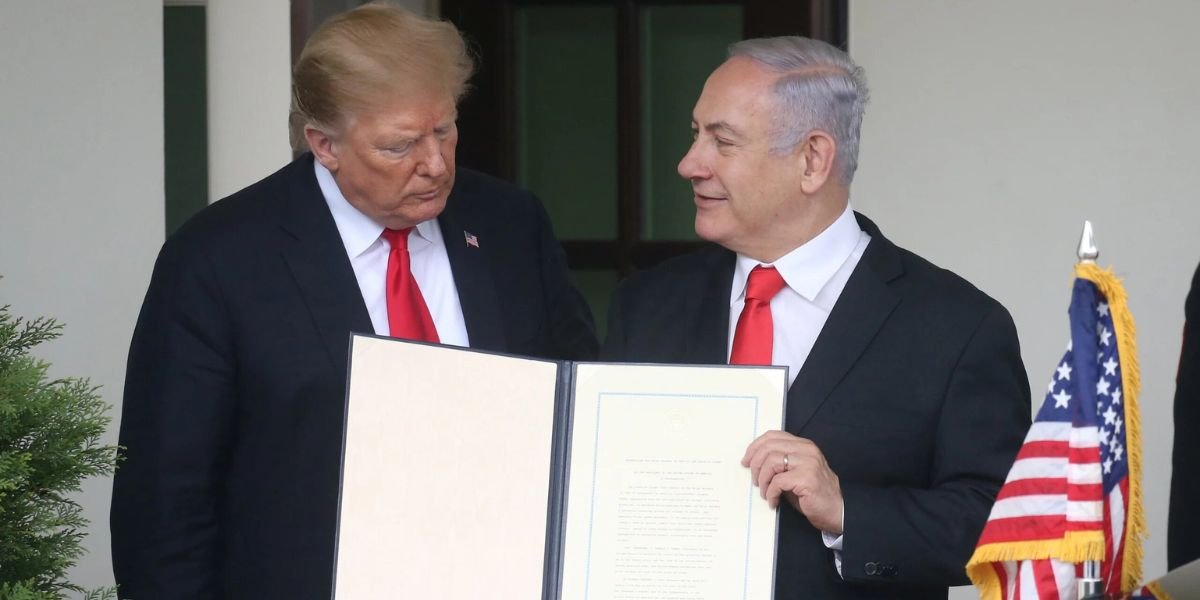
During a White House Hanukkah celebration on December 16, 2025, President Donald Trump made a startling declaration about the Golan Heights, openly revisiting his 2019 decision to recognise Israeli sovereignty over territory internationally acknowledged as Syrian land occupied by Israel during the 1967 war. Trump boasted that no previous American president had dared take such a step, portraying his action as bold, swift and unconstrained by diplomatic caution. He framed the recognition not as a complex legal judgment but as an act of personal resolve, reducing decades of international dispute to a matter he claimed required only minutes to decide.
Trump described the decision-making process with casual bravado, saying he asked then US ambassador to Israel David Friedman to explain the importance of the Golan Heights in five minutes or less. According to Trump, he interrupted after barely two minutes, declared that he understood everything necessary and proceeded to approve recognition immediately. He joked that the land was worth trillions of dollars and remarked that he should have asked Israel for something in return. The remarks transformed a grave issue of sovereignty, occupation and war into an anecdote of impulsive executive authority, with profound geopolitical consequences.
Trump used the occasion to reaffirm his broader alignment with Israel and the Jewish community, listing what he described as historic achievements of his presidency. He cited moving the US embassy from Tel Aviv to Jerusalem, backing the Abraham Accords and withdrawing from the Iran nuclear agreement negotiated under President Barack Obama, which he said endangered regional security rather than containing Iran. He framed each policy as evidence of loyalty, friendship and moral clarity, repeatedly portraying himself as the most reliable ally Israel has ever had in Washington.
He also spoke at length about his personal connections with Jewish Americans, recalling childhood interactions through his father and emphasising long-standing familiarity rather than political calculation. He referenced his daughter Ivanka Trump’s conversion to Judaism after marrying Jared Kushner as further proof of closeness, blending personal narrative with state policy and reinforcing the impression that national decisions affecting millions were shaped through sentiment and loyalty rather than institutional deliberation or international legal frameworks.
The most revealing segment of Trump’s speech came when he warned that Congress and the Senate were becoming increasingly antisemitic, claiming that traditional pro-Israel influence in Washington was fading. He described this shift as dangerous and urged greater vigilance from supporters. The statement amounted to a rare acknowledgment that discomfort with Israel’s conduct is growing within US political institutions, even as it implied that loyalty to Israel should remain a litmus test in American politics.
Despite Trump’s claims, Israel continues to enjoy unparalleled diplomatic, military and financial backing from the United States. Washington has repeatedly used its veto power at the United Nations to shield Israel from accountability, even when resolutions condemning occupation or settlement expansion enjoy overwhelming global support. This posture undermines the credibility of the international system the US helped construct, exposing a contradiction between professed grievance and actual power.
Trump’s conduct cannot be examined in isolation from regional realities. Several Muslim-majority states have normalised relations with Israel, expanded trade and entered energy partnerships even as Gaza suffers devastation. Egypt’s multibillion-dollar gas agreements with Israel inject revenue into the Israeli economy during ongoing military campaigns. Such actions weaken moral criticism of Washington, revealing a regional order where economic interests and regime security override solidarity with Palestine.
Reports of military logistics and arms transfers involving regional actors have further deepened perceptions of complicity. Whether fully substantiated or not, these allegations reinforce a widespread belief that Palestinian suffering is discounted in exchange for alliances and profits. In this context, outrage directed solely at Trump or the United States appears selective and incomplete.
Trump’s long-promised Middle East peace initiative has effectively collapsed. Mechanisms to stabilise Gaza were never implemented, ceasefire enforcement remained absent and settlement expansion continued unabated. Gaza remains devastated, its civilian population displaced, while accountability mechanisms remain paralysed. The plan functioned less as a pathway to justice than as a political diversion.
In this light, Trump’s Hanukkah speech read less as a celebration than a confession. It revealed a worldview where power overrides principle, alliances eclipse law and suffering becomes collateral. Condemning Trump alone is insufficient. He acted openly but was enabled by a broader system unwilling to enforce its own rules or defend universal standards of justice.
If peace and justice are to mean anything, the Muslim world must confront its own contradictions. It cannot decry occupation while financing its beneficiary, nor invoke international law selectively. Trump’s words should be read as a mirror, reflecting the erosion of norms and collective failure to resist it. Until complicity ends and accountability is demanded consistently, Palestine will remain abandoned and international law weakened.