
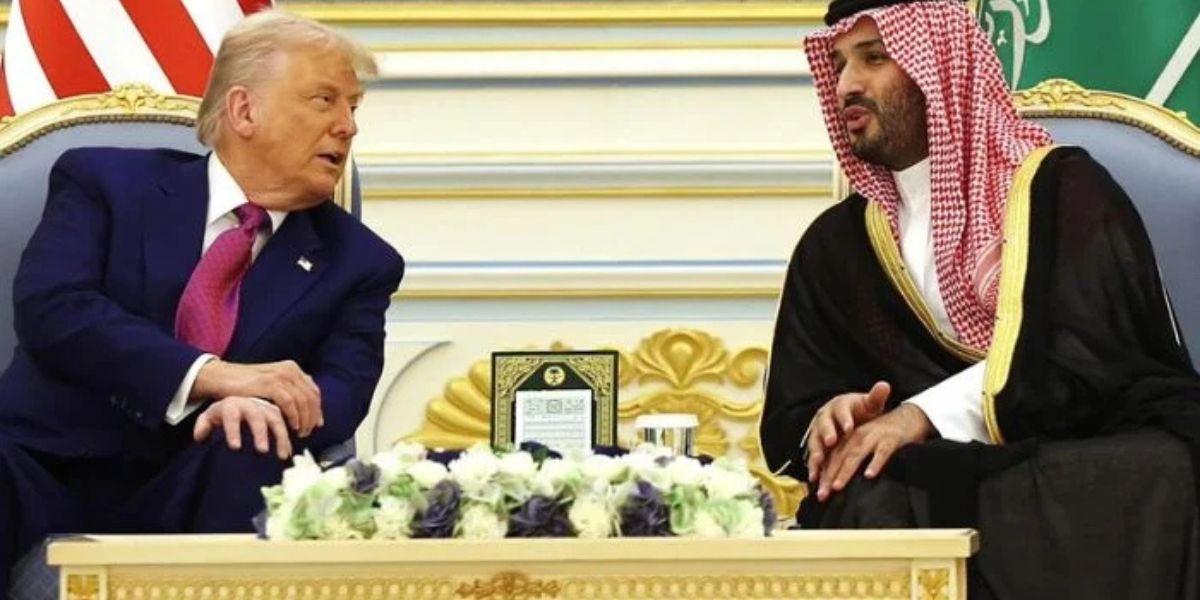
As negotiations between the United States and Iran move closer to a potential settlement, President Donald Trump has introduced a condition that has shocked many observers across the Middle East. According to his public statements, countries such as Saudi Arabia, Qatar, Pakistan, Türkiye, Egypt, Jordan, and others should join the Abraham Accords and normalize relations with Israel as part of the broader framework surrounding any final agreement with Iran. Trump went even further, suggesting that countries unwilling to sign onto the accords should not be part of the deal at all.
This demand has generated a fundamental question: what connection exists between a peace agreement between Washington and Tehran and the recognition of Israel by countries that are not direct parties to that conflict?
For many analysts, the answer is simple: there is no direct connection. The Iran negotiations concern sanctions, military confrontation, regional security arrangements, maritime navigation, nuclear activities, and the prevention of future war. The Abraham Accords concern diplomatic recognition of Israel and the broader Arab-Israeli relationship. They are separate issues involving different parties, different disputes, and different objectives.
The controversy becomes even more significant when one examines the original political context of the Abraham Accords themselves. When the accords were launched in 2020, they were presented as a pathway toward peace, coexistence, economic cooperation, and eventually a more stable Middle East. Yet critics argued from the beginning that the agreements weakened the principles of the 2002 Arab Peace Initiative, which conditioned normalization with Israel on the creation of an independent Palestinian state.
That criticism has not disappeared; in fact, it has grown stronger. Today, many people across the Muslim world continue to believe that normalization should be linked not to Iran, but to Palestinian self-determination. If there is to be a historic regional settlement, they argue, the benchmark should be Israel’s acceptance of a credible and irreversible path toward Palestinian sovereignty.
Such sovereignty would mean far more than symbolic recognition. It would require a Palestinian state with internationally recognized borders, elected institutions, a parliament, a government accountable to its citizens, a banking system, economic independence, security institutions, a national flag, and the right to determine its own future through democratic means. For many supporters of a two-state solution, this has always been the logical destination of any peace process involving Israel and the Arab world.
If that was the intended destination, then many critics ask why the Abraham Accords are now being attached to an Iran peace agreement instead of being tied to progress on Palestinian statehood. They argue that the current linkage reverses the original logic of regional diplomacy. Instead of normalization being the reward for progress toward peace and justice, normalization itself becomes the prerequisite for resolving an entirely different conflict.
This is where accusations of coercive diplomacy emerge. Critics contend that when countries are told that regional stability, participation in negotiations, or protection from future escalation depends upon accepting an unrelated political demand, the negotiation begins to resemble pressure rather than persuasion. The countries being asked to sign are not the ones negotiating over uranium enrichment, sanctions, military deployments, or ceasefire arrangements. Yet they are being asked to make significant diplomatic concessions as part of a settlement in which they are not principal parties.
The timing of the demand also raises questions. The United States and Israel emerged from months of conflict with Iran facing significant military, economic, and political challenges. Energy markets remain fragile. Shipping routes have been disrupted. Global investors remain nervous. Even among America’s traditional Gulf partners, questions have emerged regarding the reliability of regional security arrangements. In this environment, expanding the Abraham Accords offers Washington and Israel a visible diplomatic achievement that can be presented as a historic breakthrough.
Yet many governments appear reluctant. Pakistan has publicly rejected the proposal, arguing that recognition of Israel conflicts with its long-standing position on Palestine. Saudi Arabia has repeatedly maintained that normalization requires a credible path toward Palestinian statehood. Qatar has similarly emphasized the centrality of Palestinian rights. Türkiye has become increasingly critical of Israeli policies in Gaza and the broader region. Public opinion across much of the Muslim world remains strongly supportive of Palestinian self-determination.
This public sentiment cannot be ignored. Governments may sign agreements, but they must also maintain domestic legitimacy. The political costs of normalization have increased substantially following years of conflict in Gaza, Lebanon, and elsewhere. Any leader contemplating recognition of Israel without meaningful progress on Palestinian sovereignty faces a difficult political calculation.
The broader strategic question is whether the current approach advances peace or delays it. Every additional condition attached to the Iran negotiations creates new obstacles and new opportunities for disagreement. If the objective is ending hostilities, reopening trade routes, stabilizing energy markets, and reducing military tensions, then many analysts argue that those goals should remain the primary focus of the negotiations.
The economic stakes are enormous. Continued uncertainty affects oil prices, shipping insurance costs, trade flows, investment decisions, and inflation. Higher energy prices ripple through economies around the world, affecting transportation, manufacturing, food prices, and household budgets. Millions of ordinary people ultimately bear the costs of prolonged geopolitical instability.
Another issue concerns trust. One reason negotiations between Washington and Tehran have repeatedly struggled is the perception that objectives continually shift. Critics argue that whenever discussions appear close to producing a breakthrough, additional conditions emerge. Whether that perception is entirely accurate or not, it has contributed to deep skepticism regarding the durability of any future agreement.
For a peace settlement to succeed, all sides must believe that the agreed terms are final and that new requirements will not continually be added. Otherwise, negotiations risk becoming an endless process in which certainty remains permanently out of reach.
Supporters of Trump’s strategy argue that broader regional integration could create the foundation for a more stable Middle East. They believe that stronger ties between Israel and Arab states could reduce tensions and encourage future cooperation. Critics counter that stability built on unresolved grievances is unlikely to endure. They argue that ignoring Palestinian aspirations while demanding wider recognition of Israel addresses symptoms rather than causes.
Ultimately, the central question remains straightforward. If normalization with Israel is truly intended to promote peace, should it not be linked to the achievement of the very objective that generations of diplomats have identified as essential—a viable Palestinian state living alongside Israel in peace and security? If the answer is yes, then attaching the Abraham Accords to an Iran settlement appears difficult to justify. If the answer is no, then the region must confront the reality that the accords have evolved from a peace initiative into a broader geopolitical project.
The future of the Middle East will not be determined merely by signatures on agreements. Lasting peace requires legitimacy, trust, consistency, and a willingness to address the root causes of conflict. A settlement with Iran may help reduce immediate tensions, but genuine regional stability will remain elusive unless it also addresses the unresolved question that has shaped Middle Eastern politics for generations: the right of Palestinians and Israelis alike to live in secure, recognized, and sovereign states. Only then can peace become more than a diplomatic slogan and begin to resemble a durable political reality.