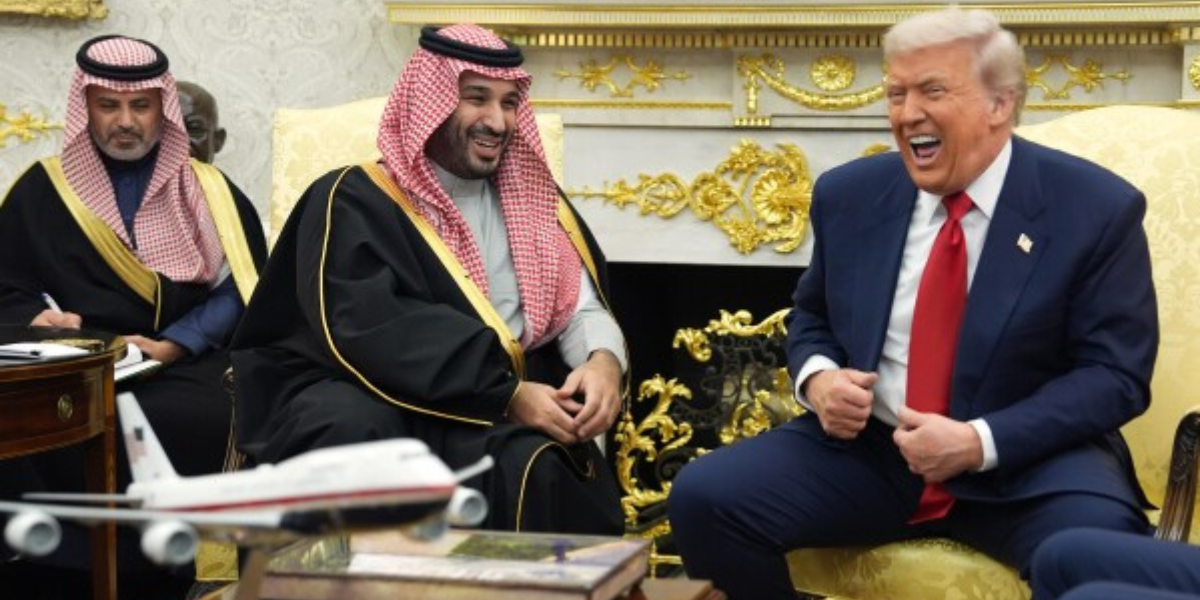
When Crown Prince Mohammed bin Salman stepped onto the White House lawn on 18 November 2025, it was not just a long-delayed rehabilitation of a controversial leader. It marked the opening scene of a transactional transformation: a Saudi–American bargain that merges hundreds of billions of dollars in investment with the transfer of the United States’ most advanced stealth fighter to a second power in the Middle East. According to a White House fact sheet, Saudi Arabia has committed to invest approximately $600 billion in the United States over the coming years, spanning energy, critical minerals, technology and infrastructure. During this visit alone, officials say at least $20 billion will be directed specifically toward U.S. artificial intelligence data centres and digital infrastructure, anchoring Saudi capital to the next engine of American power.
Alongside this economic surge comes military hardware. Trump has publicly confirmed that Washington will sell F-35 Lightning II fighters to Saudi Arabia, ending Israel’s exclusive status as the only F-35 operator in the region. Riyadh has formally requested up to 48 aircraft, a “multi-billion-dollar” package that U.S. officials acknowledge will transform the regional air balance. Although the exact price remains classified, comparisons are revealing. Australia’s F-35 programme costs roughly $160 million per jet when training, spares and support are included. Switzerland’s purchase of 36 F-35As is valued at about $7.5 billion, more than $200 million per aircraft with ancillary costs. Based on these precedents, defence analysts estimate that a 48-jet package for Saudi Arabia—complete with weapons, simulators, basing infrastructure and training—could easily reach the $10–12 billion range, with long-term lifecycle costs far higher.
This prospective deal adds to an already immense pipeline of U.S.–Saudi defence commerce. In May 2017, Trump’s first term opened with letters of intent for $110 billion in immediate arms sales and up to $350 billion over ten years. In May this year, his second administration announced another $142 billion defence cooperation package in Riyadh, described as the largest in U.S. history, spanning air defence, missiles, naval systems and cybersecurity. With an additional F-35 tranche valued at roughly $10–12 billion, Trump-era defence frameworks with Saudi Arabia approach $260 billion in nominal value—before accounting for legacy sales and support. Not all of it will be delivered, but the political message is clear: Saudi Arabia is no longer merely a major oil customer; it is the premier client of the U.S. defence-industrial system.
Understanding how disruptive this shift is requires recalling Washington’s traditional Middle East doctrine. For decades, U.S. strategy prioritised two goals: securing vital energy and trade routes, and safeguarding Israel through bases, pre-positioned stockpiles and supportive regimes. U.S. aid to Israel reflects that priority. Under a ten-year memorandum of understanding signed in 2016, Washington pledged $38 billion in military assistance between 2019 and 2028—$3.8 billion annually, including $500 million for missile defence. In total, Israel has received more than $300 billion in U.S. assistance since 1948, making it the largest recipient of American aid globally. Today, Israel holds approximately $39 billion worth of active U.S. Foreign Military Sales cases.
Much of that arsenal has been used in Gaza since October 2023. Following Hamas’s attack, which killed around 1,200 people in Israel, the subsequent war has, according to Gaza Health Ministry figures and UN-cited estimates, killed more than 69,000 Palestinians by early November 2025, with total casualties on both sides exceeding 71,000. Entire neighbourhoods were destroyed, famine took hold, and the term “genocide” moved from activist language to the vocabulary of UN officials, human-rights groups and international courts. In much of the Arab and Muslim world, this reinforced a long-held belief: that American bases across the Gulf existed primarily to secure Israel’s military freedom rather than to defend their host nations.
In this context, the Trump–MBS summit is striking because it erodes the aura of Israel’s military untouchability. By permitting Saudi entry into the F-35 club, Washington is no longer treating Israel as the only trusted steward of fifth-generation technology in the region. Instead, the United States is elevating Riyadh into a near-peer—despite the need to revisit debates about Israel’s “qualitative military edge” in Congress. The Council on Foreign Relations notes that maintaining that edge has historically meant giving Israel first access to new platforms and compensating it when others received high-end systems. This time, Israel must watch as another regional actor is courted with America’s most prized aircraft.
The implications extend beyond a single procurement programme. Saudi Arabia is strengthening security ties with Pakistan, the Muslim world’s only declared nuclear-armed state, and has the financial capacity to acquire nearly any conventional system. An F-35 fleet would sit atop a layered ecosystem of imported missiles, defences and cyber capabilities—operated by Saudi officers but maintained by U.S. and allied technicians. Simultaneously, tens of billions in Saudi AI and tech investments will bind its economic future to U.S. semiconductor and data infrastructure. Economic leverage will flow both ways: Washington supplies weapons and regulatory shelter; Riyadh provides capital, energy coordination and political influence.
For Gulf publics who watched U.S. forces stand aside—or assist—during the devastation in Gaza, the symbolism is potent. If the same American system that armed Israel now empowers a Saudi-led bloc to assert its own interests, longstanding political assumptions begin to shift. Arab governments, increasingly aware that U.S. basing arrangements have historically served Israel, will face pressure to limit future U.S. operations to their own national interests. If Israel contemplates future annexations or regional strikes launched from territory hosting U.S. troops, it may encounter pushback not only from its neighbours but also from Gulf rulers who now possess—or will soon possess—F-35s of their own.
This evolving landscape does not mean Israel is abandoned. Its cumulative $300-plus-billion aid history, the active $38-billion MOU, and additional wartime allocations—at least $16.3 billion in extra military support since October 2023—ensure that Israel remains deeply embedded in the American security system. But it does mean that the narrative of a Middle East defined exclusively by Israeli priorities and enforced by U.S. power is beginning to fray. The Trump–MBS handshake, backed by $600 billion in investment pledges and a potential $10-billion-plus F-35 sale, signals that Washington now treats Saudi Arabia not merely as a client but as a co-architect of regional order.
Critics highlight the moral contradictions: the unresolved Khashoggi killing, political prisoners in Saudi Arabia, and American weapons implicated in tens of thousands of deaths in Gaza. Supporters counter that integrating Saudi Arabia through advanced military and technological ties is the surest way to keep it aligned with a U.S.-led system and restrain more disruptive actors—from Tehran to armed militias. Both interpretations may hold truth. What is indisputable is that the Trump–MBS summit has fused money and military power on an unprecedented scale, creating a relationship in which petrodollars, AI infrastructure and stealth aircraft form interconnected pillars.
For decades, regional analysts complained that Washington was effectively “run by Israel,” its Middle East policy shaped disproportionately by a small state with significant political influence. This week’s choreography at the White House does not erase that perception, but it does weaken it. A United States willing to sell F-35s to Saudi Arabia, welcome $600 billion in Saudi investment and tolerate a partial erosion of Israel’s exclusive privileges is no longer acting as the loyal guardian of a single ally. It is returning—whether wisely or dangerously—to the role of a great power balancing multiple partners, navigating competing ambitions and gambling that this time its bet on Mohammed bin Salman, Saudi capital and a re-armed Gulf will produce stability rather than another cycle of upheaval.